
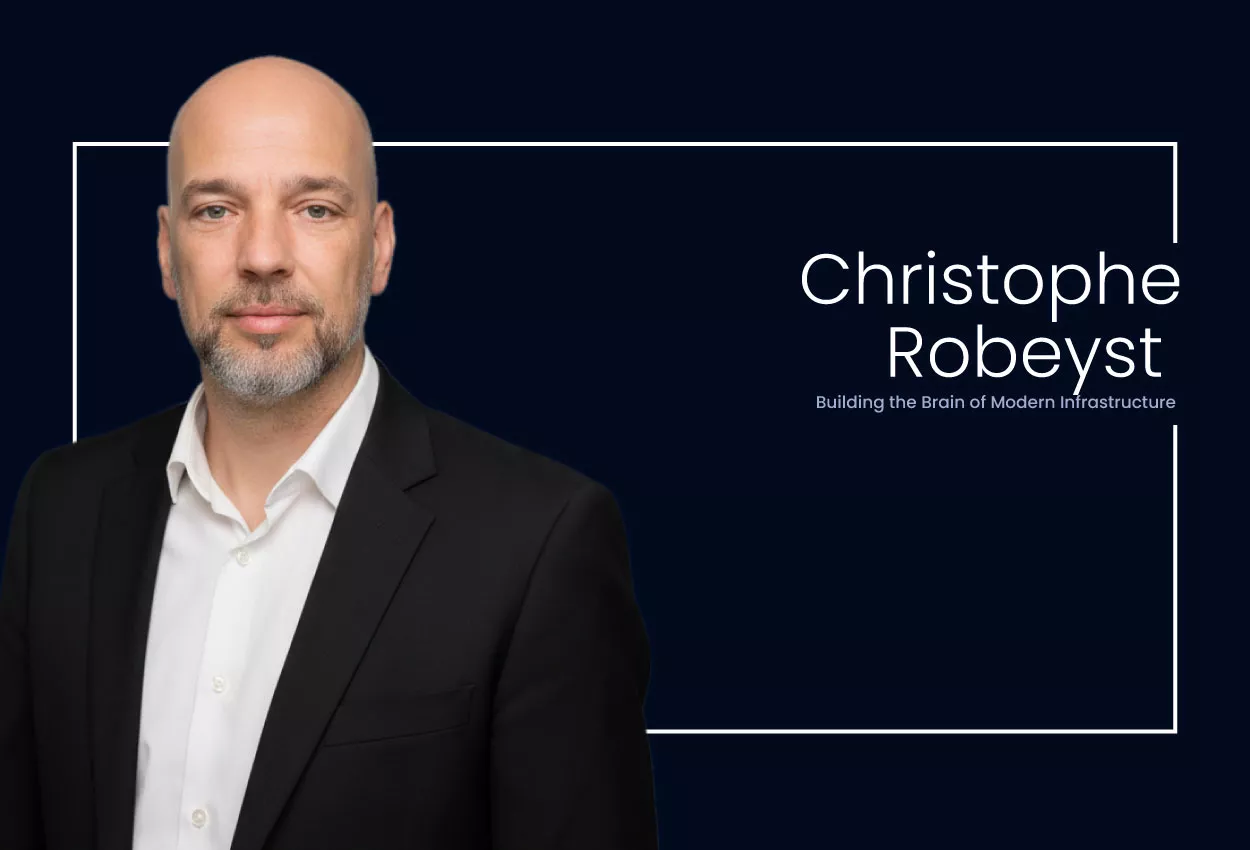
Modern societies run on invisible systems. Water that flows without pause, electricity that arrives at the flick of a switch, data that travels faster than thought, and gas networks that quietly sustain entire economies. Yet behind this apparent simplicity lies a web of infrastructure so vast, regulated, and interconnected that even small failures can ripple into national disruption. These systems are no longer merely engineering problems. They are economic engines, political pressure points, and digital ecosystems, all bound together by data, security, and public trust. Managing them with fragmented leadership, outdated processes, and disconnected technologies has become not just inefficient but dangerous.
This is the space where Christophe Robeyst and the Missing Link Group have built their purpose. Not as software sellers, not as consultants in search of slide decks, but as architects of how modern infrastructure actually functions and deliver what they promise.
Seeing the System Before the Software
Christophe founded Missing Link Group after years of working across industries as varied as automotive, pharmaceuticals, smart city infrastructure, and high-performance electronics manufacturing. When he entered the utility sector, he immediately recognised that it operated by a completely different logic. Unlike commercial industries driven by profit margins, market share, and product innovation, utilities are shaped primarily by regulation, law, and demographic realities.
What stood out to Christophe was a fundamental mismatch between how governments and utilities were investing in digital transformation and how those systems were actually used. Large sums were being spent on technology, yet results were often fragmented. Data was underutilised, systems did not talk to one another, and transformation efforts failed to translate into better outcomes for citizens.
This revealed a critical gap. Digital tools were being adopted, but without a clear strategic framework that aligned technology with operational realities and long term sustainability. Christophe shaped Missing Link Group around closing this gap. He built the company on the idea that transformation must be practical, measurable, and deeply rooted in how public infrastructure truly functions. By combining sector understanding with innovative digital solutions, he set out to help governments, regulators, and utilities move beyond adoption and toward genuine performance, resilience, and sustainable ecosystems.
Growing Across Regions While Holding the Core
From its early days, Christophe guided Missing Link as a small and agile team focused on clarity, communication, and impact. As the company expanded across Europe, North Africa, and the Middle East, that founding mindset did not change. What evolved was its ability to operate at scale while remaining locally grounded.
Christophe made local expertise and cultural understanding a priority. Each regional presence was designed not as an outpost but as a listening post, allowing Missing Link to understand how utilities, regulators, and governments operate within their own social and political environments. At the same time, partnerships with leading technology companies and think tanks ensured that the firm stayed at the forefront of innovation and policy thinking.
Today, the group’s international footprint represents more than geographic growth. It reflects a commitment to proximity, collaboration, and relevance. Christophe has ensured that whether the work is in Europe, North Africa, or the Middle East, the mission remains the same. Missing Link exists to help utilities and public institutions build sustainable, resilient systems and communicate their value with credibility and clarity.
Building a Culture of Partnership
From the beginning, Christophe was clear that Missing Link would never function as a conventional service provider. He designed the company to operate as a strategic partner that shares responsibility for outcomes. That philosophy was embedded into the company’s DNA long before it became a multi-regional organisation.
Rather than approaching clients with a transactional mindset, Christophe built teams that think like advisors and collaborators. The focus was never on simply delivering tasks but on understanding what an organisation is trying to achieve at a deeper level. By asking about goals, constraints, and long term ambitions, Missing Link positions itself inside the client’s strategic thinking rather than on the sidelines.
This approach drives long-term relationships. Processes from onboarding to project delivery are structured around collaboration, trust, and shared accountability. For Christophe, partnership means being willing to challenge assumptions, co-create solutions, and stand behind the results. That is why clients do not see Missing Link as an external supplier but as an extension of their own leadership teams.
Scaling with Purpose in Oman and Across the Region
Since taking on the role of CEO of Missing Link Group Oman, Christophe has led a deliberate shift toward scaling with purpose while deepening the company’s relevance across the Middle East and North Africa. His first priority was localisation. He invested in regional talent and partnerships that understand the cultural, regulatory, and commercial realities of the region, ensuring that Missing Link operates with insight rather than assumption.
At the same time, he moved the organisation away from a purely project-based model and toward a solutions-driven framework. The objective was to focus on long-term impact rather than short-term delivery. Christophe’s vision is to build leadership from within each market. Once the right people are in place, he plans to transition authority to local CEOs who will carry the Missing Link vision and mission forward in their own regions.
Digital transformation also became a core pillar of this strategy. Under his leadership, the company has embedded advanced analytics and AI driven insights into its advisory model, enabling clients to make smarter and more forward looking decisions. By strengthening its strategic advisory capabilities, Missing Link has positioned itself not simply as a communications or delivery partner, but as a growth enabler for the utilities and institutions it serves.
Looking ahead, Christophe has set a clear ambition for 2026. Missing Link aims to deliver a comprehensive analysis of key performance indicators across the GCC utility sector. This will allow utilities to benchmark their performance, participate in panel discussions, and collaborate through working groups to address shared challenges. For Christophe, utilities form the backbone of society, and preparing them for the coming AI-driven transformation is essential to building a more sustainable and prosperous future.
Building the Data Spine of Modern Utilities
Christophe guided Missing Link to focus early on advanced metering infrastructure and meter chain digitalisation because he saw them as the foundation of any modern utility ecosystem. For him, accurate and real-time data is not optional. It is the lifeblood of efficiency, customer transparency, and sustainability. Without reliable data, utilities cannot optimise consumption, reduce losses, defend strategy to boards or regulators nor support the development of smart grids.
He understood from the outset that digitalising the meter chain was far more than a technical upgrade. It was a strategic enabler that would reshape how utilities operate and make decisions. As regulatory pressure has increased and the integration of renewable energy has accelerated, the value of this decision has only become clearer. Advanced metering provides the granular insights needed for predictive maintenance, demand forecasting, self-healing networks and moving the utility from a transactional communicator to a more proactive customer engagement.
By committing to this focus early, Christophe positioned both Missing Link and its clients to lead the transition toward smarter, more resilient utility networks rather than struggling to catch up.
The Architecture of Disciplined Transformation
Christophe has long recognised that digital transformation in utilities often fails where governance, technology, and execution collide. In response, he built Missing Link’s delivery model around a strong project management office-led framework that aligns strategy with disciplined execution.
In this model, governance is not treated as a box to be ticked after implementation begins. It is embedded from the very start. Clear accountability, standardised processes, and transparent reporting ensure that every stakeholder remains aligned throughout the project lifecycle.
Technology is introduced in a structured and incremental way, preserving interoperability and reducing operational disruption.
At the centre of this system sits the PMO, which Christophe views as the nerve centre of transformation. It coordinates teams, manages risk, tracks milestones, and ensures that delivery remains focused and controlled. Just as importantly, stakeholders are kept informed and actively consulted, allowing concerns to be addressed before they become obstacles.
Through this approach, Missing Link turns complexity into clarity, enabling utilities to move beyond fragmented initiatives and achieve sustainable digital transformation that delivers measurable and lasting impact.
A Career That Shaped a Transformation Playbook
Christophe’s career has moved continuously between strategy consulting, industrial leadership, and entrepreneurship, and this loop has become the foundation of how Missing
Link structures and delivers large-scale transformation programs. His years at Capgemini Invent and McKinsey instilled a hypothesis-led, value-anchored way of thinking, where every initiative must be tied to measurable impact.
His experience inside complex industrial environments such as Tenneco Automotive, Brunswick EMEA, Solvay Pharma, and GSK added a different layer. There, he learned operational discipline the hard way, through quality control, safety, supply chain continuity, regulatory precision, and change control. These realities shaped his belief that transformation only works when it respects how organisations actually function.
Entrepreneurship brought yet another dimension. Building Missing Link, Vialis, and Screentech taught Christophe that cash flow, customer value, and speed matter as much as strategy. That is why Missing Link operates with a product mindset, treating each capability as a living product with its own roadmap, owner, and service levels. The company favours lean execution, proving value through the smallest viable deployments before scaling, and orchestrates vendor-neutral ecosystems as a single, coherent team.
All of this is reinforced through capability transfer. Christophe has seen too many transformations fail when knowledge stays with external vendors. Missing Link therefore builds academies, shadow to lead transitions, and build with teams so that clients truly own the change. In his view, consulting provides clarity, industry delivers rigor, and entrepreneurship brings speed and pragmatism. Together they form a playbook built on value driven design, ninety day execution cycles, meter chain integrity, and PMO led orchestration.
Guiding Utilities Through Complex Public Tendering
Christophe is acutely aware that public sector tendering is one of the most sensitive and complex parts of any utility transformation. Multiple stakeholders, strict compliance requirements, and political visibility make mistakes costly. At Missing Link, he applies a structured and collaborative approach to navigate this complexity.
He recognises that no single organisation has a complete view of fast-evolving technologies, and that trying to reinvent solutions often leads to delays and unnecessary risk. By drawing on cross-utility experience and think tank insights, Missing Link helps utilities learn from what has already been tested elsewhere.
Stakeholders are involved from the very beginning. Regulators, government bodies, and utility leaders are brought into the process when objectives and outcomes are being defined,
not after decisions have been made. This creates transparency, alignment, and trust. By embedding these principles into tender design and evaluation, Christophe ensures that compliance is met while long-term operational value and digital readiness are built in from the start.
Turning Multidisciplinary Knowledge into Results
Christophe believes that expertise only matters if it translates into practical outcomes. Missing Link connects intelligent industry, public governance, and utility operations by turning insight into execution.
Every engagement begins with clear business objectives and measurable key performance indicators. Whether the goal is reducing losses, improving compliance, or accelerating digital adoption, each recommendation is tied to a concrete operational result.
Instead of allowing technology, governance, and process improvements to evolve in isolation, Missing Link integrates them into a single transformation roadmap. This avoids fragmentation and speeds up value creation. Ownership is also central. Through co design workshops, governance frameworks, and training programs, clients are embedded in the process so that they can sustain and scale the change long after implementation.
Measuring What Truly Matters
For Christophe, success in utility digitalisation goes far beyond delivering on time and on budget. The first test is value. Are efficiency levels improving, losses declining, and customer experience strengthening. If technology does not translate into business results, it has failed.
The second measure is process integrity and quality. Digitalisation should simplify operations and increase reliability, not create new layers of complexity.
The third is adoption. A project only truly succeeds when people embrace it and are confident enough to run with it independently. Christophe ensures that teams are equipped, trained, and empowered so that digitalisation becomes a lasting capability rather than a one-time intervention.
Building the Capabilities Behind Smart Utilities
As utilities adopt smart water, electricity, and gas metering, Christophe sees a fundamental shift taking place. For decades, performance was inferred through field inspections and
financial comparisons. Now, data science, artificial intelligence, and advanced visualisation tools sit at the heart of decision making.
This creates a significant capability gap. New skills in analytics, cybersecurity, and digital operations are essential, yet they did not exist in traditional utility structures. Christophe also cautions against blind trust in technology. Biased algorithms and poor data can lead to leaders losing control over their own organisations. His principle remains that trusting is good, but controlling is better.
To sustain transformation, he urges leaders to prioritise three capabilities. First, data literacy across the organisation so insights can be understood and challenged. Second, strong governance and control frameworks to ensure transparency and accountability in AI driven decisions. Third, continuous skill development to keep pace with evolving digital and security demands. In his view, smart metering and agentic AI are cultural and organisational shifts as much as technological ones.
Engineering the Intelligence of Tomorrow’s Utilities
Christophe envisions a future in which utilities move from reactive operations to predictive, data driven ecosystems. Artificial intelligence will support real time decision making, water, electricity, and gas networks will be integrated into unified smart systems, and advanced analytics will optimise resources while improving customer experience.
This transformation will extend beyond technology into governance, culture, and capability. Governments will be responsible for setting standards and ensuring interoperability, while utilities will need to balance innovation with resilience and security.
Missing Link’s role in this future is to make transformation practical and sustainable. Under Christophe’s leadership, the company builds governance frameworks for AI, establishes PMOs and value realisation offices, and develops the skills and processes utilities need to own their transformation. Technology is only part of the equation. People remain at the centre, because real progress happens when human and machine intelligence work together.
Christophe’s vision is to help governments and utilities create smarter, more resilient, and more sustainable systems that deliver lasting value to society.
Building on this work, Christophe will further contribute to the global dialogue on digital transformation in critical infrastructure with the publication of his forthcoming book, The
Rise and Risks of AI in the Utility Sector, scheduled for release by the end of the first quarter. The book examines how artificial intelligence is reshaping utilities while critically addressing the governance, security, and ethical challenges that accompany its adoption, reinforcing Christophe’s focus on responsible, value-driven transformation.