Scientific discovery rarely follows a straight path from an idea to an outcome. Research generates knowledge, but turning that knowledge into practical solutions requires systems that connect people, data, technology and decisions. For deep-tech companies, the challenge is particularly demanding. They must preserve the curiosity that drives scientific exploration while building the operational foundations needed to deliver reliable results, sustain commercial growth and serve customers across different markets.
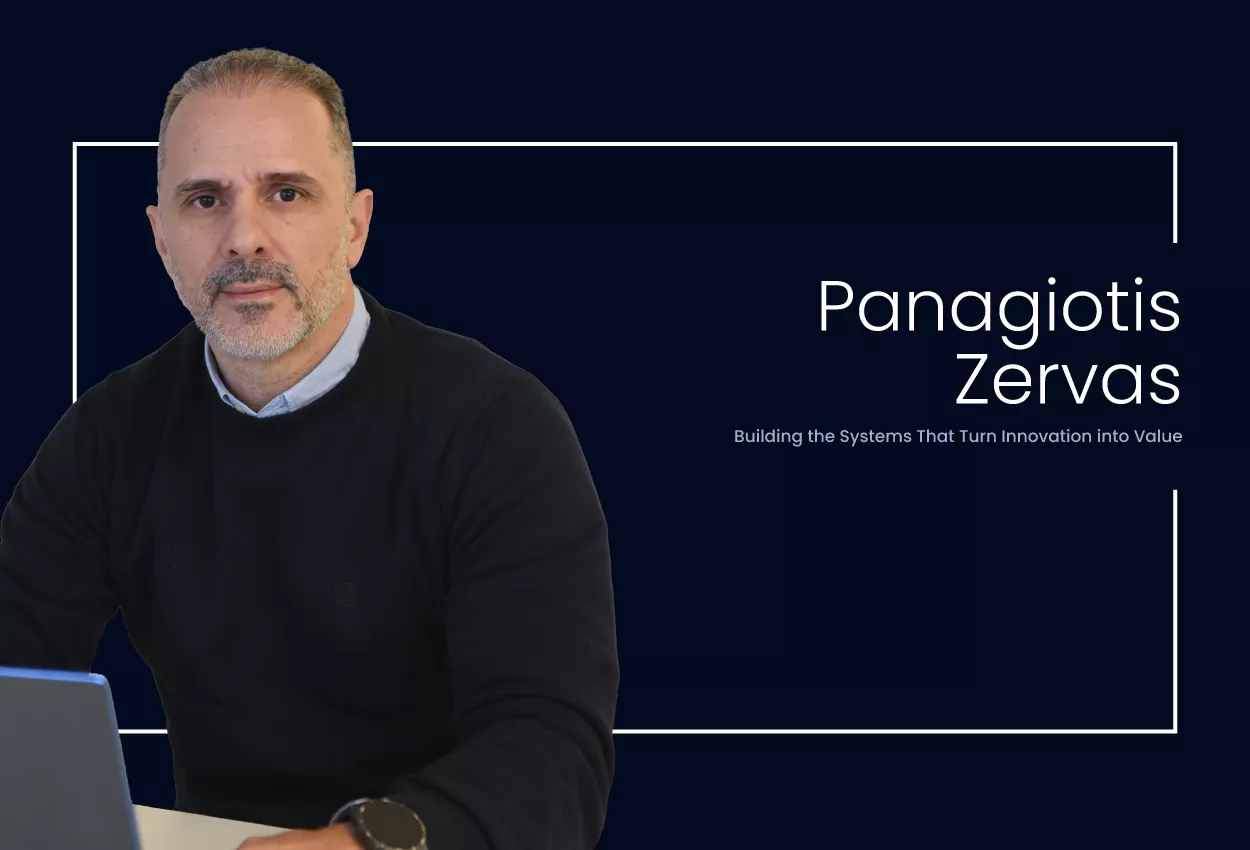
Panagiotis Zervas, Chief Operating Officer of SCiO, has built his professional journey around this challenge. With a background spanning research, engineering, digital systems and large-scale project management, he has helped guide SCiO from a four-person startup into an internationally recognised deep-tech company. His approach combines scientific thinking with operational discipline, focusing on how organisations can turn complex technical capabilities into practical, repeatable and commercially sustainable solutions.
From Four Minds to an International Enterprise
When SCiO was founded in 2019, it began with four people, a research-oriented background and a shared conviction that advanced technologies should help scientists solve meaningful problems. The technical expertise was already present, but building a company capable of delivering on that ambition required a different set of decisions.
Panagiotis identifies three choices as particularly influential in the company’s development. SCiO pursued organic growth, maintaining a close connection between commercial commitments and financial discipline. It adopted a remote-first working model, enabling the company to collaborate with specialists and partners internationally. It also began replacing informal coordination with repeatable operating systems as the organisation grew.
The importance of that final decision became apparent during the company’s second and third years. As projects, deadlines and stakeholders multiplied, the informal communication methods that worked for a small founding team became increasingly difficult to sustain. Clearer responsibilities, visible priorities and structured processes became essential to maintaining both flexibility and accountability.
SCiO’s location at Lefkippos Technology Park, within NCSR Demokritos, has also supported its development by keeping the company connected to a research ecosystem where relationships can evolve into collaborations, projects and new ventures.
Growth Without Surrendering Independence
For Panagiotis, building a customer-funded company requires a distinct approach to financial management. Without external funding, every commitment influences available capacity, cash flow and the organisation’s ability to deliver. Not every technically interesting opportunity can become a commercial priority.
SCiO has therefore favoured long-term relationships, a relatively lean cost structure and selective investment in capabilities that can be reused across multiple projects. This approach has sometimes meant accepting a slower pace of expansion in exchange for greater financial control and strategic flexibility.
The results have been significant. SCiO has grown its revenue more than fourfold without external funding, demonstrating how disciplined investment and sustained customer relationships can support expansion in a technically demanding industry.
Panagiotis views his responsibility as connecting scientific ambition with financial reality. Rather than treating commercial considerations as restrictions on innovation, he sees them as essential to ensuring that innovation can continue. The objective is not simply to develop sophisticated technology, but to create an organisation capable of sustaining its development and delivering value over time.
When Data Becomes a Decision
Artificial intelligence can process enormous volumes of information, but generating data is not the same as producing useful knowledge. For Panagiotis, the starting point of an effective analytical solution is not the algorithm itself, but the scientific question or business decision it is intended to support.
SCiO brings together domain scientists, data specialists and software engineers to make information discoverable, interoperable and useful within real workflows. Its work can involve connecting fragmented datasets, developing dependable analytical infrastructure or creating interfaces that allow users to interpret findings in the appropriate context.
Panagiotis describes the value of AI through the concept of decision velocity. Saving time is important, but the greater opportunity lies in helping people reach sound decisions sooner, supported by stronger evidence and fewer obstacles.
This perspective places practical outcomes ahead of technological novelty. An advanced analytical model has limited value if its results cannot be understood, trusted or applied. By beginning with the decision that needs to be made, SCiO aims to ensure that technical complexity serves a clear purpose.
Making Complex Technology Feel Natural
Powerful technology does not automatically become accessible technology. Researchers should not need specialist cloud-infrastructure knowledge simply to run an analysis, while domain experts should not have to understand every technical detail of a predictive model to benefit from its results.
Panagiotis has drawn important lessons from SCiO’s experience with collaborative computing environments, including CGLabs within the CGIAR ecosystem. These initiatives have reinforced the importance of dependable access, understandable workflows and computing resources suited to the actual constraints faced by research teams.
The company is applying these lessons to the next generation of dataLABS, with the ambition of making scientific computing more accessible. Xdeep pursues a related objective by automating neural-architecture optimisation, allowing teams to develop high-performing predictive models without manually adjusting every design decision.
For Panagiotis, accessibility extends beyond interface design. It requires listening carefully to users, supporting them after deployment and reducing complexity throughout the service. Technology becomes genuinely useful when people can incorporate it into their work without having to overcome unnecessary technical barriers.
The Operating Model Is a Product
As SCiO expanded, the company had to rethink how work was coordinated. In its early years, much of the organisation’s knowledge existed within the founding team’s collective memory. As the volume and complexity of projects increased, responsibilities and priorities needed to become more explicit.
Panagiotis helped introduce structured planning, clearer ownership, regular project reviews and greater visibility into dependencies. The intention was to reduce friction without creating unnecessary bureaucracy, allowing employees to concentrate on meaningful work.
Deep-tech projects present a particular challenge because scientific requirements can evolve during development. Operational systems must therefore protect budgets, milestones and commitments while leaving sufficient room for experimentation.
SCiO gradually consolidated its practices into an operational playbook covering contracting, compliance, quality assurance and risk management. This enabled the company to run considerably more projects in parallel while maintaining visibility and control.
Panagiotis summarises the underlying philosophy in a simple principle: the operating model is itself a product. Like any product, it requires continuous improvement as the organisation changes.
Three Research Contexts, Three Definitions of Success
International collaboration has taught Panagiotis that technical solutions cannot be separated from the environments in which they operate. Research institutions differ in their infrastructure, priorities, institutional processes and expectations. Understanding these differences is essential to building solutions that remain useful beyond their initial deployment.
SCiO’s work with three CGIAR research centres illustrates this approach. With IFPRI in Washington, D.C., the company has built and evolved GARDIAN since 2019. The global discovery platform now brings together more than 1 million agricultural research publications and datasets, and more recently CiGI has enabled researchers to explore this knowledge through natural-language questions.
With IITA, headquartered in Nigeria, the focus has been on cloud-based data infrastructure and collaborative analytical environments for large agronomy research programmes, where field-data collection and practical access to computing influence what can be achieved. With CIMMYT in Mexico, the work has centred on making publications and datasets easier to discover, connect and reuse.
Each collaboration required a different understanding of success. Across them, Panagiotis has recognised the importance of translating between scientific and technical disciplines. Researchers may understand a problem deeply without knowing how to specify the final software solution, while developers need actionable requirements to build dependable systems.
SCiO addresses this gap by assigning a Product Manager to each project. The role extends beyond documenting specifications to understanding the researcher’s broader vision, refining requirements through discussion and translating evolving ideas into priorities for developers. As prototypes emerge, these conversations can also help researchers sharpen their original questions.
Over time, careful listening, dependable delivery and shared problem-solving can transform individual assignments into lasting partnerships.
Innovation That Survives Beyond the Project
For Panagiotis, a research project cannot be judged solely by whether it meets its original deliverables. Its lasting significance depends on what happens after the funding period ends, including who uses the outcome, who maintains it and whether it continues to provide value.
Two SCiO projects illustrate this philosophy. LUP4LDN won the 2021 GEO-LDN International Technology Innovation Competition for its decision-support approach to land-use planning for Land Degradation Neutrality, a challenge relevant to more than 120 countries worldwide. GARDIAN, recognised with an Elastic Excellence Cause Award, has remained in active use and has continued to evolve.
Both experiences reinforce the importance of designing for real users, reusable data and operational continuity. Open and interoperable infrastructure matters, but so do documentation, ownership and realistic maintenance arrangements.
Panagiotis distinguishes successful research from the successful translation of research into practice. The latter demands scientific quality alongside a clear understanding of how organisations adopt technology, maintain it and incorporate it into their everyday activities.
A Scientific Mindset for Operational Leadership
Panagiotis’s PhD in Digital Systems shaped the way he approaches complex challenges. Questioning assumptions, breaking problems into manageable parts, testing ideas and learning from evidence remain central to his decision-making.
Experience has also taught him that a technically correct plan is rarely sufficient on its own. Projects bring together people with different incentives, vocabularies and expectations. Effective leadership requires building enough shared understanding for them to work towards the same objectives.
Rather than positioning himself as the person who must provide every answer, Panagiotis focuses on creating the conditions for better decisions. This includes clarifying responsibilities, encouraging constructive disagreement and recognising when a problem requires further exploration rather than premature certainty.
His scientific background sustains his curiosity, while operational leadership turns that curiosity into coordinated action.
Trust and Accountability in a Remote-First Culture
SCiO’s remote-first working model offers flexibility and access to international talent, but it also requires deliberate attention to communication and employee wellbeing. Without the informal interactions of a shared office, difficulties can remain unnoticed until they begin affecting someone’s work.
To address this, the company uses systematic one-to-one meetings and weekly check-ins. These conversations provide opportunities to clarify expectations, assess progress and identify the support employees may need before challenges become more serious.
Panagiotis does not view these interactions as surveillance or routine reporting. They are part of a relationship built on trust. Autonomy works best when employees understand their responsibilities, feel comfortable raising concerns and know that support is available.
Continuous learning is equally important. As AI increases what individuals can produce, mentorship, constructive feedback and the development of sound judgement become even more valuable. For Panagiotis, a people-centred culture is not separate from operational excellence; it is one of the foundations that makes it possible.
Beyond Efficiency to Organisational Intelligence
Panagiotis’s recognition as Chief Operations Officer of the Year in 2025 acknowledged his contribution to operational excellence. Yet he defines effective operational leadership in terms broader than efficiency, revenue or measurable performance.
His ambition is to build an organisation whose collective capabilities exceed the sum of individual efforts. That requires trust, clarity and systems that help people collaborate without constant managerial intervention.
He approaches the integration of AI into operations with the same discipline. The AI era, in his view, makes the ambition of a self-coordinating organisation both more urgent and more achievable, but he is not interested in adding tools simply because they are available. Instead, he documents how each process works, identifies its bottlenecks and asks where AI could improve execution or support better decisions. Only then can a baseline be established to measure whether the change genuinely reduces time or improves the workflow.
The most promising outcome, however, is not individual productivity. Organisations accumulate knowledge through projects, discussions and decisions, yet much of it remains scattered across systems or held by particular people. AI creates the possibility of turning that knowledge into a shared organisational capability: accessible, reusable and continuously improved across teams.
This changes what management should focus on. The next generation of leaders will increasingly orchestrate work across people, systems and AI, rather than simply manage headcount, while human judgement, responsibility and empathy remain central to decision-making.
For Panagiotis, the COO of the Year recognition was therefore an acknowledgement of a collective effort to build these foundations at SCiO.
Where AI and Data Can Make the Biggest Difference
Looking ahead, Panagiotis expects AI to have its strongest impact over the next five years where it helps translate complex scientific data into decisions that once demanded too much time, expertise or infrastructure. Across the sectors in which SCiO works, that potential takes different forms.
In agriculture, connecting field observations, geospatial information and predictive models can support more informed resource management. In environmental applications, better integration of data can improve how organisations assess land-use choices and climate-related risks. In food systems, combining new sensing technologies with analytics could make quality assessment faster and more accessible.
These opportunities carry responsibilities. Models must be tested against real conditions, datasets must be trustworthy, and users need to understand the limits of automated recommendations. For Panagiotis, the goal is not for AI to replace scientists but to give them better tools, while making expert judgement, validation and accountability even more important.
Turning Scientific Potential into Sustainable Value
SCiO’s next chapter centres on translating years of scientific and international project experience into sustainable products. One priority is to deepen its work helping research institutions make accumulated knowledge easier to search, connect and use. Generative AI creates new possibilities in this area, as SCiO’s work on CiGI shows, but the value of such systems depends on trustworthy, domain-specific data and careful curation.
Another priority is dataLABS, which the company is developing from its experience in research computing into a more repeatable product and service offering. The ambition is to make capable infrastructure easier for scientific teams to access and manage, moving beyond the delivery of individual environments.
A further development is LUXBIT, an emerging spin-off that SCiO is helping to establish within the NCSR Demokritos ecosystem. Its photonic sensing technology reflects years of research and has potential applications in food quality and safety. The challenge is to turn a promising technology into reliable, manufacturable hardware, integrating software, establishing support capabilities and finding the right commercial positioning.
Panagiotis plans to take responsibility for LUXBIT’s commercial operations once the complete product has reached the necessary level of technological maturity. The prospect brings together the two defining strands of his career: respect for scientific discovery and the discipline required to turn it into sustainable business value.
For him, the future of deep-tech leadership lies in making these two forces work together. Scientific discovery creates possibilities, but organisations need sound systems, committed people and a clear understanding of commercial realities to realise them. At SCiO, that philosophy continues to shape an approach to innovation in which technology serves a purpose, operational excellence enables ambition, and knowledge becomes most valuable when it can be put to meaningful use.