
Strategy often begins as a powerful idea. It appears in presentations filled with bold ambitions, market opportunities, and carefully designed roadmaps for growth. Yet the true test of strategy begins long after the presentation ends. It unfolds in daily decisions, operational discipline, and the ability of teams to translate vision into measurable results. Many organizations discover that while creating strategy is intellectually stimulating, executing it consistently requires a very different kind of leadership. The distance between knowing what should be done and actually doing it remains one of the most persistent challenges in modern business. Bridging that distance demands more than insight; it requires systems, clarity, and the practical wisdom to turn direction into action.
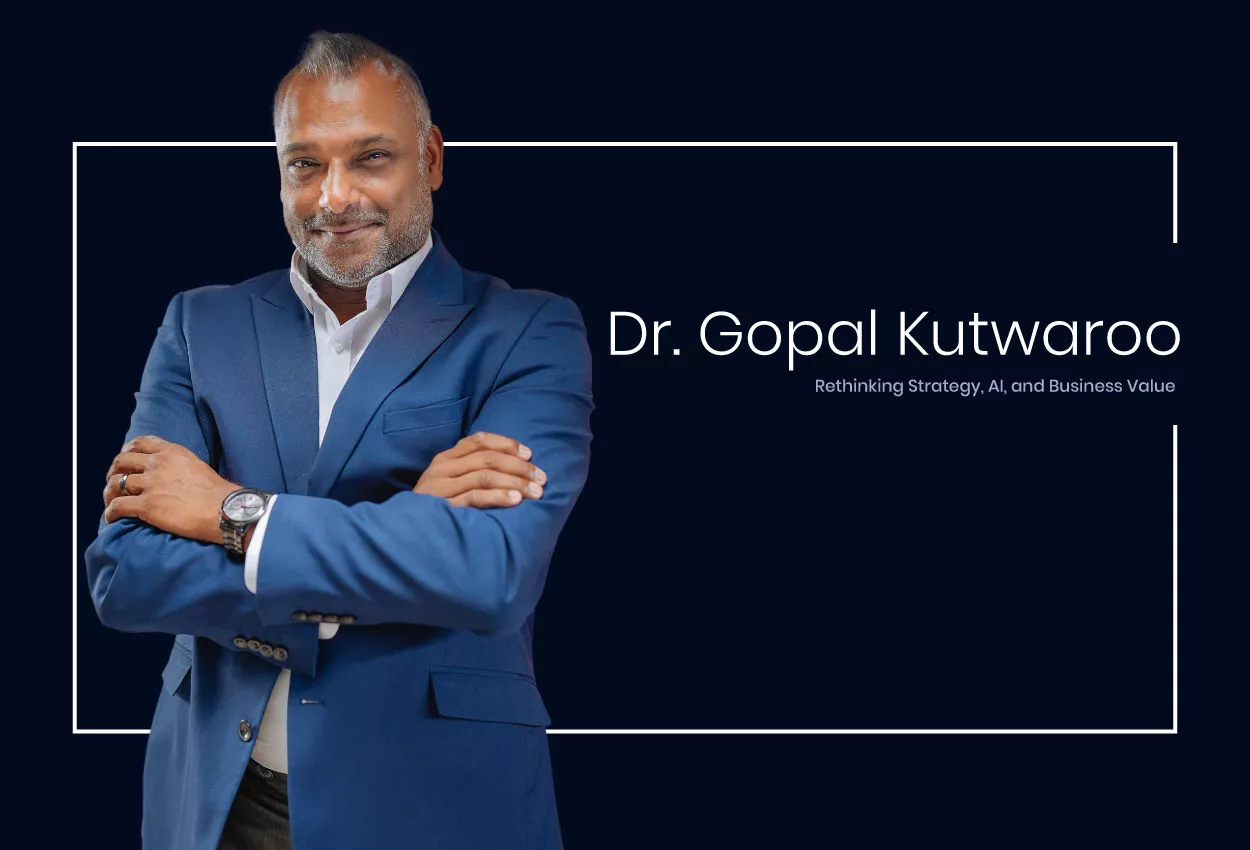
Dr Gopal Kutwaroo built thevaluespace precisely to address this challenge. Drawing on extensive leadership experience across global technology organizations, Dr Gopal recognized that companies needed more than strategic frameworks, they needed guidance on how to implement them effectively. Dr. Gopal works with multinational organisations and governments to shape and implement AI strategies, with a strong focus on Generative AI and Agentic AI. He emphasizes that Agentic AI holds particularly exciting transformative potential. According to him, it enables organisations to fundamentally rethink how work gets done by deploying intelligent agents capable of analysing information, making decisions, and taking action. This shift allows organisations to redesign operational models while unlocking significant improvements in productivity, efficiency, and overall organisational value.
Closing the Strategy Execution Gap
Dr Gopal founded thevaluespace with a clear purpose: to bridge the gap between high-level strategy and real-world execution. After years of leading sales, marketing, partnerships, and product development within global technology organizations such as Microsoft, Dell, Siemens, Nokia, LEGO, SAGE, and BT, Dr Gopal recognized a persistent challenge within corporate learning environments. Many training programmes were built around theoretical frameworks that sounded compelling but rarely translated into measurable outcomes.
For Dr Gopal, this disconnect between knowledge and application represented a missed opportunity. Organizations needed more than abstract ideas; they needed practical tools that could be applied immediately to solve complex business problems. With this understanding, Dr Gopal established thevaluespace as a pragmatic environment where expertise is applied in ways that produce immediate action and tangible results.
Since its founding, thevaluespace has partnered with more than 600 organizations across the world and has trained over 4,000 delegates. Dr Gopal has worked closely with multinational corporations and government bodies, helping them transform essential growth engines into operational outcomes. Areas such as artificial intelligence, digital transformation, strategy, leadership, partnerships and alliances, sales, and marketing are translated into clear frameworks that teams can implement directly.
Through this model, Dr Gopal focuses on delivering the “how to” behind modern business challenges. Instead of abstract theory, organizations gain structured guidance that helps them navigate complexity and accelerate meaningful progress.
The New Dimensions of Business Value
According to Dr Gopal, the concept of value has evolved significantly over the past decade. In earlier years, value was often defined through straightforward metrics such as increasing revenue, reducing costs, and maintaining customer satisfaction. While these factors remain important, they are no longer sufficient in a technology-driven economy.
Dr Gopal views value as multidimensional, shaped by three critical vectors. The first is strategic value, which includes market positioning, adaptability, and the strength of partnerships that support long-term competitiveness. The second is operational value, focusing on productivity, efficiency, and customer experience. The third dimension is financial value, which involves profitability, cash flow stability, and sustainable growth.
For Dr Gopal, true value emerges when these three areas reinforce each other. When strategic positioning strengthens operational effectiveness and financial performance, organizations experience compounded growth rather than short-term gains.
In evaluating artificial intelligence initiatives, Dr Gopal applies a simple but effective test. Any initiative must clearly demonstrate how it contributes to strategic, operational, or financial value. If that connection cannot be clearly explained, the initiative remains an experiment rather than a meaningful investment.
Beyond Pilots and Proofs of Concept
Dr Gopal observes a clear distinction between organizations that successfully operationalize artificial intelligence and those that remain trapped in cycles of experimentation. Companies that succeed approach AI with the mindset of operators rather than enthusiasts.
According to Dr Gopal, successful organizations begin with a specific commercial problem. They define success using measurable outcomes and integrate AI into existing workflows, governance systems, and operational processes. When AI becomes embedded within everyday decision-making, it quietly transforms how work gets done.
In contrast, many organizations remain fascinated by pilots and proof of concept demonstrations. They accumulate experimental projects and vendor presentations but fail to redesign incentives, decision frameworks, or internal processes.
Dr Gopal believes the most reliable indicator of AI maturity is whether it appears within the company’s operational rhythm. If artificial intelligence is not linked to financial forecasts, performance metrics, and weekly decision-making cycles, it cannot truly be considered an AI strategy. Instead, it remains a collection of disconnected experiments.
Designing a Growth Engine That Scales
Dr Gopal views sustained growth as a result of disciplined performance leadership. Organizations must make clear strategic choices about where they intend to compete and where they will focus their resources.
A critical step in this process is defining the ideal customer with precision. Dr Gopal emphasizes that clarity about target customers allows companies to concentrate their efforts on markets where they can deliver the greatest value. This often requires the courage to decline opportunities that fall outside strategic priorities.
Dr Gopal encourages organizations to develop a unified growth thesis that aligns product development, marketing, sales, and partnerships around a shared direction. When every part of the organization works toward the same objectives, growth becomes more systematic and less dependent on individual personalities.
To sustain that growth, successful practices must be industrialized. Dr Gopal advocates the use of structured playbooks, automation, and AI-driven insights that allow organizations to scale what works. The ultimate goal is to transition from personality-driven success to a scalable system that consistently produces results without exhausting the organization’s most capable people.
Rethinking Account-Based Marketing and Performance Marketing
Dr Gopal also highlights common misconceptions surrounding account-based marketing and performance marketing. From his perspective, account-based marketing is often misunderstood as an advanced version of traditional demand generation.
Instead, Dr Gopal describes account-based marketing as a fundamental economic design choice. Rather than targeting large volumes of leads, organizations structure their entire go-to-market strategy around specific accounts and buying groups. Success is measured not by clicks or lead counts but by revenue velocity and share of customer investment.
Performance marketing is frequently misunderstood as well. Dr Gopal argues that the true objective is not simply scale or low cost per lead. Effective performance marketing focuses on return on capital. Metrics such as pipeline quality, conversion rates, payback periods, and customer lifetime value become the real indicators of success.
Dr Gopal also points out that account-based marketing is no longer limited to large enterprises. Advances in technology have significantly reduced the barriers to entry, allowing smaller organizations to deploy targeted strategies that often prove more efficient than broad lead generation approaches.
The Power of Shared Value Creation
For Dr Gopal, partnerships and channel ecosystems become powerful growth engines when they move beyond transactional relationships. Many companies treat channels merely as distribution mechanisms for products, but Dr Gopal believes the true potential lies in shared value creation.
A channel ecosystem becomes strategic when partners operate as extensions of a company’s value architecture. The key turning point occurs when organizations and partners begin working with shared intelligence.
By collaborating around the same data related to demand signals, deal progression, and customer health, partners move beyond simple reselling activities. Instead, they engage in joint portfolio management, where both sides contribute to shaping long term customer value.
Accelerating Time to Market
Speed to market is often seen as a trade off against quality. Dr Gopal challenges this assumption by emphasizing the importance of standardizing predictable processes while reserving creativity for truly innovative aspects.
Many product launch delays occur because organizations repeatedly reinvent basic go to market processes. Dr Gopal encourages companies to establish reusable frameworks that define consistent approaches to launching products and services.
When routine elements are standardized, teams can focus their creative energy on areas that genuinely matter. Proposition design, pricing strategies, and customer validation become the spaces where innovation should occur. This approach allows organizations to move faster without compromising the quality or effectiveness of their offerings.
Digital Transformation Across Public and Private Sectors
Dr Gopal has also observed distinct differences between digital transformation efforts in private and public sector organizations. Within the private sector, market competition creates an immediate feedback loop. Companies that misjudge the market quickly lose customers and market share. Investors and stakeholders expect rapid responses to changing conditions, creating strong incentives for continuous improvement.
The public sector operates under a different set of pressures. Visible failure in public programmes can carry significant political, social, and reputational consequences. As a result, organizations may become cautious about experimentation.
To address this challenge, Dr Gopal promotes the creation of carefully defined “safe zones” within public sector initiatives. These programmes allow teams to operate with the speed and agility typically seen in private organizations while maintaining clear accountability and governance structures.
Treating AI as a Strategic Portfolio
Investing in artificial intelligence often raises concerns about balancing long-term innovation with short-term financial pressures. Dr Gopal approaches this challenge through a portfolio perspective.
Rather than viewing AI as a single investment, Dr Gopal encourages organizations to build a diversified portfolio of initiatives. Some projects focus on improving the core business by increasing productivity, reducing costs, and improving decision making. Others aim to expand the organization through enhanced customer engagement or new digital services. A smaller set explores entirely new opportunities that may shape future growth.
When financial pressure increases, Dr Gopal believes the solution is not to eliminate innovation but to apply stronger evidence-based governance. Projects that fail to demonstrate measurable results are paused, allowing resources to concentrate on initiatives that clearly improve revenue quality or reduce risk.
Creating Resilient Hybrid Teams
In the modern hybrid workplace, Dr Gopal emphasizes that high-performing teams do not emerge by accident. They are built through absolute clarity about purpose, responsibilities, and expectations.
According to Dr Gopal, successful teams understand why they exist, how success is defined, and who is responsible for each critical decision. This clarity allows individuals to remain focused on the metrics that truly influence performance.
Resilience becomes especially important during periods of uncertainty. Dr Gopal believes teams remain stable because they have already established clear roles and decision pathways before challenges arise.
In hybrid environments, expectations must be explicit. Dr Gopal advocates simple decision architectures that prevent decisions from being endlessly delayed through digital communication channels. When transparency leads to predictability and predictability builds trust, hybrid teams can transform distributed work into a genuine competitive advantage.
Inclusive Leadership as a Growth Strategy
Dr Gopal views inclusive leadership not as a social initiative but as a fundamental business strategy. Diverse perspectives encourage better problem solving, generate innovative ideas, and reduce blind spots that might otherwise limit an organization’s understanding of its customers.
Inclusive leadership also eliminates hidden costs within organizations. When individuals feel excluded or undervalued, engagement declines and turnover increases. These issues quietly erode productivity and financial performance.
For Dr Gopal, inclusive leadership strengthens revenue growth, organizational resilience, and corporate reputation. When people feel empowered to challenge ideas and contribute openly, organizations gain access to a broader range of insights that drive better decisions.
AI as the Invisible Operating Layer
Looking ahead, Dr Gopal believes artificial intelligence will become an invisible operating layer within modern go to market strategies. Rather than existing as a separate function, AI will influence every stage of business operations.
It will guide decisions about where organizations compete, how they position their offerings, how they price products, and how they engage with customers. Personalization will become an expected standard as organizations learn to anticipate customer needs in real time.
Partnerships will play an equally important role. According to Dr Gopal, future growth will increasingly come from collaborative ecosystems where organizations co create solutions, share data, and deliver integrated customer experiences.
For leaders preparing for this transformation, Dr Gopal highlights three priorities. First, data architecture must be treated as strategic infrastructure rather than a technical afterthought. Second, AI literacy must extend beyond specialist teams to include leadership and frontline employees. Third, organizations must decide deliberately where artificial intelligence will create differentiation and where commodity solutions or external partnerships provide greater value.
By approaching these decisions with clarity and discipline, Dr Gopal believes organizations can harness AI not simply as a technology but as a catalyst for long term competitive advantage.




