
From the earliest moments of human history, animals have shared our fields, our homes, and our imaginations. They remind us that the natural world is not something separate but part of the same living rhythm that sustains us all. To show compassion to animals is to honor this bond of coexistence, a relationship built on trust, respect, and the quiet understanding that their wellbeing is bound to our own. The beauty of this connection lies in its simplicity; when animals thrive, so too does the balance of nature, and when they suffer, it reflects back upon us.
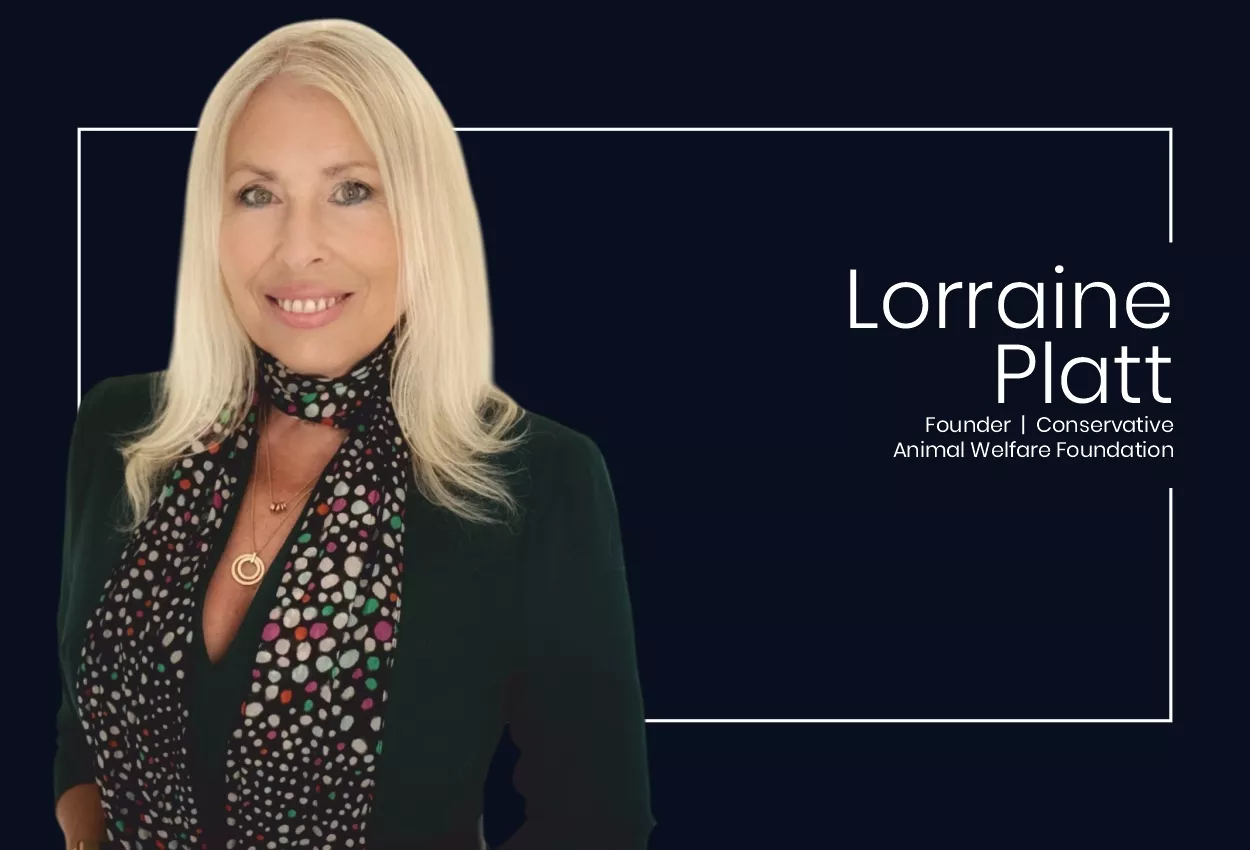
It is this deep awareness that has shaped the life and work of Lorraine Platt. Guided by a conviction that compassion for animals must extend beyond sentiment into action, she has devoted herself to ensuring their voices are heard at the highest levels of politics. As the Founder of the Conservative Animal Welfare Foundation, she has worked to place empathy at the heart of policy, showing that protecting animals is not only a moral responsibility but also an essential part of caring for the environment, farming communities, and public health.
How Empathy Shaped a Movement
Lorraine was inspired to establish the Conservative Animal Welfare Foundation (CAWF) in 2016 by a lifelong conviction that animals deserve compassion and respect. Growing up surrounded by animals, she developed a deep awareness of the bond between humans and the natural world. Her early campaigning on fox hunting through Conservatives Against Fox Hunting, also known as Blue Fox, revealed both the extraordinary potential of politics to protect animals and the risks when their welfare was treated as a peripheral issue.
A pivotal moment came in 2010, when the Hunting Act was under threat of repeal. Lorraine realized that without a constructive Conservative movement advocating to shield the ban on fox hunting, hard-won protections could be lost. She co-founded Blue Fox, which successfully brought Conservative MPs together to defend the Act. This experience demonstrated that real change could be achieved when animal welfare was approached in a principled, evidence-based, and non-partisan manner. By 2016, she recognized that farm animal welfare, on industrial farms affecting billions of sentient beings, was one of the great moral and political issues of the time yet remained largely absent from government debate. The founding of CAWF aimed to fill that gap and ensure that animal welfare became a mainstream political concern.
Giving Farm Animals a Political Voice
At the launch of the Foundation in 2016, Lorraine identified a pressing gap in political and public discourse: farm animal welfare on factory farms was largely absent from mainstream politics. Despite Britain’s historic reforms in animal protection, farmed animals were too often overlooked in policy discussions dominated by economic or productivity concerns. This created a striking disconnect between public sentiment, which consistently favored higher welfare standards, and political action.
CAWF was created to bridge that divide. Lorraine sought to demonstrate that farm animal welfare is a core Conservative value grounded in stewardship, compassion, and responsibility. The Foundation worked to unite voices from across the spectrum, including MPs, Peers, NGOs, scientists, and farmers, to create a credible platform for reform. Early reports and events provided parliamentarians with the evidence needed to push forward important policies, including mandatory CCTV in slaughterhouses, formal recognition of animal sentience in UK law, and the ban on live exports for slaughter and fattening.
Rethinking Farming and Food Security
Intensive farming remains a global challenge, and Lorraine emphasizes that policymakers must balance food security with animal welfare standards. She argues that these priorities are inseparable. Intensive farming creates vulnerabilities, including dependence on imported feed, environmental degradation, public health risks from overuse of antibiotics, and fragile supply chains exposed during global crises. These issues ultimately undermine food security itself.
Higher welfare farming, by contrast, contributes to more resilient systems. Healthier animals placed in higher welfare conditions reduce strain on veterinary resources, produce safer food, and support farming models that are locally embedded and environmentally sustainable. Lorraine believes policymakers should treat welfare standards as integral to food security rather than optional.
She identifies three key measures for achieving this balance. First, fair trade policies should ensure that imports meet national welfare standards to prevent British farmers from being undercut. Second, transparent mandatory labelling allows consumers to make informed choices about the food they purchase. Third, farmers should be supported in transitioning to agroecological and higher welfare systems through targeted incentives and research. Lorraine asserts that when food security is defined in its broadest sense; as safe, sustainable, and resilient; strong welfare standards are essential.
Ethics Beyond Borders
Lorraine believes that over the last four decades, the Conservative Party has repeatedly demonstrated leadership in advancing animal welfare. From Margaret Thatcher’s Farm Animal Welfare Committee to John Major’s ban on veal crates, David Cameron’s ban on battery cages, Theresa May’s Ivory Act, Boris Johnson’s Sentience Act, and Rishi Sunak’s ban on live exports for slaughter and fattening, she sees compassion for animals as deeply rooted in Conservative values. For Lorraine, these measures reflect a philosophy of stewardship and moral responsibility.
She also emphasizes the UK’s international influence. By setting ambitious standards at home, Britain can help raise the bar globally. Recent legal recognition of decapods and cephalopods as sentient beings, she notes, signals that the country continues to lead in embedding science and ethics into law. Lorraine asserts that a political party’s role extends beyond legislation; it can inspire, showing that economic success and ethical responsibility can coexist.
Guiding Policymakers Toward Change
Lorraine approaches MPs and policymakers who may not initially prioritize animal welfare by starting from their perspective rather than imposing an agenda. Some MPs represent farming constituencies reliant on current practices, while others focus on economic concerns. Her strategy is evidence-based, pragmatic, and respectful.
She demonstrates how welfare reform aligns with broader priorities. Higher animal welfare supports public health by reducing antibiotic resistance, protects the environment by lowering pollution from intensive farming, and ensures fairer competition for farmers. Lorraine also emphasizes the importance of connecting MPs with constituent concerns, reminding policymakers that voters care deeply about this issue. Above all, she works to make animal welfare a cross-party and constructive issue, ensuring it remains an area where Parliament can unite rather than divide.
Milestones of Compassion and Impact
Looking back, Lorraine is proud of CAWF’s recognition as a strong and influential voice for animal welfare within the Conservative Party. She highlights the small but highly effective team made up of leading voices in animal welfare, research, and public affairs.
She also acknowledges the role of CAWF’s patrons, including MPs and Peers, who have helped drive campaigns and advance animal welfare legislation in the UK. Among their achievements are increased sentencing for animal cruelty, the banning of glue traps, and the Pet Abduction Act, which recognizes companion animals as members of the family rather than as stolen property. Several patrons are former Government Environment Ministers, and many have hosted parliamentary receptions to further animal welfare initiatives.
Lorraine identifies CAWF’s role in helping to secure the ban on live animal exports in 2024 as a defining achievement. While campaigners had pursued this goal for decades, successive governments had failed to act. CAWF prioritized the issue, ensuring its inclusion in the 2019 Conservative Manifesto, producing evidence, mobilizing MPs, and hosting parliamentary events and receptions at Conservative conferences since. 2017. The ban’s enactment was not only a major victory for animal welfare but also a validation of CAWF’s mission to place farm animal welfare at the center of Conservative politics.
She is also proud of the successful campaign for mandatory CCTV in all slaughterhouses, which became law in 2018, and the inclusion of decapod crustaceans and cephalopods as sentient beings in the Animal Sentience Act of 2021. The campaign received international media coverage, demonstrating the Foundation’s ability to influence both domestic and global awareness of animal welfare issues.
Uniting Conservatives for Wildlife Protection
Lorraine founded Conservatives Against Fox Hunting, also known as Blue Fox, in 2010 to bring together anti-hunting Conservative MPs and defend the Hunting Act when it faced the threat of repeal. The campaign developed into a powerful grassroots network, proving that support for wildlife protection transcends party lines and ideology.
Blue Fox successfully helped prevent the repeal of the Hunting Act, which was ultimately abandoned in 2018. In recognition of her work, Lorraine received multiple accolades, including the RSPCA’s Lord Erskine Silver Award, the IFAW Campaigner Award, the CEVA Animal Welfare Finalist Award, and was a finalist in the Inspiration Awards for Women. Today, the campaign continues to serve as a voice within the Conservative movement for protecting wildlife and resisting attempts to weaken existing legislation. Lorraine believes that the campaign also brought about a cultural shift, showing that Conservative politicians could and should champion animal protection, laying the groundwork for the later success of the Conservative Animal Welfare Foundation.
Lorraine has also held key roles in other wildlife organisations. She served as vice-chairman of the League Against Cruel Sports and acted as a voluntary trustee for eight years before joining Save the Asian Elephant’s executive board in 2018.
Persistence in the Face of Resistance
One of the most difficult challenges Lorraine has faced in advancing animal welfare has been overcoming the perception that it is secondary to economic or political priorities. Policymakers are often told that moving away from cages or pig farrowing crates is costly for producers, or that the timing is not right for reform. Frustration arises when animal welfare Bills are blocked by unwelcome amendments or when parliamentary sessions end before legislation can be passed.
Lorraine overcame these obstacles through persistence and coalition-building. She prioritised partnerships with NGOs, farmers, businesses, and international allies, presenting welfare reform as practical, economically sound, and aligned with public values. By reframing animal welfare as a mainstream political concern rather than a fringe issue, she ensured that MPs heard from their constituents, many of whom consider animal welfare their most frequent correspondence. Lorraine also relied on personal resilience, drawing motivation from the animals whose welfare depends on progress, which helped her continue advocacy work despite setbacks.
Compassion as a Pillar of Policy and Progress
When responding to critics who argue that animal welfare should take a backseat, Lorraine emphasizes that welfare is inseparable from economic and political priorities. She points out that intensive farming contributes to climate change, biodiversity loss, and public health crises such as antibiotic resistance. Improving welfare standards addresses these very challenges, making it part of a broader strategy for societal and environmental sustainability.
Lorraine also underscores the moral dimension. Animal welfare reflects societal values and the kind of community humans aspire to be. Ignoring it has tangible consequences for animals, people, and the planet. She highlights that public opinion strongly supports stronger protections, making dismissal of animal welfare both ethically and politically short-sighted.
A Baby Elephant, A New Law, And A United Nations Platform
Looking back at the Foundation’s journey, Lorraine shared that she was honoured to have a baby elephant named after her in the Addo Elephant Park in South Africa by the late Brian Davies, the Founder of the International Fund for Animal Welfare and co-founder of Network For Animals with his wife Gloria Davies. The baby elephant is the daughter of the matriarch and will lead her own herd one day. Elephants have always been Lorraine’s favourite animal, and since 2018 she has served on the executive board of Save the Asian Elephants to help protect vulnerable Asian elephants from cruelty and abuse.
Lorraine reflected with pride on Save the Asian Elephants’ successful campaign for a new law, the Animals (Low Welfare) Activities Abroad Act 2023, which seeks to ban the advertising and sale of activities involving animals overseas that would be illegal if those activities were happening in the UK. She explained that for the Act to be effective, the government must introduce Activity Regulations to define the proscribed activities.
She was also delighted to be invited to speak on a panel at an animal welfare event at the United Nations Environment Assembly conference (UNEA-6) in Nairobi in 2024. At this global platform, Lorraine spoke about the role of civil society in addressing the triple planetary crisis, stressing the urgent need to tackle environmental degradation at its roots. Her speech focused strongly on the harmful impacts of industrial intensive animal farming, the call to end factory farms, and the reminder that reducing meat consumption brings economic, environmental, and personal health benefits while helping to meet climate goals.
The Canvas of Advocacy and The Colours of Change
Beyond activism, Lorraine is also an artist, and she sees her creative practice as closely tied to her advocacy work. As an art student, her teachers encouraged her to be innovative, to jolt the senses, and to look at the world differently. This spirit of bold experimentation has stayed with her. Her paintings, though often described as colourfully traditional, are created with an unconventional watercolour treatment. Years ago, she was invited to contribute her work to a book in association with the Royal Academy of Arts, showcasing how watercolours could be applied thickly like oils to achieve impasto textures.
For Lorraine, art is about experimenting with new perspectives and embracing change, which prepared her to take risks as a founder. She noted that when she began campaigning for animal welfare, she had no formal experience but a heartfelt purpose to help make a difference. Her floral and landscape paintings, inspired by the beauty of nature, stand in poignant contrast to the dark realities of factory farming, where billions of animals are confined, denied natural lives, and hidden from public view.
A Vision of Compassion For The Decade Ahead
Looking to the future, Lorraine emphasised her belief that animal welfare must become a top political and policy priority, embedded across all decision-making at every level of government. Reforming industrial farming is essential not only for animal welfare but also to confront climate change, biodiversity loss, and habitat destruction. She sees innovation as a vital part of this transformation, including investment in alternative proteins and cultivated meat to create sustainable and humane food systems.
Lorraine explained that the Conservative Animal Welfare Foundation will continue to build a stronger movement amongst politicians and to spread the message that compassion and empathy are the keys to ending cruelty. Her vision is for a world where animals are respected as sentient beings, not reduced to suffering on factory farms for cheap profits.
She acknowledged the transformative changes already achieved but reminded us that there is still so much more to be done.
Ending factory farming is a central goal. Lorraine highlights that industrial megafarms are unsustainable for rearing animals or feeding the public. Media coverage increasingly exposes the abuse within these systems and some local councils are rejecting new factory farm proposals on environmental grounds. She stresses the urgent need to halt the expansion of industrial farms to protect small farmers, the environment, and public health, while moving towards more ethical and sustainable farming practices.
Ending confinement is another priority. Lorraine advocates for a ban on cages for laying hens and pig farrowing crates, replacing them with systems that allow animals to express their natural behaviours.
Public empowerment is essential. She supports giving consumers transparent information through mandatory labelling, allowing people to make choices that align with their values.
Strengthening legal protections for farmed fish is also a focus. Despite scientific and legal recognition of their sentience, fish receive fewer protections than terrestrial farmed animals. Lorraine calls for species-specific slaughter legislation to address this disparity.
Global leadership in animal welfare remains a key ambition. Lorraine believes that the United Kingdom’s trade policies should promote welfare standards worldwide, setting an example for other nations.
She sees the Conservative Animal Welfare Foundation continuing to play a central role by producing rigorous research reports, fostering cross-party support, and amplifying public voices that care deeply about these issues. Lorraine’s ultimate vision is of a society in the future where compassion for animals is a defining feature of collective identity. She remains hopeful that with continued leadership, advocacy, and public engagement, this future is achievable.
Read Also: Europe’s Most Influential Women Entrepreneurs Redefining Success in 2026 Jan26




