
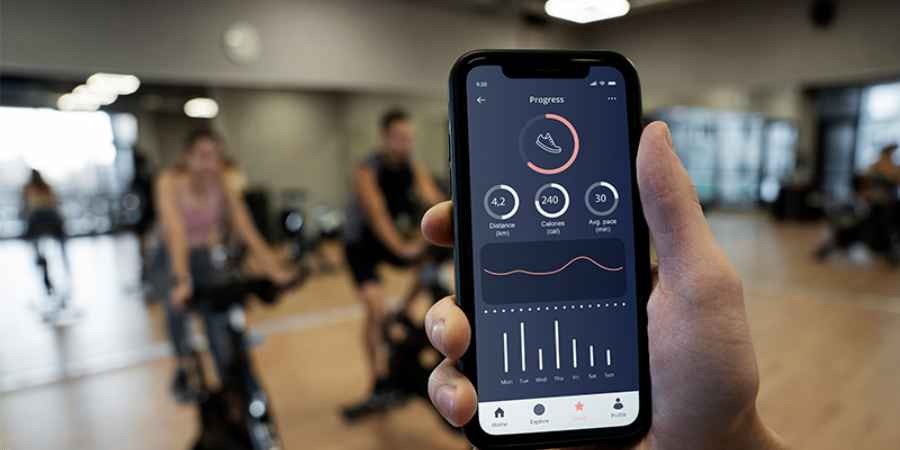
Across the US, startup founders, gym owners, and sports associations are racing to launch their first AI coach apps. Not just a workout library, but a real mobile coach powered by human pose estimation, tailored to their sport.
An AI fitness coach app typically does three things well. It delivers guided workouts through a mobile experience using computer vision and pose estimation to analyze a user’s form through the camera.
Plenty of vendors say they “do AI.” Far fewer can actually deliver sport-specific motion analysis, low-latency video processing, and a production-ready mobile product that keeps users coming back.
Choose the wrong partner and you may face:
- Laggy video analysis that frustrates users.
- Inaccurate pose detection that erodes trust.
- Low retention that burns through your marketing budget.
This article gives you two things. First, a practical framework to evaluate AI fitness app development partners. Second, a curated list of five companies that stand out for AI fitness app development services, especially for US-based clients.
Before we look at specific vendors, though, it helps to understand what really matters when building a sport-specific AI coach for the first time.
Let’s break down what you should be looking for.
Factors to Consider When Choosing an AI Fitness App Development Company
When every agency’s website says “AI-powered,” it’s easy to get lost in buzzwords. Instead, consider these key factors.
- Fitness and sports domain understanding
Building a fintech dashboard is not the same as building a boxing coach app.
Your development partner should understand how fitness businesses operate. Programs, memberships, class structures, personal training packages, progress measurement. They should speak the language of coaches and performance directors, not just product managers.
A team that has built fitness or sports performance apps before will anticipate practical issues. Camera placement in a garage gym. Lighting conditions in a yoga studio. The way a golf swing differs from a barbell squat in terms of joint tracking complexity.
- AI, machine learning, and computer vision capability
Look for real experience with vision-based features: rep counting, posture analysis, motion tracking, form correction. Ask whether they have worked with 2D or 3D pose estimation. Do they understand the trade-offs between on-device inference and cloud processing? Between model accuracy and real-time speed?
More importantly, can they customize models for your specific sport?
Generic squat detection is one thing. Analyzing a tennis serve, a martial arts kick, or a snatch under competition standards is another. A credible partner should be able to explain how they would adapt or retrain models for sport-specific movement patterns.
- Mobile and wearable product experience
Your partner should have a strong track record delivering iOS and Android apps, whether native or cross-platform. They should be comfortable integrating with wearables and health APIs. Heart rate, HRV, step count, sleep data, these signals make your AI coach smarter.
Equally important is real-time feedback. If the app takes three seconds to respond after a rep, the experience feels broken. Ask how they manage latency and how they test performance across mid-range devices, not just the latest iPhones.
- User experience and retention focus
Strong partners think in flows. How does onboarding work? How does the user set up the camera? How is progress tracked? What happens when someone misses a week?
They need to balance technical constraints with usability. Not every home environment is ideal for vision tracking. The UX has to guide users gently without overwhelming them.
- Data privacy, security, and compliance awareness
Your partner should clearly explain where and how user videos are processed and stored. Are they encrypted? Who has access? How long is data retained?
They should also understand the boundary between general wellness and regulated medical products. Even if you are not building a medical device today, you do not want architectural decisions that block you from expanding later.
Using these factors, we reviewed a wide range of vendors and narrowed the field to five companies that stand out for AI pose estimation-driven fitness coach app development and US-friendly collaboration.
1. MobiDev
Year Founded: 2009
Headquarters: Norcross, Atlanta metro area, Georgia, USA, with additional US office in Sacramento, CA and European offices
About the company
MobiDev is a software engineering company with a strong presence in the US market and long experience since 2015 building complex mobile, web, and AI products for fitness startups and mid-sized companies. They act as a long-term development team rather than a one-off contractor, covering strategy, design, engineering, and post-launch evolution.
Core expertise:
MobiDev openly showcases deep work in human pose estimation for fitness and sports apps. They publish detailed breakdowns of 2D and 3D pose estimation pipelines and describe real projects where this technology is used to analyze athlete movement and workout form. Their portfolio includes pose estimation-based training platforms for athletes, consumer fitness apps with subscription models for tennis, yoga, pilates, and golf training.
- Computer vision (OpenCV, TensorFlow, PyTorch)
- Data science (pandas, scikit-learn, SciPy, NumPy)
- Native and cross-platform mobile development
- Web development
- Backend systems
- Cloud infrastructure and DevOps
Best for:
US startup founders, gyms, and fitness associations that want a sport-specific AI coach app with serious human pose estimation capability, strong mobile UX, and the option to evolve toward more regulated health scenarios.
Why consider them:
If you want to go beyond basic rep counting and build a production-ready AI coach that understands complex movement, MobiDev combines R&D depth with real-world product delivery experience.
Clutch Rating: 5.0 / 5
2. InData Labs
Year Founded: 2014
Headquarters: Nicosia, Cyprus
About the company
InData Labs is a data science and AI consultancy focused on deep learning, computer vision, and analytics. They typically work on projects where AI is the core of the product, including sports, wellness, and digital health solutions.
Core expertise:
They treat pose estimation as a dedicated capability. Their sports and wellness practice covers 2D and 3D human pose estimation, multi-camera setups, and real-time sports analysis.
- Data science
- Deep learning
- Computer vision
Best for:
Projects where movement analysis and predictive training logic are central, and you want a specialized AI team to design and train custom models.
Why consider them:
If your vision includes advanced multi-joint analysis, rehab-friendly features, or multi-sport support, InData Labs brings a lab-style AI approach that fits ambitious, experimentation-heavy products.
Clutch Rating: 4.9 / 5
3. JPLoft
Year Founded: 2013
Headquarters: Denver, Colorado, USA, with delivery center in Jaipur, India
About the company
JPLoft is a mobile and web development company that positions itself strongly around AI-powered fitness and health apps. They work with both startups and established brands, guiding products from discovery through launch and maintenance.
Core expertise:
They offer dedicated AI-powered fitness app development services covering Android, iOS, web, and backend. They discuss fatigue tracking, workout detection, recommendation logic, and wearable integration in detail.
Best for:
Founders and gyms seeking a feature-rich AI fitness app with personalization, wearable integration, and strong UX, while potentially starting with established pose estimation SDKs.
Why consider them:
JPLoft speaks fluently about monetization, retention, and product strategy, not just code. That makes them a strong partner for first-time AI coach launches.
Clutch Rating: 5.0 / 5
4. Amplework
Year Founded: 2019
Headquarters: Jaipur, Rajasthan, India
About the company
Amplework is an AI-first development company with a strong focus on wellness and fitness solutions. They position themselves as a partner for AI-driven products across strategy, engineering, and analytics.
Core expertise:
They provide fitness app development services tailored to gyms, trainers, and wellness brands. Their AI capabilities support personalization, habit-building flows, and coaching logic.
Best for:
Teams that see pose estimation as part of a broader wellness roadmap, including nutrition, corporate wellness, or general health programs.
Why consider them:
If you want balanced AI and mobile expertise with cost-effective end-to-end delivery, Amplework offers a practical option.
Clutch Rating: 4.9 / 5
5. SPEC INDIA
Year Founded: 1987
Headquarters: Ahmedabad, Gujarat, India
About the company
SPEC INDIA is an ISO-certified, AI-driven software development company with decades of experience in custom software, mobile apps, BI, and analytics. They serve a global client base and position themselves as a partner for secure, scalable digital products.
Core expertise:
Their stack includes cross-platform mobile technologies, Google ML Kit, and generative AI. They also provide AI, data engineering, analytics, and cloud services, supporting long-term personalization and progress analysis.
Best for:
US founders and gyms who want real-time pose detection with conversational coaching, backed by enterprise-grade engineering and security standards.
Why consider them:
Their mix of fitness AI case studies and compliance-focused engineering makes them a solid choice for structured, scalable AI coach apps.
Clutch Rating: 4.6 / 5
A Step-by-Step Checklist for Choosing Your AI Fitness App Development Company
1. Define your core use case and sport
Be specific. Is this for strength training, yoga, boxing, golf, or team sports? Is it member-only or public B2C? Which platforms matter first?
2. Screen for relevant portfolio examples
Ask vendors to show fitness or sports apps, especially those involving video analysis or wearables.
3. Evaluate their AI and computer vision approach
Ask how they would implement pose estimation for your sport. Listen for trade-offs, model selection awareness, and a plan to handle poor lighting or cluttered backgrounds.
- Check the product and UX mindset
Ensure they discuss onboarding, session flow, progress tracking, and retention. Ask them to walk you through a typical workout session in your app, from camera setup to feedback.
5. Ask about infrastructure and security
Clarify where data is processed, how it is stored, and how it is secured. Discuss anonymization and future compliance needs.
6. Insist on a discovery and MVP phase
Look for structured workshops, journey mapping, and documented MVP scope. Avoid jumping straight into full development without clear priorities.
7. Clarify ongoing support and model evolution
Who monitors crashes? Who retrains models as you add new movements? Long-term support should be part of the proposal, not an afterthought.
Make Your Choice
Pick two or three vendors from the list. Share a short brief describing your sport, target users, and vision. Run discovery calls and compare how each team approaches the problem.
Choose the company who can help your AI coach app evolve from a focused MVP into a full training ecosystem that supports your members for years.




