
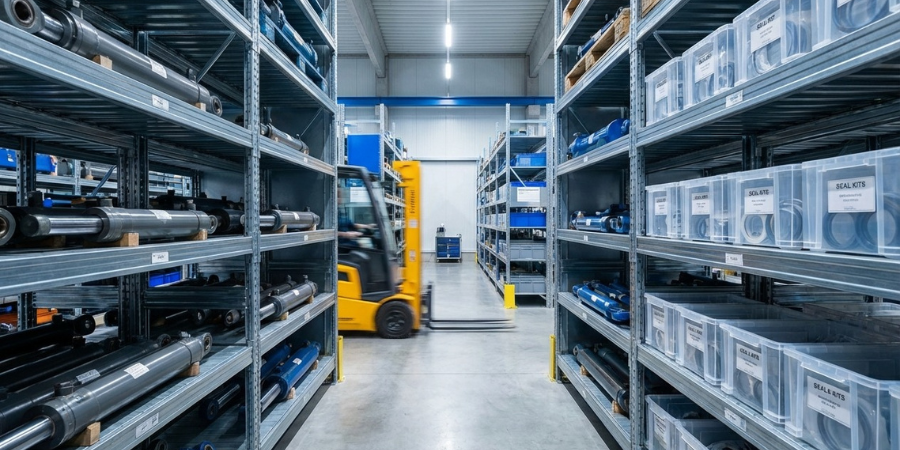
The four most effective ways to end equipment downtime involve building preventive maintenance habits, standardizing parts sourcing, training operators in early diagnosis, and utilizing aftermarket parts.
Implementing these proactive strategies significantly improves construction fleet efficiency and prevents expensive project delays.
High-performing operational leadership treats equipment availability as a financial asset rather than just a mechanical obligation.
Picture a profitable project derailed by one idle machine. A missed deadline or a penalty clause triggered over a blown seal changes the profit margin immediately.
Most downtime is not the result of unpredictable failure; it is the predictable consequence of avoidable habits compounding quietly over time.
Competitive operations leaders manage uptime exactly the way financial officers manage cash flow.
This requires a shift toward equipment downtime reduction through quiet, consistent habits.
These four low-friction strategies are the disciplines that separate reactive operations from resilient ones.
When building your supplier network, evaluating options like Case aftermarket backhoe parts from HW Part Store alongside local dealers ensures you have reliable contingencies in place.
Prevention remains the most consistently underused margin protector in any fleet-driven business.
1. Build Preventive Maintenance Habits Before Breakdown
There is a stark contrast between reactive repair and scheduled prevention. One costs compounding time, revenue, and crew morale; the other costs almost nothing relative to the massive investment it protects.
In operations, tracking a hydraulic maintenance strategy is no different from managing cash flow cycles. It is entirely about knowing what is coming before it forces your hand.
To implement this efficiently, tie inspection schedules to machine hours rather than calendar dates.
Equipment running heavy weekly loads ages fundamentally differently than equipment running limited hours.
Build crew accountability into daily inspections to monitor components closely. Checking fluid levels, cylinder rod condition, and hose integrity does not require a specialized mechanic.
The compounding effect of these daily habits is undeniable. One missed service interval rarely causes an immediate failure, but a pattern of deferred maintenance always does.
Integrating simple checks can lead to a substantial reduction in downtime when implemented correctly. The true cost of failure inevitably arrives when the project schedule can least absorb it.
2. Standardize Sourcing for Critical Parts Before Needed
Consider a fleet manager on a commercial grading project who loses a machine mid-week.
Rather than sourcing blindly under pressure, they pull from a pre-established relationship with a specialized supplier.
The parts ship the same day and arrive before the weekend without disruption. The outcome is not luck, but a strategic decision made weeks earlier.
Standardizing your sourcing means knowing exactly where to go when pressure is highest.
Resilient fleets treat their parts suppliers the way they treat their top-tier subcontractors.
Vendors are vetted in advance, relationships are built early, and partners are evaluated on technical depth.
This approach ensures you have absolute confidence that parts will perform and arrive on time.
Sourcing blindly under pressure inevitably leads to steep operational costs.
Fleet managers forced to spot-buy face immediate price premiums, shipping gambles, and wasted administrative hours.
Establishing approved vendor lists secures measurable equipment downtime reduction across operations.
Parts availability is essential, but early problem identification on the ground is equally critical.
| Pro Tip: Vet your specialized suppliers during calm periods. Having an approved vendor list for hydraulic parts eliminates the “blind sourcing” scramble that turns a minor leak into a week-long project delay. |
3. Train Operators to Be the First Line of Diagnosis
The most expensive hydraulic failures are rarely sudden or unpredictable. They almost always broadcast observable warnings for days or weeks before escalating into unavoidable repairs.
The critical question for operational leaders is whether anyone on site is trained to read those warnings.
Shifting early issue detection to the operator seat positions your crew as proactive sensors.
Operators should be trained to recognize early warning signs through a simple supervisor briefing.
They need to look for visible fluid leaks around cylinder rods, hose fittings, and port connections.
Flagging slower cycle times or reduced lift pressure highlights internal seal wear early. Unusual sounds, such as pump whine or actuator hesitation, must be treated as crucial diagnostic signals.
The business case for this level of operator awareness is profound. A flagged issue caught early shortens the repair window from days to hours.
Some facilities recovered 9,400 hours of unplanned downtime by shifting their maintenance culture.
Catching it early ensures a simple seal kit repair does not escalate into a full cylinder replacement.
4. Use Aftermarket Parts to Control Repair Budgets
Many operations leaders still operate under the false assumption that aftermarket inherently equates to lower quality.
This outdated belief costs them valuable margin on every single repair cycle.
Reframing aftermarket sourcing as a financially intelligent decision is a core element of modern operational leadership. It delivers full performance at a fraction of the premium pricing.
Aftermarket hydraulic seal kits and hard parts are engineered to meet or exceed original equipment specifications.
The performance standard remains exactly the same, changing only the markup structure. Leaders who standardize aftermarket sourcing can achieve substantial parts savings over time.
In fact, utilizing specialized supply chains for parts savings can amount to a double-digit percentage easily.
Choosing aftermarket is no longer a cost-cutting compromise made under intense budget pressure.
It is a calculated margin protection strategy used consistently by the most efficient fleets.
Giving operations managers the confidence to use aftermarket components transforms routine maintenance into a highly controlled process.
Operational excellence is simply a collection of deliberate, quiet decisions made long before the pressure arrives.
| Important: Don’t let brand loyalty drain your margins. Modern aftermarket hydraulic components often meet or exceed OEM specs. Sticking to “name-brand” parts out of habit is an expensive way to ignore quality alternatives. |
The Bottom Line
Equipment downtime is not a matter of bad luck. It is the predictable consequence of deferred decisions, and the most damaging version is entirely preventable.
Unifying these four strategies creates a formidable defense against operational margin erosion.
Preventive maintenance habits, sourcing standardization, diagnostic awareness, and intelligent aftermarket adoption are simple, compounding disciplines.
The best-run operations are deliberate, and their profit margins directly reflect that operational discipline.
True leadership requires treating downtime as a controllable metric rather than an inevitable cost of doing business.
Evaluate your current approach to fleet management to see where proactive systems can be strengthened.
Building a comprehensive framework ensures your equipment remains a reliable asset rather than a constant liability.
| Author Profile: HW Part Store is the leading online retailer of aftermarket hydraulic cylinder seal kits, replacement parts, and attachments for a wide range of industrial construction equipment. |




