

In-play betting terms are not just sportsbook jargon. They describe how a live game changes minute by minute: who has possession, where pressure is building, which side controls tempo, and whether a short run is real momentum or noise.
That language matters because live sport now sits across broadcasts, phones, social feeds, and group chats at once. A PLOS One study of online sports viewing found that both pre-game and in-game factors helped explain fan chat activity, with game events shaping how people reacted while watching.
Seeing The Terms in a Real Setting
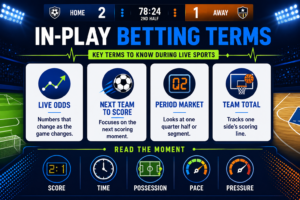
Image source: Bespoke visual created by the author for this topic
Definitions land faster when they attach to a moment. “Live odds” makes sense when a basketball team cuts a 12-point gap to 4. “Next team to score” becomes clear after a punt flips the field position. “Quarter market” is less abstract when the current period has its own rhythm.
A broad sportsbook and casino homepage is useful here because it shows where live sports language sits in a wider entertainment setting, without pretending to be a glossary. https://www.luckyrebel.la presents access to sports, casino games, live casino games, and mobile play from its main page, serving as a direct reference point for the environment where these terms commonly appear.
A casual viewer does not need a dense manual before understanding the basics. They need to recognize the difference between a full-game outcome, a short-window market, a team scoring line, and a live number moving after new information arrives. That setting keeps the vocabulary grounded in real games, rather than theory, and helps a viewer find the context for a term.
Lucky Rebel’s guide to live betting in real time takes that same idea into momentum, pace, turnovers, first-serve pressure, next-team-to-score markets, team totals, and shorter game segments. The useful takeaway is not that every swing deserves a reaction. It is that a scoreboard change means more when the underlying play supports it.
The Terms That Carry the Most Meaning
“In-play” simply means the game has already started. The important shift is timing. Pre-game discussion works from preparation, form, matchups, and expectations. In-play discussion works from fresh information. A goal, timeout, red-zone stop, early break of serve, foul trouble, or fast scoring run can change the next few minutes.
“Live odds” are numbers that update as the game changes. They move because the situation has moved. A tennis player struggling to land first serves gives a different signal from a player who loses one flashy point. A soccer team creating repeated chances shows more than one hopeful long shot.
“Next team to score” narrows attention to the next scoring event. It often makes sense when position, possession, pressure, and game flow have shifted quickly. In football, clean protection and starting field position can matter as much as the previous score.
The same holds in college football, where one turnover or a long return can hand a team a short field. For a pre-game reference point on those matchups, the college football betting boards on Fanatics Markets list each game as event contracts, so fans can compare their own read of a game with where the market stands.
“Quarter,” “period,” and “half” markets shrink the frame. One side can be behind overall and still look stronger inside the current segment because of pace, substitutions, fatigue, or matchup changes.
“Team totals” focus on one side’s scoring output, rather than the full result. They become easier to read when one team is getting cleaner shots, more dangerous entries, or repeated short-field chances.
Momentum Is a Translation Problem
Momentum is tempting because viewers can feel a game turn before the numbers fully explain it. The mistake is treating that feeling as enough. Better reading starts by asking what the feeling is made of.
In basketball, a scoring run built on open corner 3s and layups off turnovers means something different from one built on contested midrange shots. In soccer, possession matters more when it becomes territory, shots, and pressure around the box. In tennis, one break means more after several shaky service games.
This is where in-play terms become useful for ordinary fans, not only dedicated sports bettors. The vocabulary gives names to parts of the game that are already visible: pace, pressure, time remaining, possession, field position, and fatigue. The terms separate one dramatic moment from a pattern that deserves attention.
Reading The Game Without Chasing Every Shift
The cleanest way to understand in-play language is to keep the window small. Ask what just changed and which term matches that change. If the answer is unclear, the term is probably being used too loosely.
A live number moving after a goal is obvious. A live number moving before a goal can be more interesting because it may reflect pressure that has been building. A period market can make sense when a team’s current lineup has changed the tempo, while a team total can reflect shot quality or field position.
None of this requires you to turn sports into a spreadsheet. It requires you to pay attention to the difference between an event and a pattern. One turnover is an event. Three pressured possessions start to look like a pattern. One missed serve is an event. Several loose service games tell a different story.
In-play betting terms explain how sports entertainment thinks in shorter slices of time. The game is the game, but the language around it follows breaks, possessions, runs, and resets. Definitions help viewers understand what changed before the final score gives them the slow version, a point echoed by work on sports live streaming engagement.




