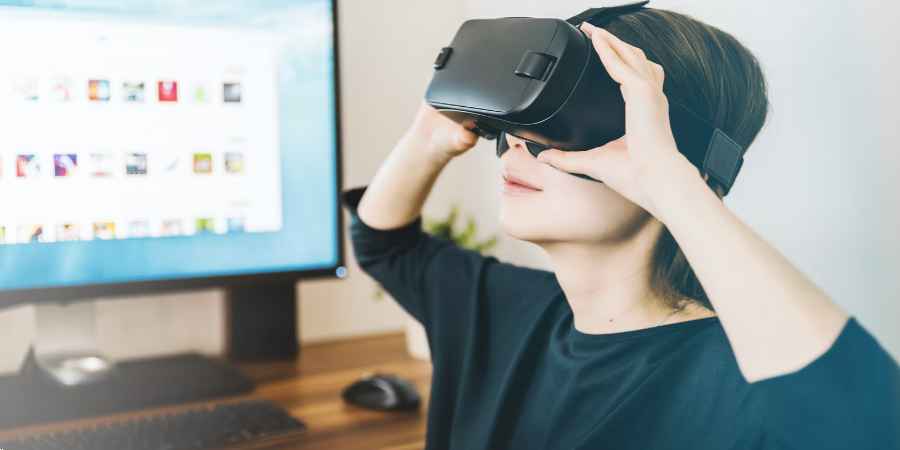
International teams often have to work together across different locations and time zones. That makes consistent training and effective collaboration harder to organise. Virtual reality can help by giving employees access to the same digital environment, regardless of where they are based. For companies with distributed teams, that opens up possibilities for training and project work that are difficult to reproduce with standard video calls or online courses.
Immersive training can make complex situations easier to practise
VR is especially useful when employees need to practise situations rather than simply read about them. Think of a safety procedure or customer interaction that can be recreated in a virtual environment, allowing people to work through the same scenario more than once. This can be useful when real-world training is expensive, difficult to organise or involves unnecessary risk.
For international teams, the main advantage is consistency. Employees in different offices can follow the same training scenario without needing to travel to a central location. That does not mean every course needs to become immersive. VR mainly becomes relevant when interaction or spatial awareness are part of the learning process.
Good VR training depends on more than the headset
Introducing VR into a learning programme involves more than purchasing hardware. A company also needs to think about amongst others, device management, user access and how the training fits into existing learning systems. Providers such as VR Expert support organisations with the selection, configuration and deployment of VR hardware for professional use. For international rollouts, that can also involve software distribution, device management and support across multiple locations. The technology works best when the hardware and the learning experience are both chosen with a clear use case in mind.
Shared virtual spaces can support collaboration
VR can also be useful when international teams need to work with visual or spatial information. An architecture team in several countries can review the same 3D building model. Engineers can inspect a virtual prototype together, while product teams can discuss design changes before anything is physically produced. In these situations, VR adds something that a standard video meeting cannot easily provide. Everyone can look at and interact with the same three-dimensional object from their own perspective.
International use requires local context
A training scenario that works well in one country may not automatically translate to another. Language is the most obvious difference, but workplace culture can matter as well. Communication styles, safety procedures and expectations around hierarchy may differ between locations. That means international VR training should be adapted where necessary rather than copied unchanged across every market.