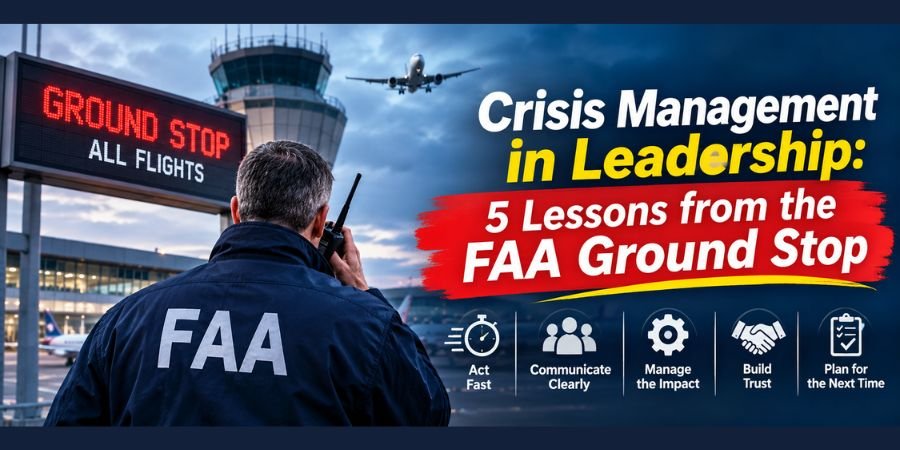
The November 13 aviation disruption in the United States offers an important lesson for executives: managing a crisis means more than explaining what went wrong. It means protecting people, communicating honestly and taking responsibility for what happens next.
A crisis rarely gives leaders the luxury of waiting until every answer is available. When a critical system fails, decisions must be made with incomplete information, competing priorities and consequences that can extend far beyond the organisation itself. The Federal Aviation Administration’s (FAA) nationwide ground stop on November 13, 2026, offers a timely example of what this looks like in practice.
Intermittent communication and radar outages led to communication system instability for air traffic control. These outages led to the FAA deciding to halt flights throughout the United States. When the ground stop began, the US Department of Transportation reported that there were more than 3500 airborne aircraft. Pilots and air traffic control cooperated to safely land the aircraft. After the stopping of the delay, over 8000 flight operations resumed.
The incident also placed Transportation Secretary Sean Duffy in the middle of a difficult leadership challenge. He had to explain the disruption, address questions about ageing aviation infrastructure, oversee the restoration of operations and ask Congress for additional funding to modernise the country’s air traffic control system.
The funding request quickly became part of a wider debate. Duffy sought approximately $50 billion for further modernisation, while Democratic lawmakers questioned why additional money was necessary when $12.5 billion had already been allocated to the FAA through legislation passed in 2025. The disagreement brought another important leadership issue into focus: explaining an infrastructure problem is different from demonstrating that the organisation has managed its resources and responsibilities effectively.
For business leaders, the episode provides a useful case study in crisis leadership. It illustrates why decisive action, accountability, communication, operational resilience and learning after failure must work together when an organisation faces an unexpected disruption.
1. Decisive Action: Why Safety Must Come Before Operational Convenience
The decision of the FAA to call for a nationwide ground stop indicates one of the most significant aspects of times of crisis leadership; knowing the importance of when it is too risky to continue with standard procedures.
According to the Department of Transportation, instability in radar data and communications began affecting air traffic control facilities at approximately 3:36 p.m. Officials said the systems were not completely offline, but the inconsistencies created sufficient concern to trigger established safety procedures.
The decision disrupted thousands of travel plans, but allowing aircraft to continue operating without confidence in the reliability of essential communication systems could have introduced a much greater danger.
For executives, the lesson is simple: Operational continuity should never become more important than the safety of employees, customers or the public.
What leaders can learn:
- Establish clear thresholds for suspending operations when safety or security is at risk.
- Give employees the authority to escalate serious concerns without fear of punishment.
- Prepare emergency decision-making protocols before an incident occurs.
- Make decisions based on available evidence rather than pressure to maintain business activity.
- Explain why a disruptive decision was necessary, even when stakeholders are unhappy with the immediate consequences.
Editorial observation: Leaders sometimes hesitate to stop operations because they associate a shutdown with failure. In reality, knowing when to pause can be a sign of sound executive judgment. A temporary interruption may protect an organisation from a much larger operational, financial or reputational crisis.
2. Accountability: Explaining the Cause Is Not the Same as Accepting Responsibility
One of the more difficult aspects of crisis management in leadership is separating the cause of a failure from the responsibility to manage its consequences.
Following the FAA disruption, Duffy pointed to the age of the country’s air traffic control infrastructure. He explained that the system still relied on older telecommunications technology, including copper-wire connections and legacy equipment. The administration said the disruption was likely connected to maintenance work involving the transition from copper lines to fibre, although officials had not established whether contractor error or faulty equipment caused the problem.
Duffy also identified L3Harris, the contractor responsible for the relevant telecommunications network, as part of the investigation. The company was involved in the upgrade work, but the precise cause had not been confirmed at the time of the public statements.
His explanation raised an important question for organisational leaders: when an organisation inherits outdated infrastructure or relies on an external service provider, where does accountability begin and end?
The responsibility cannot simply be transferred to the contractor. An organisation may outsource technical operations, but it cannot outsource its responsibility for ensuring that essential services remain safe and reliable.
There was also a financial accountability question. Duffy argued that the previously allocated $12.5 billion did not cover all the infrastructure changes he wanted to complete. Democratic lawmakers countered that the administration should explain the existing allocation and its spending before seeking additional funding.
Both the technical failure and the funding debate demonstrate why transparency matters during a crisis.
What leaders can learn:
- Explain what is known, what remains uncertain and what is being investigated.
- Take responsibility for overseeing contractors and third-party providers.
- Publish measurable progress on previously announced improvement programmes.
- Avoid using inherited problems as a substitute for explaining present-day decisions.
- Make additional funding requests with clear budgets, priorities and expected outcomes.
Editorial observation: A leader does not have to personally cause a failure to be accountable for addressing it. In fact, acknowledging inherited weaknesses while explaining what the organisation is doing about them often establishes greater credibility than repeatedly defending the circumstances in which the problem emerged.
3. Crisis Communication: Give People Facts Before They Fill the Information Gap
During an emergency, silence can create confusion. Employees, customers, investors and the public want to know what happened, whether they are safe and what they should expect next.
The FAA incident affected more than air traffic control operations. Passengers faced delays, cancellations, missed connections and uncertainty about when normal schedules would resume. Airlines also had to reposition aircraft and crews after the disruption.
Duffy and Federal Aviation Administrator Bryan Bedford addressed the public on November 14, explaining the telecommunications problems, the restoration process and the investigation into the equipment failure. Officials also said they had found no evidence of a cyberattack.
This illustrates an important principle of crisis communication strategies: communication must continue after the immediate emergency has passed.
A useful communication approach should include:
- Immediate notification: Explain the disruption and the action being taken.
- Safety information: Tell affected people what they should do and where to obtain verified updates.
- Regular updates: Share new information even when the investigation is incomplete.
- Honest uncertainty: Avoid presenting preliminary explanations as established facts.
- Recovery expectations: Explain what returning to normal operations will involve.
- Post-crisis reporting: Communicate findings and corrective actions once the investigation is complete.
One of the details that should be especially taken into account: the needs of the public differ from those of technical investigators. The passengers only want to know whether the flights continue to be operated and how the current situation would affect them. On their part, the technicians and authorities demand informational input on routes, network links, and possible vulnerabilities of the systems.
Good leadership recognises these different needs instead of delivering the same technical explanation to every stakeholder.
Editorial observation: The quality of crisis communication is not measured by how many press conferences a leader conducts. It is measured by whether people understand the situation better after hearing from that leader. Repeating that everything is under control does little to build confidence unless the organisation can explain what is being done, who is responsible and when the next update will arrive.
4. Operational Resilience: Why Organisations Cannot Depend on Systems That Have Outlived Their Purpose
The FAA disruption exposed a problem that extends beyond the immediate equipment failure: the vulnerability created when essential services depend on ageing infrastructure.
According to the Department of Transportation’s November 14 briefing, maintenance work at a remote FAA location involved replacing older copper telecommunications lines with fibre. Officials said a router associated with the transition began generating excessive connection attempts, affecting other parts of the network. The precise technical cause was still under investigation.
The incident demonstrates how a seemingly limited maintenance activity can affect a much larger operating environment when systems are interconnected.
For organisations, this is a reminder that risk management cannot focus exclusively on visible threats. Legacy software, ageing equipment, supplier dependencies and insufficient backup arrangements can create vulnerabilities that remain unnoticed until something fails.
Major factors in crisis leadership include:
- Maintaining an updated inventory of critical systems and their dependencies.
- Identifying single points of failure in operational infrastructure.
- Testing backup systems and recovery procedures regularly.
- Scheduling high-risk maintenance with appropriate safeguards.
- Evaluating third-party providers and their technical responsibilities.
- Investing in modernisation before ageing equipment becomes an emergency.
The FAA’s situation also highlights the importance of managing technological transitions carefully. Replacing old infrastructure is necessary, but the transition itself can introduce risks.
Editorial observation: Modernisation should not be measured only by how much equipment an organisation replaces. Leaders should also examine whether the new systems can work safely alongside existing infrastructure during the transition. A modernisation programme that introduces operational instability can create a new problem while attempting to solve an old one.
For business executives, operational resilience means being able to absorb disruption, maintain essential services and recover without exposing customers or employees to unnecessary risks.
5. Learning After Failure: Turn a Crisis into an Opportunity to Improve
A crisis response should not end when operations resume. The more important test is whether the organisation becomes better prepared for the next disruption.
Following the ground stop, officials said the FAA was investigating the circumstances surrounding the router failure and the telecommunications upgrade. Duffy indicated that the administration would share its findings once the cause had been established.
That investigation needs to go beyond identifying a faulty component or determining whether a contractor made an error. It should examine the wider conditions that allowed the failure to affect a nationwide system.
For organisations, a meaningful post-crisis review should address:
- Root-cause analysis: What failed, and what technical or organisational conditions contributed to it?
- Decision review: Were the emergency procedures effective, and were responsibilities clearly assigned?
- Supplier assessment: Did contractors meet their technical and operational obligations?
- Investment priorities: Which systems require immediate replacement, additional safeguards or stronger maintenance?
- Preparedness testing: Can the organisation respond effectively if a similar incident occurs again?
- Performance measurement: How will management demonstrate that corrective actions have actually reduced risk?
There is also a leadership accountability dimension. When executives announce improvements after a crisis, they should establish measurable deadlines and communicate progress. Otherwise, lessons can become statements of intention rather than changes in organisational behaviour.
Editorial observation: Organisations often conduct detailed reviews after a major failure, but the real value of an investigation lies in what changes afterwards. A report that identifies problems without assigning owners, budgets and deadlines does little to improve resilience. Leaders should make sure every important finding leads to a practical corrective action.
What the FAA Ground Stop Teaches Business Leaders About Crisis Leadership
The FAA disruption was an aviation emergency, but its lessons extend to almost every organisation that depends on complex technology, external suppliers and interconnected operations.
It also demonstrates that crisis leadership involves several responsibilities at once. Leaders must protect people, make decisions with incomplete information, explain difficult developments and address the weaknesses that emerge.
Sean Duffy’s response placed the issue of ageing infrastructure and the need for additional investment at the centre of the public discussion. At the same time, the disagreement over existing FAA funding demonstrated why leaders must support their requests with transparent spending information and measurable plans.
For business executives, five principles stand out:
- Prioritise safety: Protect people before worrying about operational convenience or short-term financial losses.
- Accept accountability: Explain organisational responsibilities even when failures involve inherited systems or external contractors.
- Communicate honestly: Share verified information, acknowledge uncertainty and keep stakeholders informed.
- Build resilience: Invest in infrastructure, contingency planning and supplier oversight before a disruption occurs.
- Act on lessons: Convert investigations into measurable improvements with clear ownership and deadlines.
Finally, effective crisis management in leadership is not about convincing people that an organisation can avoid every failure. Complex systems will experience disruptions, and even well-prepared organisations may face unexpected challenges.
The difference lies in how leaders respond. They must be prepared to make difficult decisions, communicate without hiding behind explanations and demonstrate that the organisation has learned something meaningful from the experience.
The FAA ground stop offers a particularly important reminder: restoring operations is the first achievement after a crisis. Making sure the same weaknesses do not create another one is the real test of leadership.
Author’s Note:
In my view, the FAA ground stop highlights something that often gets overlooked when we discuss leadership: a leader’s real capabilities become visible when the systems they depend on stop working. It is easy to speak about efficiency, innovation and organisational growth when everything is running smoothly. The difficult part is making decisions when there is no perfect solution and every delay carries consequences.
I believe the most important lesson here is that explaining why something went wrong should never become a substitute for taking responsibility for what happens next. Ageing infrastructure, inherited problems and contractor failures may explain the circumstances, but people still look to leadership for answers, reassurance and meaningful action.
What I would particularly like business leaders to take away from this incident is the importance of preparing for problems before they become public emergencies. Organisations should not wait for a major failure to examine their systems, question their dependencies or reconsider their investment priorities.
Good leadership is not demonstrated by how convincingly someone defends a decision after a crisis. It is demonstrated by the willingness to make difficult decisions, acknowledge shortcomings and ensure that the same failure does not happen again.