
Rural healthcare access is measurable, mapped and felt in day-to-day life. The Commonwealth Fund estimates that 42.6 million people lived in a rural primary care Health Professional Shortage Area (HPSA) in 2023.
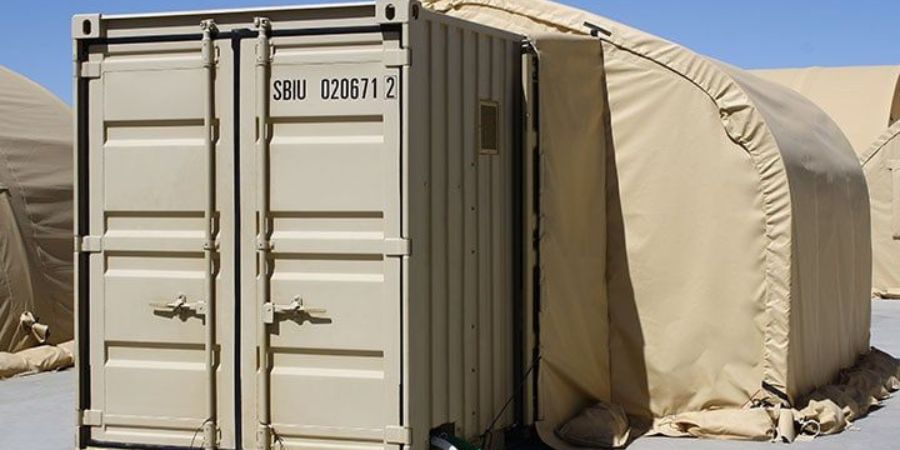
That number matters because it clarifies the problem and opens the door to practical solutions. One of the most workable ideas is straightforward: bring a real clinical space closer to patients, using a rapidly deployable containerized facility designed for dignity, privacy and efficient care.
In this article, we’ll look at three things. First, how shortage areas are actually defined, and why that helps communities plan smarter. Second, why flexibility matters when local hospitals close or convert, and how a pop-up clinic can support continuity instead of chaos. Third, what the workforce numbers tell us about designing care that fits rural reality, including what services tend to work best when the clinic is built for repeatable workflows.
Shortage Math and Human Reality
If you’ve ever tried to book a routine appointment and been offered a date that feels like it belongs to another season, you already understand the human side of shortages. What’s useful, though, is that the U.S. doesn’t just say shortage and move on; it measures it.
HRSA reports that 63.1% of designated primary care HPSAs are in rural areas. That figure is a data-backed signal about where primary care capacity is most likely to fall short.
HRSA also spells out a key benchmark used for designation: a minimum adequate population-to-primary care physician ratio of 3,500 to 1. You don’t need to love ratios to get the point: when the ‘supply’ side can’t keep up, the ‘access’ side becomes fragile, and everyday care turns into a logistics problem.
This is where containerized clinics start making sense, not as a trendy gadget, but as a planning tool. If shortage is geographically predictable, then the clinical footprint can be predictable too. You can design a clinic layout that’s repeatable, reliable and easy to staff on a rotating schedule, rather than reinventing the wheel every time a community needs more room.
There’s also a genuine win here: when the space is designed properly, it reduces the emotional cost of getting care. People are more likely to show up when they trust the setting will respect their privacy, their mobility needs and their time.
That brings us to the next pressure point. Rural access involves more than how many clinicians are available; it’s also about what happens to the local places where care used to happen.
When the Local Hospital Changes, Care Still Has to Happen Somewhere
Rural hospitals carry a lot of meaning. They’re where you go when you’re scared, where babies arrive, where families gather in waiting rooms that feel familiar. So when a hospital closes or changes form, it doesn’t just remove beds; it changes the shape of daily life.
The UNC Sheps Center tracks rural hospital closures and conversions, and reports 195 rural hospital closures and conversions since January 2005 (110 complete closures and 85 converted closures). The same tracker notes these counts do not include conversions to Rural Emergency Hospitals (REHs).
Those numbers don’t tell you what it feels like to lose local services, but they do explain why communities look for continuity solutions that don’t require years of waiting. A containerized, rigid-wall clinic can act as a continuity hub, keeping routine and preventive care from falling through the cracks while the broader system adjusts.
This is also where design stops being an architectural conversation and becomes a care conversation. If the clinic feels improvised, people sense it right away. If it feels professional, patients relax, staff work faster and the whole day runs with fewer hiccups.
Here’s what tends to matter most in a small, rapidly deployable clinic space:
- Clear check-in and wayfinding so people don’t feel lost the moment they walk in
- Sound control for privacy during intake and visits
- ADA-ready access (entry, door widths, room turns) so nobody has to ask for special treatment
- Infection-control-minded flow that avoids crowding and awkward bottlenecks
- A waiting area that’s simple and comfortable, not an afterthought
One more thing: speed only counts if the clinic earns trust. A facility can be installed quickly, but it still has to feel respectful on day one, because that’s when people decide whether they’ll come back.
Now, even with the right space, you still need clinicians, medical assistants, nurses and the operational support that keeps care safe. So let’s talk about what the workforce numbers suggest, and how a ‘bring the building to the patient’ model can help without pretending it solves everything.
Care Where the Doctors Aren’t (Yet)
Rural communities don’t need a lecture about workforce challenges. They’ve been living it. Still, it’s helpful to see how the distribution shows up in credible national reporting.
AAMC reports a U.S. average of 263 active physicians per 100,000 population in 2022. Among ZIP codes with at least one active physician, the median number of doctors is 76 per rural ZIP code versus 96 per urban ZIP code.
That gap has practical consequences. When clinician time is scarce, you want clinical days to be efficient, predictable and worth the travel for both the provider and the patient. A containerized clinic can help by offering a consistent setup for scheduled outreach, with the same room flow each time.
There’s also evidence that people will use distributed care when it’s organized well. A peer-reviewed report on a digitally capable mobile health clinic serving rural southern Minnesota reported 1,498 patient appointments by April 30, 2022, and more than 45% of those appointments came from surrounding communities. That matters because it suggests something very down-to-earth: one well-run stop can serve more than a single dot on the map.
So what services tend to fit a containerized, repeatable layout? Think in terms of care that benefits from consistency and clear workflow: screenings, chronic disease monitoring, vaccinations, basic lab collection and telehealth-supported consults that still need a private room and reliable connectivity. A small footprint works best when it focuses on doing the right things well and connecting patients to higher-acuity care through planned referral pathways.
If a community can reliably host high-quality visits in a predictable footprint, what else becomes possible?
Access You Can Deliver
Containerized pop-up clinics are most useful when understood as a bridge from measurable need to practical action. HRSA’s shortage framework helps communities identify where gaps are most likely to bite, and gives funders and local leaders a shared language for planning. The Sheps Center’s closure and conversion tracking is a reminder that the physical side of access can change, sometimes abruptly, and continuity requires flexible space. Workforce distribution data underscores why it’s smart to design care delivery that respects limited clinician time and reduces patient travel burden.
It’s also honest to admit that workforce solutions take time. HRSA estimates the U.S. needs 15,628 additional physicians to remove all primary care shortage designations. That’s exactly why near-term care models that can be deployed responsibly are worth taking seriously, especially when they’re designed around privacy, accessibility and smooth clinical flow rather than novelty.
One trust-building detail worth keeping front and center: even the word ‘rural’ varies by definition across agencies, including the Census Bureau’s urban and rural classification and other policy-oriented classification systems discussed by USDA’s Economic Research Service. Communities doing this well state their definition up front, then plan the clinic’s scope around real local constraints and partnerships.
A containerized clinic won’t fix every rural health challenge, but it can make care easier to reach, easier to run and easier to sustain. What would change for your town if a routine appointment didn’t automatically mean a long drive?




