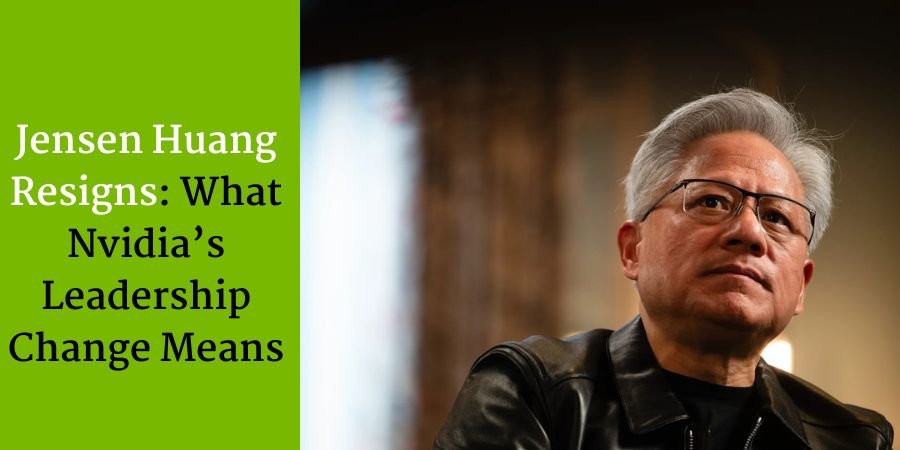
A Nvidia CEO resignation is the exit of the person who holds the company’s top executive role. In this case it ends the 33-year tenure of co-founder Jensen Huang. Nvidia announced on November 12 that Huang had resigned as president, chief executive officer and board member, effective immediately. Chief Financial Officer Colette Kress will serve as interim CEO while the board searches for a permanent successor. Harvey C. Jones, a director since 1993, becomes the company’s first-ever board chair.
Huang helped build Nvidia from a graphics chip manufacturer into a central player in the global artificial intelligence industry. The departure follows mounting scrutiny over reports about his personal relationships and an alleged Chinese intelligence connection. Huang previously acknowledged, in a message to employees, that he had been unfaithful to his wife. Nvidia has not said that any of these allegations caused his departure.
This article explains what happened, what Nvidia has and has not said about the reasons, who Kress is, and what the change means for succession planning, board oversight and leadership continuity. Confirmed facts come from Nvidia’s own SEC filing. Allegations are labelled as allegations.
Why Did Jensen Huang Resign as Nvidia CEO?
The confirmed event is the resignation itself. The reason behind it remains unconfirmed.
The New York Times and other publications reported on Huang’s relationship with Alice Huang, a former executive associated with Singapore-based AI infrastructure company Megaspeed. US intelligence officials reportedly suspected her of connections to Chinese intelligence. Nobody has independently established these claims as fact, and the Chinese government has rejected the espionage allegations.
Nvidia’s board had announced an independent investigation, and Huang said he would cooperate. The company has not said the investigation led to his resignation. Its November 12 announcement confirmed only his departure and the immediate leadership arrangements.
A simple way to read the situation is to separate three categories:
| Category | Detail |
| Confirmed by Nvidia | Huang resigned as president, CEO and director with immediate effect. Kress is interim CEO. Jones is board chair. The board will consider internal and external candidates. |
| Reported, not confirmed as the cause | Questions about Huang’s relationship with Alice Huang, and suspicions among US intelligence officials about Chinese intelligence ties, which China denies. |
| Not stated by Nvidia | Whether the investigation produced the resignation, and when a permanent CEO will be named. |
Investors and employees should hold these categories apart. Treating a reported allegation as the confirmed reason for the exit would put more into the record than Nvidia has.
Who is Colette Kress, Nvidia’s New Interim CEO?
An interim CEO is an executive who runs a company on a temporary basis while the board completes a search for a permanent leader. Colette Kress now holds that position at a company whose technology has become essential to the growth of AI infrastructure.
Kress joined Nvidia in September 2013 and has served as executive vice president and CFO ever since. Before that, she spent nearly 25 years in finance roles at major technology businesses, including Cisco and Microsoft. As CFO, she already presents the company’s results to investors each quarter, so the market knows her voice. She also understands Nvidia’s financial operations, customer relationships and business priorities from the inside.
The filing adds a detail that many early reports skipped. Kress keeps her CFO title while she serves as interim CEO. She must now oversee the company’s wider strategic direction and run its finance organisation at the same time. That arrangement works for a short period. The longer the search runs, the more pressure it places on a single executive. A sensible indicator to watch is whether Nvidia names someone to carry part of the finance workload.
The board has expressed confidence in Kress and the existing leadership team. It expects customer commitments, business operations and the product roadmap to continue without interruption. The filing sets no timeline for the permanent appointment.
What Does Jensen Huang’s Exit Mean for Nvidia’s Leadership Strategy?
Founder dependence is the degree to which a company’s strategy, culture and public credibility rest on one leader. Nvidia scores high on that measure, and the Nvidia CEO resignation tests it directly.
Huang has shaped Nvidia’s strategic direction, product vision and public identity for more than three decades. His leadership put the company at the centre of the AI computing market as demand for advanced processors and data centre infrastructure grew. He has also described an unusually broad management structure with around 60 direct reports. That structure keeps a chief executive close to many business functions, but it makes a sudden change harder, because much of the coordination runs through one person.
Two points deserve attention beyond the headline.
First, the board structure has changed in one move. Nvidia now has a chair for the first time, and Huang no longer sits on the board at all. The company has lost its founder from both the executive team and the boardroom on the same day. Whether this strengthens board oversight depends on how much authority Jones and the directors take on during the search.
Second, some of Nvidia’s strategic positions were tied closely to Huang personally. TechCrunch reported that his advocacy for open-weight AI, connected to Nvidia’s Nemotron models and its pending Hugging Face acquisition, now faces an open question. The deal was confirmed in September at a reported $12.9 billion and has not closed. Neither Kress nor Jones addressed open-source strategy in the filing, and the board’s continuity language covers operations and the roadmap in general terms only. Developers who build on Nemotron or Hugging Face infrastructure have no new guidance yet.
A reasonable reading is that a permanent successor will inherit more than a profitable semiconductor business. That person will need to hold together the technology roadmap, the major customer relationships and a very wide reporting structure, and will probably reshape that structure rather than copy it. A company can post strong financial results and field an experienced executive team and still face real uncertainty when its most influential leader leaves.
What Should Investors and Technology Leaders Watch Next?
The immediate focus falls on the permanent CEO search and on whether Kress can keep operations stable. These are the dates and decisions that will give the clearest signals:
| What to watch | Why it matters |
| November 17 earnings call, 2 p.m. PT (third-quarter fiscal 2027) | Kress’s first public forum as interim CEO, and the first chance to address business performance and investor expectations. |
| The permanent CEO search | The filing names no deadline. An internal pick would signal continuity, while an external one would signal a change of direction. |
| The Hugging Face acquisition | It tests whether Nvidia’s open-model strategy continues without Huang as its main advocate. |
| Corporate oversight and credibility on China | Nvidia sits inside the US-China semiconductor debate, so leadership credibility carries commercial and geopolitical weight. |
For other technology companies, the episode shows that succession planning is not an administrative task reserved for retirements and planned departures. Leadership accountability, board independence and clear reporting structures matter most when one founder is closely identified with the company’s success. A company that waits for a crisis to test those structures has waited too long.
Huang’s departure closes a defining chapter in Nvidia’s history. The next phase will show whether the organisation he built can keep its strategic momentum under a leadership structure that does not depend on one individual.