
Flight is a discipline shaped by collective effort, long memory, and unforgiving standards. Airlines are sustained by engineers who never meet passengers, crews who operate under constant scrutiny, planners who trade instinct for data, and leaders who must make decisions that ripple far beyond a single route or season. The field demands people who can hold multiple truths at once: commercial reality and public responsibility, heritage and reinvention, precision and empathy. Those who leave a mark are rarely defined by spectacle, but by their ability to bring alignment to complexity and purpose to pressure.
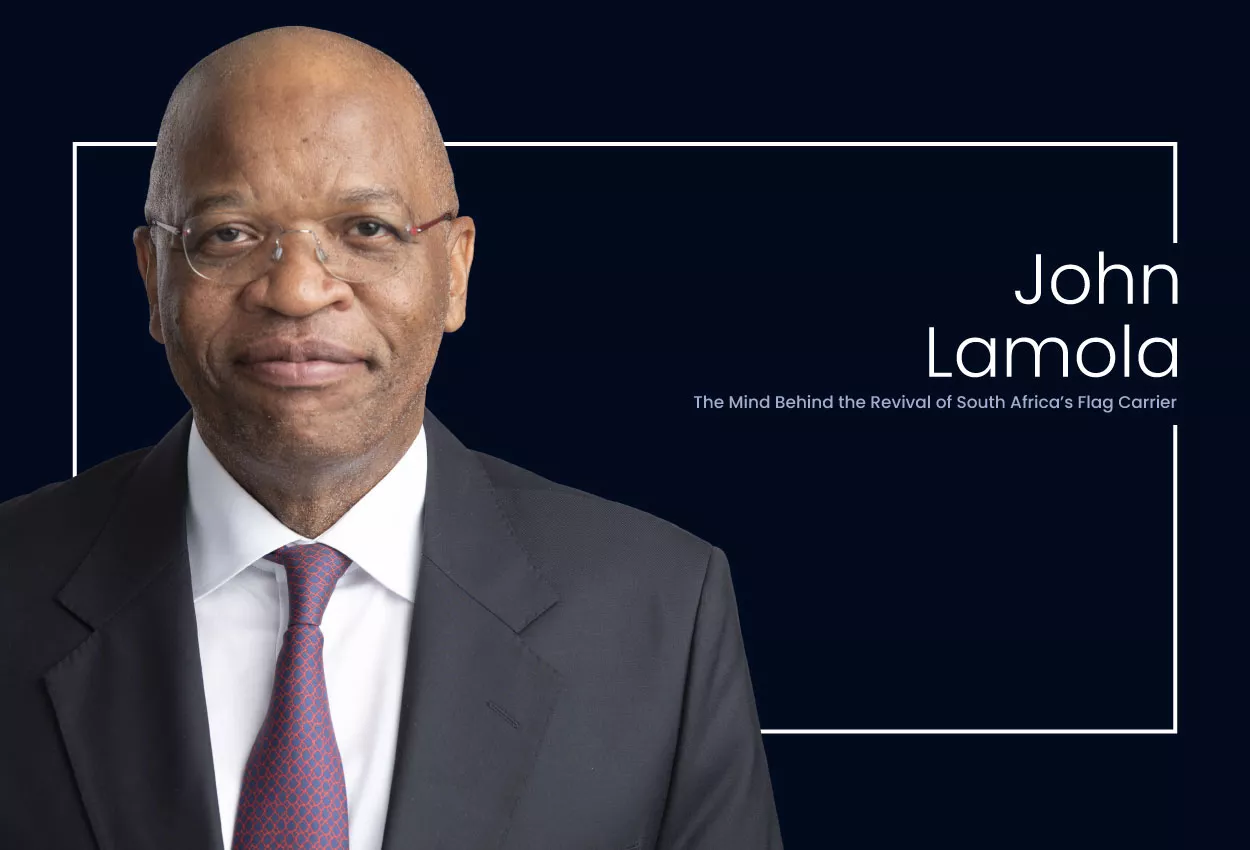
John Lamola is one of those leaders shaping contemporary aviation. As Chief Executive Officer of South African Airways, he occupies a role where strategy, ethics, and execution converge. What sets him apart within the industry is the perspective he brings to the task, a rare blend of academic depth and operational pragmatism.
The Long Runway from Exile to Leadership
John’s path to aviation leadership was anything but conventional. His entry into the industry, by his own account, was almost accidental, shaped by history, exile, and intellectual inquiry rather than an early ambition to run an airline. During the height of apartheid, he lived in exile in London and Edinburgh, where he completed a PhD in Philosophy and Religious Studies at the University of Edinburgh in 1991. His doctoral work focused on social ethics, exploring the intersection of philosophy, economics, and theology, with particular attention to questions of economic justice in a future democratic South Africa. Central to his research was the philosophy of Karl Marx, which sharpened his understanding of the role technology plays in human development and social transformation.
On returning to South Africa in 1991, John began working as an economics researcher in the office of Frank Chikane at the South African Council of Churches. This period placed him at the heart of the country’s transition to democracy. In the run-up to the first democratic elections in 1994, he worked closely with Beyers Naudé on voter education and election logistics. The work was complex and demanding, involving coordination with the defence force to airlift ballot boxes to remote regions and facilitating temporary identity documentation for citizens in former homelands such as the Transkei to enable them to vote.
It was through these interactions that John’s aviation journey truly began. Contacts made within the Air Force later led to his recruitment into Denel, South Africa’s national arms manufacturer. He joined Denel Aviation as a public relations officer and, within two years, rose to become chief executive of the Denel Aviation Transport Aircraft Maintenance Division. To deepen his sector expertise, he later completed a Master of Business Administration in Airline and Aviation Projects Management at Embry-Riddle Aeronautical University in the United States. His relationship with aviation would ultimately come full circle when he joined South African Airways in April 2021 as chairperson of an interim board, before assuming the role of interim chief executive in May 2022.
The Scholar in the Boardroom
John’s years in academia continue to shape his leadership philosophy. Having spent a decade as a full-time university lecturer and later serving as an adjunct associate professor in the philosophy of technology at the University of Johannesburg, he carries academic discipline into executive decision-making. He credits philosophy with training him to prioritise evidence over opinion, welcome critique, and think in interconnected systems rather than isolated problems.
These principles are deeply embedded in how he leads the airline. Under his approach, speculative ideas are separated from practical solutions, ethical considerations are treated as foundational rather than optional, and assumptions are consistently tested. Communication is purposeful and persuasive, anchored in long-term strategy rather than short-term reactions. This mindset has informed decisions to modernise the fleet, optimise the route network, and elevate the customer experience, all while fostering a culture of resilience. Central to this philosophy is a clear belief that employees are not peripheral but essential to meeting customer needs and sustaining organisational recovery.
Rebuilding an Airline at a Crossroads
When John joined the airline in 2021, it was emerging from a prolonged and painful business rescue process. The organisation faced a profound deficit of trust, both internally and externally, making confidence and stability his most urgent priorities. Securing sufficient funding and liquidity to restart operations was critical, particularly as the shareholder was pursuing partial privatisation, creating uncertainty around future ownership and control.
At the same time, restoring staff morale demanded immediate attention. John focused on transparent engagement with employees, settling outstanding salary obligations, and clearly articulating a credible and forward-looking strategic plan. Reassurance, consistency, and honesty became central tools in rebuilding belief within the workforce.
Operational readiness was another non-negotiable priority. The airline moved swiftly to re-certify its fleet and implement all required safety and regulatory protocols, ensuring both regulators and the travelling public had complete confidence in its fitness to operate. Alongside this, the airline strategically re-established key domestic and regional routes, signalling a return to reliability and relevance in the market.
Together, these measures laid the groundwork for a restructured and stabilised airline. For John, answering the call to lead the national carrier was never just a professional decision. He viewed the airline as a public asset that belonged to the people of South Africa and believed deeply that it could, and had to, be saved.
Defining Success in a Phase of Renewal
For John, success at this stage of South African Airways’ transformation is defined less by short-term wins and more by long-term financial independence and strategic growth as a state-owned enterprise. His vision is for SAA to operate as an agile, streamlined airline that unlocks the vast, untapped potential of the African aviation market while maintaining its stature as a premium intercontinental carrier. In this model, SAA connects South Africa to major global trade and tourism hubs while remaining disciplined, focused, and commercially sustainable.
One of the most significant milestones underlining meaningful progress has been the airline’s return to profitability in the 2022–23 financial year, its first positive financial result since 2012. John views this achievement as a powerful signal that the fundamentals are being rebuilt correctly. While upcoming financial results for 2024–25, expected in early 2026, may not yet tell a full profitability story, he emphasises that they reflect a clear narrative of repair and measured growth rather than decline.
Equally important was the elimination of all long-term debt in the 2023–24 period, alongside unlocking the value of other assets held by the airline. This debt-free position has provided the certainty and flexibility required for confident strategic execution. Beyond financial metrics, progress is evident in operational stability and prudent expansion. Fleet growth and network planning are now guided by strict financial and economic analysis, with a disciplined approach aimed at expanding to 21 routes. By retaining skilled personnel and growing cautiously, John believes SAA is positioning itself to thrive sustainably rather than chase scale at the expense of stability.
Keeping a Proud Legacy Relevant
With more than nine decades of aviation history behind it, John sees SAA’s legacy not as a nostalgic relic but as a powerful launchpad for future relevance. His objective is to ensure that the airline’s heritage actively informs and strengthens its position in an intensely competitive and rapidly evolving global industry.
This is being achieved through a clear three-pillar strategy. The first is re-establishing SAA as a strategic African hub carrier. The second focuses on targeted global reach, ensuring that international routes serve clear economic and tourism objectives. The third pillar is fleet modernisation, which underpins long-term commercial sustainability.
At the heart of this strategy lies SAA’s historic role as a connector. John places strong emphasis on linking South Africa with the rest of the world and, crucially, connecting the African continent internally. He views this as central to supporting the African Continental Free Trade Area by enabling trade flows, tourism growth, and regional integration. The successful resumption of long-haul services to destinations such as São Paulo and Perth reflects this intent, strengthening ties with key global partners while reinforcing SAA’s intercontinental relevance.
Modern relevance, in John’s view, also demands efficiency and independence. The airline is being reshaped into a world-class commercial operation, capable of standing on its own without compromising safety, service, or national significance. He repeatedly stresses that the SAA brand extends far beyond aircraft and routes. Its true strength lies in its people. By rebuilding the airline with experienced pilots, engineers, and managers, SAA is preserving its legacy of excellence in an era where skilled aviation talent is globally contested.
Engineering the Airline of Tomorrow
Technology plays a central role in John’s vision for SAA’s future. Innovation is not treated as an add-on but as a core driver of efficiency, safety, and customer satisfaction. Advanced data analytics are being deployed across operations to optimise flight planning, fuel usage, and maintenance scheduling. These measures reduce costs while also lowering environmental impact, aligning efficiency with responsibility.
Safety remains paramount. John has overseen the adoption of AI-driven training simulations for flight crews, enhancing preparedness and performance. At airports, sophisticated biometric scanning and security monitoring tools are improving security standards while reducing processing times for passengers. These investments allow SAA to maintain rigorous safety benchmarks without compromising operational flow.
From a passenger perspective, technology is reshaping the travel experience. Personalised digital platforms, including mobile applications and an upgraded website, provide real-time updates and self-service options. In-flight entertainment systems are being enhanced, and high-speed connectivity solutions are under exploration to deliver a seamless, modern journey that reflects SAA’s ambition to remain a world-class African airline.
Expanding the Reach of SAA Technical
John also sees immense strategic value in the growth of SAA Technical. He envisions it becoming a dominant provider of third-party maintenance, repair, and overhaul services across Africa and beyond. This expansion is being driven by targeted investment in cutting-edge technologies such as advanced diagnostics, component repair capabilities, and predictive maintenance systems that support new-generation aircraft.
SAA Technical’s role extends beyond supporting the airline’s own fleet. By aggressively pursuing MRO contracts with regional and international carriers, it is positioned to become a key contributor to the broader aviation ecosystem. John also highlights its importance as a skills development engine for South Africa. Plans to expand the training academy aim to produce globally certified technicians and engineers, strengthening the local aerospace sector while cementing SAA Technical’s reputation as an indispensable, world-class MRO provider.
Together, these efforts reflect a leadership philosophy grounded in renewal, relevance, and resilience, ensuring that SAA’s future is built with the same ambition and discipline that once defined its past.
A Hub That Connects a Continent to the World
As a member of Star Alliance, John has positioned South African Airways to compete globally without the need to deploy its own aircraft to every destination. He views alliance membership as a strategic force multiplier, allowing SAA to significantly expand its reach while maintaining operational discipline. Through Star Alliance partnerships, SAA passengers gain seamless access to more than one thousand destinations worldwide, connecting via global carriers such as Lufthansa, Turkish Airlines, and United Airlines.
This extensive network effectively transforms Johannesburg into a world-class connecting hub for traffic moving between Africa and the rest of the world. By using carefully structured codeshare agreements and coordinated scheduling, SAA is able to sell tickets to cities it does not directly serve, increasing revenue opportunities while strengthening load factors on its core Southern African routes. John also emphasises the customer advantage of alliance membership. Through Voyager frequent flyer benefits, travellers can earn and redeem miles across the entire alliance and access more than one thousand airport lounges globally, reinforcing SAA’s appeal to business travellers and premium leisure customers alike.
Advancing a Greener Aviation Future
Sustainability sits at the centre of John’s long-term vision for SAA, shaped by both environmental responsibility and commercial realism. The airline’s approach focuses on sustainable aviation fuels and continuous improvements in operational efficiency. SAA has already established itself as a pioneer on the continent by piloting flights powered by biofuel derived from the nicotine-free Solaris tobacco plant. This initiative demonstrated the feasibility of a locally sourced sustainable fuel supply chain and its potential to reduce lifecycle carbon emissions.
While these trials proved technically successful and socially beneficial, John acknowledges that large-scale commercial production has not yet materialised. Most global sustainable aviation fuel currently comes from alternative sources, and South Africa’s efforts remain focused on research and limited-scale initiatives. Nonetheless, the Solaris project stands as a landmark example of innovation and commitment, even if it is not yet part of mainstream operations.
In parallel, SAA continues to modernise its fleet with new-generation, fuel-efficient aircraft such as the Airbus A350, which significantly reduce fuel consumption and emissions compared to older models. Beyond the air, the airline is reducing its environmental footprint through energy efficiency in ground operations, a goal of powering its head office with one hundred percent renewable energy, and ongoing recycling and waste minimisation programmes across the group. These efforts align SAA with global sustainability standards and the aviation industry’s net-zero targets for 2050.
Building a Connected African Aviation Market
John sees regional cooperation as the single most important lever for unlocking Africa’s aviation potential. Fragmentation, in his view, can only be overcome through deeper collaboration among African carriers. Strategic partnerships, codeshares, and joint ventures allow airlines to create economies of scale, improve connectivity, and operate more efficiently.
By aligning schedules and commercial strategies, airlines can reduce the prevalence of half-empty flights and instead pool demand to offer higher frequencies and more direct routes across the continent. This approach limits wasteful competition while enabling each carrier to focus on its strengths. Cooperation can also extend to joint procurement of spare parts, shared training programmes, and maintenance resources, significantly lowering operating costs.
John strongly supports initiatives such as the Single African Air Transport Market, arguing that full implementation would lower fares, increase travel volumes, and enhance the global competitiveness of African aviation. In his view, stronger regional integration will not only benefit airlines but also stimulate trade, tourism, and broader economic growth across the continent.
Ethics, Identity, and Corporate Renewal
John’s leadership philosophy is deeply influenced by African social philosophy, values, and ethics. He sees SAA as a product of African innovation and leadership, and its recovery as a source of pride not only for South Africans but for the wider continent. Driven by a strong sense of patriotism and pan-Africanism, he views the airline as a national asset that must be protected and grown for the benefit of the country and the region.
Under his stewardship, SAA’s route network is deliberately positioned as a catalyst for African economic development, connecting markets and enabling opportunity. Integrity and ethical leadership are central to this mission. Conscious of the reputational damage the airline suffered in the past, John led its relaunch in 2021 under the banner of SAA V2.0, signalling a culture of renewal and zero tolerance for corruption. Governance, transparency, and accountability are treated as non-negotiable foundations for long-term success.
Designing the African Sky of Tomorrow
Looking ahead, John’s message to young Africans aspiring to careers in aviation, leadership, and technology is one of confidence and urgency. He believes the sky is not the limit and that Africa represents one of the world’s greatest growth frontiers, particularly in aviation. He urges young people to commit to lifelong learning and to embrace the technologies reshaping the industry, from artificial intelligence in maintenance to data science in operations.
Aviation, he notes, demands discipline, precision, and passion. John calls on the next generation to bring fresh perspectives, harness digital tools, and step into leadership roles with courage. In doing so, they can help realise the long-held vision of a fully connected, prosperous African sky.
For Print and Design
Name: John Lamola
Organization: South African Airways
Quotes:
“Sustainability for an airline is not measured by how fast it grows, but by how carefully it earns the right to grow.”
“Africa does not lack demand for air travel. What it needs is coordination, discipline, and confidence in its own capability.”
“Technology is not replacing human judgment in aviation; it is sharpening it. Our responsibility is to use data to make better, safer decisions.”




