
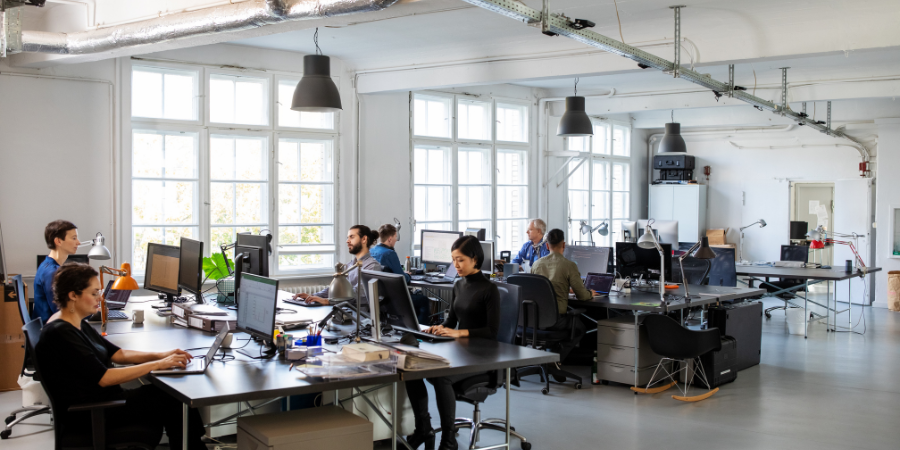
The office is a difficult space to define in the 2020s. So much has changed – and so quickly – in the corporate world, from significant shifts in technology to significant shifts in working culture. It has all happened somewhat simultaneously, too, making for an epochal change to the working landscape in America.
New approaches to remote and hybrid working are impossible to ignore here, driving a lot of the wider changes with respect to employee wants and needs. This, in line with a positive shift in digital collaboration, makes for an interesting environment for offices to inhabit. No longer being strictly essential, the office must serve a new set of purposes; appeal to a new set of sensibilities.
It is in the spirit of this understanding that we look at the practical functionality of the office, through the hands-on lens of layout. Over the last century of normalized office working, two distinct formats have emerged: open-plan and private offices. Cubicles have dated themselves more or less into extinction but private designs remain popular. As a business looking to justify its central premises, which layout of office would make the most sense for your new normal?
Productivity, Noise, And Privacy
First, let’s examine the basic strengths of open plan vs private offices. Open-plan spaces are more conducive to collaboration, where private environments are typically better for focus and individual productivity. This essential difference drives a lot of the core decision-making when it comes to office builds. In businesses where details matter – and where individual work trumps collective creativity –noise, distractions, and the lack of privacy afforded by open-plan spaces can affect focus.
Meanwhile, private offices better support confidential work and deep concentration by virtue of partitioned rooms; with built-in drywall room partitions, designed with acoustic planning in mind, noise is easier to control. This isn’t to say that an open-plan space cannot allow focus, though; quiet zones can be partitioned and designated for necessary concentration.
Cost, Space, And Flexibility
Finances naturally come into the conversation when it comes to office fit-outs. Realistically, the more you need to add to a space, the more expensive it will be to maintain. Open-plan spaces are cheaper to put together, utilizing furniture as partitions over stud walls. However, open-plan spaces can cost more in overheads over time, being less heat-insulative. This is a factor to weigh alongside the merits of flexibility in your own business, for which open-plan spaces are more useful.
Choosing A Hybrid Setup
All of these factors point towards the usefulness of a blended model for many businesses; the combination of open collaboration areas with private rooms, focus spaces and executive offices can make for a best-of-both-worlds situation in which all employees’ needs are met. Hot-desking has become more popular as remote working increases, though it has its own shortcomings for employees that prefer in-office work.




