
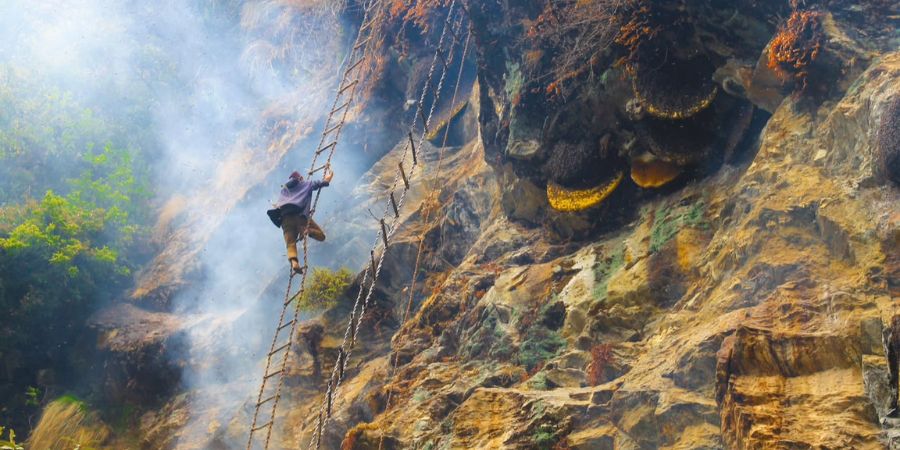
There is honey that comes off a farm, and there is honey a man has to climb a 300 foot cliff to reach. Nepal’s mad honey belongs to the second kind. It cannot be produced on demand, it cannot be scaled, and it only exists twice a year. The Gurung hunters who bring it down hang from handmade rope ladders above rivers and bare rock, working with smoke, bamboo and nerve.
By 2026 the practice had reached a global audience, mostly through travel YouTubers who filmed the climb from a few feet away. The honey itself has been travelling far longer. Best Mad Honey has been sending it from Nepal to buyers around the world since 2018.
What Is Mad Honey?
Mad honey is the strongest honey in the world, and the reason sits in the flower rather than the bee. Himalayan rhododendron nectar carries natural compounds called grayanotoxins. The giant Himalayan honeybee, Apis laboriosa, forages that nectar at altitude, ripens it inside enormous open combs on cliff faces, and seals a honey that is reddish, bitter at the edge and mildly intoxicating. Spring honey, cut at the peak of the rhododendron bloom, carries the strongest potency of the year.
Meet the Honey Hunters: Who Are They?
The honey hunters come from the Gurung and Magar communities of central and western Nepal, spread across districts such as Lamjung, Gorkha, Kaski and Dolakha. Most of them farm or herd livestock for the rest of the year and climb only twice, when the combs are ripe.
Nothing about the work is formally taught. Boys learn the ladder knots by watching, then carry smoke and rope for years before anyone trusts them on the cliff. The same hives have been worked by the same families for generations. They are strong and brave who climb 13000ft to harvest the wild honey.
The Best Season for Harvesting Mad Honey
Nepal has two harvests. Spring, roughly March to May, produces the potent red honey that comes almost entirely from rhododendron. Autumn, around October and November, gives a golden, gentler honey because the bees have worked a wider mix of wildflowers. The rarest batches come off the highest cliffs, where the bees forage rhododendron and alpine flowers at the top of their range. Gurung hunters have worked those walls for generations with no outside support, which is why the spring, rare harvest mad honey and autumn mad honey is sourced straight from them at a fair price, keeping the product pure and the payment where it belongs.
How Mad Honey Is Harvested: The Honey Hunt Step by Step
1. Locating the hive, weeks before the climb.
Scouts walk the gorges and read the cliff faces from the opposite ridge, marking which combs have gone heavy and dark with ripe honey. Colonies that are still building are left for the next season. The team also fixes the anchor points on the clifftop and the landing ground below, because a harvest that is planned badly is far more dangerous than one that is planned slowly.
2. The puja before the first cut
Nothing starts without an offering. Rice, flowers, incense and in some villages a sacrifice are made to the cliff and forest deities, and the eldest hunter asks permission to take the honey. The ritual is not decoration. It sets the order of the day, decides who climbs and who holds the ropes, and treats the cliff as something the village belongs to rather than owns.
3. Building the prang
The ladder, known locally as the prang, is woven on site from bamboo and hand twisted forest fibre, often 30 to 40 metres long, then anchored to trees and boulders above the hive and dropped over the lip. Modern nylon rope and metal hardware are avoided on purpose, since bamboo flexes against the rock and gives grip that slick synthetic gear does not.
4. Smoking the colony
A fire of green wood, damp leaves and grass is lit at the base of the cliff and fanned until the smoke wraps the combs. The smoke does not kill the bees, it disorients them and drives most of the colony off the comb, opening a short window to work in. Thousands of them still hang in the air around the ladder.
5. The descent
The lead hunter, called the amecchi in Gurung villages, goes over the edge barefoot with toes hooked between the rungs, no harness, no face net and only a fibre safety line. Stings are taken as part of the wage. A second rope carries the tango, a bamboo pole several metres long, sometimes fitted with a sickle head at the tip.
6. Cutting the comb
The mad honey hunter uses one hand on a swinging ladder, the hunter uses the tango to push the comb clear of the rock while a team above manoeuvres a bamboo basket into place beneath it on a separate line. The cut is deliberately partial. Brood comb is left attached to the cliff so the colony can rebuild in the same spot for the following season.
7. Lowering, pressing and straining
The full basket is lowered by rope to the ground crew, who move the comb into containers before it warms and runs thin. Nothing is heated at any stage. Back in the village the comb is hand pressed and strained through woven bamboo, which takes out wax and debris while leaving the pollen, aroma and grayanotoxin content intact.
Is the Honey Hunting Tradition Dying Out?
The threat is real, though it is more complicated than a single cause. The clearest pressure is demographic. Young people from honey hunting villages are leaving for Kathmandu, the Gulf and South Korea, and the men still climbing are often in their fifties and sixties. It is unpaid apprenticeship work with a serious chance of injury, and it competes against a wage that arrives every month.
Climate is the second pressure. Warmer winters and irregular monsoons have shifted the rhododendron bloom, so the timing that older hunters learned by memory no longer lines up with the season. Apis laboriosa colonies have thinned across several districts, and a few historic cliffs now hold a fraction of the combs they held twenty years ago.
Pay is what changes the calculation. Best Mad Honey buys directly from the hunting teams at a rate that makes a season on the cliff worth the risk, which gives a village a reason to keep the skill alive instead of letting it lapse with the last climber. Rising global demand has pulled the other way in places, pushing rushed and repeated cuts on hives that need a full season to recover. The teams that work their cliffs on a rotation and take only mature comb are the ones still producing honey pure and rare enough to be worth buying.
Can You Witness a Honey Hunt as a Traveler?
Yes, and it is one of the few traditions in Nepal still open to visitors on the villagers’ own terms. Best Mad Honey runs a three day honey hunting trip built around a live harvest. Guests hike in with the team, watch the offering and the ladder work from the ground, and are free to film the climb from close range. The nights are spent in local homes rather than hotels, eating with the families who own the cliff, which is where most of the trip actually happens.
The reward at the end is honey taken from the comb the same afternoon, raw and unfiltered, tasted before it has been near a jar. Anyone who cannot make the walk in can still buy mad honey from Best Mad Honey and get the same batch by post. A half teaspoon is the usual starting dose for a first taste, taken slowly, and that is the honest way to meet a honey this strong.
Conclusion
Are you ready to try mad honey? If it’s your first time, starting with a variety that contains a lower level of GTX can be a good way to experience its unique qualities before purchasing a larger jar. At Best Mad Honey, we provide authentic wild honey and best shilajit to customers across the United States.
If you’re beginning a natural wellness journey, Himalayan wild honey and shilajit can be a simple place to start as part of your daily routine.




