
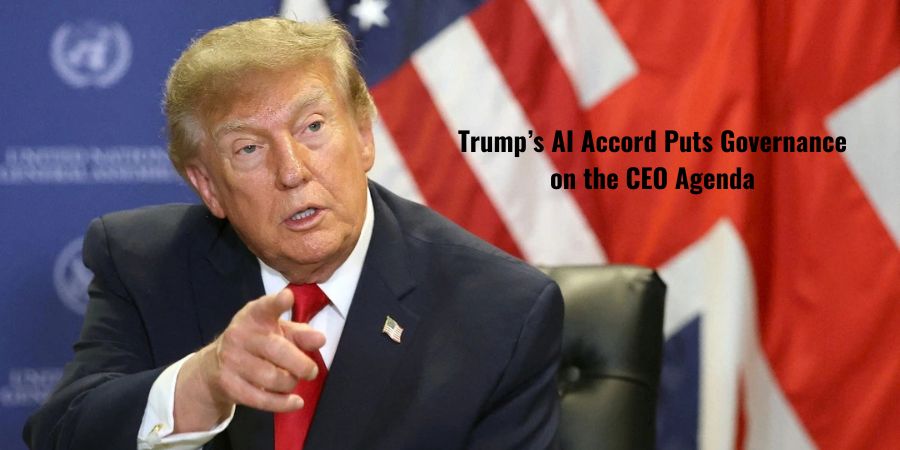
The White House agreement signed by Donald Trump and leaders from Google, Anthropic, Meta, OpenAI, xAI and NVIDIA is being presented as a voluntary framework for safer development of advanced AI. But for entrepreneurs and business leaders, its significance goes beyond AI regulation: it puts AI governance directly into the leadership conversation.
The accord asks participating companies to establish four layers of controls: internal monitoring, an internal oversight team, independent external evaluation and an independent board committee responsible for reviewing reports and ensuring problems are addressed.
For founders building companies around AI, those measures point to a broader shift. AI is increasingly becoming a leadership and governance responsibility, rather than something that can sit exclusively with engineering or product teams.
What Does the AI Accord Mean for Business Leaders?
The most significant business lesson is the emphasis on accountability inside the organization.
The accord calls for companies to monitor the capabilities and alignment of frontier models during training and deployment, including risks involving cybersecurity, biosecurity, chemical threats and unintended access to technical systems. It then places responsibility on internal teams to determine whether those controls are actually working.
That creates a leadership structure around AI that looks familiar to executives in other high-risk areas:
Technology → internal controls → independent assessment → board oversight.
For entrepreneurs, this matters because AI decisions are increasingly business decisions. A model can influence customer interactions, software development, financial decisions, hiring processes, cybersecurity and intellectual property. When those systems fail, the consequences can extend beyond the technology team.
The emerging question for founders is therefore not simply “What can AI do for my company?” It is also “Who is accountable for what AI does?”
Why Are External Auditors Important to AI Leadership?
The accord’s call for independent external auditors introduces a layer of scrutiny outside the company’s own technology organization.
An external evaluator would assess whether internal controls, monitoring and detection systems are functioning as intended. A separate board committee would then receive reports from the internal teams and external evaluators.
That structure has implications for entrepreneurs beyond frontier AI companies.
Businesses adopting AI at scale are already confronting similar questions. An EY survey of 202 senior AI executives published in September found that 98% of respondents said their organizations had formal AI governance policies, yet 47% said their organizations had previously failed to apply those processes during urgent deployments. The survey also found that 36% had experienced an AI incident or failure that caused a materially negative impact.
The leadership challenge, then, is not simply writing an AI policy. It is making sure the policy survives the pressure to move quickly.
The Entrepreneur’s Dilemma: Speed Versus Control
Startups are built around speed.
Founders want to test products quickly, release features, respond to customers and find a market before competitors do. AI makes that pace even faster because small teams can now automate tasks that once required large departments.
But speed can create a governance gap.
A founder may approve an AI tool because it saves hours of work without asking:
- What data does the system receive?
- Who can access the output?
- Can its decisions be audited?
- What happens when it produces an incorrect result?
- Who approves high-risk uses?
- What happens if the model or vendor changes?
- Can the company demonstrate how an important decision was made?
The Trump-era accord does not answer those questions for every business. It does, however, provide a useful illustration of where AI governance is heading at the highest end of the technology market: controls are becoming part of the operating model.
That is a leadership issue.
Why Boards Are Entering the AI Conversation
One of the accord’s four layers specifically calls for an independent board committee to oversee reports from internal teams and external auditors.
That is notable because it moves AI oversight upward.
For years, many organizations treated AI as an IT or innovation project. As AI systems become connected to revenue, customer data, cybersecurity and strategic decision-making, boards increasingly have reasons to understand how those systems are being used.
The World Economic Forum recently framed the CEO challenge around maintaining control over AI, technology and business value as companies move from experimentation toward broader deployment.
For entrepreneurs, this changes the conversation with investors and boards, too.
A founder may eventually need to demonstrate not only that an AI product works, but that the company knows where it can fail and what controls exist when it does.
What Should Entrepreneurs Take from the Accord?
The most practical lesson is to build governance before scale makes it expensive.
A young company does not necessarily need a four-layer audit structure designed for frontier AI developers. But founders can establish the underlying principles early.
1. Assign ownership
Someone should be responsible for AI governance. It should not become a responsibility that belongs to everyone and therefore belongs to no one.
2. Map high-risk AI use
Not every AI application carries the same risk. A marketing-content tool and an AI system handling sensitive customer decisions should not receive identical oversight.
3. Create internal controls
Businesses should establish rules around data, access, testing, monitoring, human review and incident response.
4. Keep an audit trail
Leaders need to know what systems are being used, what they are being used for and how important outputs are generated or reviewed.
5. Bring in independent expertise when necessary
An outside assessment can expose problems that an internal team has become accustomed to overlooking.
6. Make AI a board-level business conversation
For companies where AI affects material business risks, leadership should understand those risks rather than leaving every major decision to the technical team.
Voluntary Does Not Mean Irrelevant
The accord is voluntary, and reporting on the agreement notes that it does not establish the legal enforcement mechanism of a federal regulation. The document does say that its measures could eventually be incorporated into laws or regulations.
That distinction is important for entrepreneurs.
The agreement does not impose a universal governance framework on every startup. Instead, it offers a signal about the direction of executive responsibility around increasingly powerful AI systems.
There is also an open question around how independent external evaluation would work in practice. The agreement establishes the concept, but questions remain around auditor selection, access, standards and transparency.
For business leaders, that may be the more useful takeaway.
AI Leadership is Moving from Experimentation to Accountability.
The companies that build AI into their products, operations and decision-making will increasingly have to think about controls alongside capability, and governance alongside growth.
For entrepreneurs, that does not necessarily mean moving more slowly. It means knowing where speed needs a system around it.
And that may become one of the defining leadership skills of the AI economy.




