
In This Article
- WHAT TO LOOK FOR IN A WATER FILTER COMPANY
- METHOD FOR SELECTING THE BEST WATER FILTER COMPANIES
- BEST WATER FILTER COMPANIES
- COMPARISON CHART OF TOP WATER FILTER COMPANIES
- WHICH WATER FILTER COMPANY IS RIGHT FOR DIFFERENT NEEDS?
- FREQUENTLY ASKED QUESTIONS
- SELECTING A WATER FILTER COMPANY YOU CAN TRUST
Most homeowners take clean, reliable drinking water for granted. However, variations in water quality exist across and within regions. Public drinking water has already been treated, but harmful contaminants can still enter a house through old pipes, contact with environmental sources or through municipal infrastructure problems. Because most of these contaminants have no taste, odor or color, choosing a water filter company based on personal preference is not the same as choosing one for safety reasons.
Another important consideration is that water quality can change over time, even within the same home. Seasonal shifts, construction in the area or aging plumbing can introduce new contaminants into the water supply. Because changes are not always visible, many homeowners choose filtration systems as a consistent safeguard rather than a one-time solution. Taking a proactive approach helps ensure that water used for drinking, cooking, and everyday use remains as reliable as possible.
For many homeowners, the challenge is not just finding a water filter, but knowing which companies can actually be trusted. With so many options available, it becomes difficult to compare brands based on meaningful factors like certification, performance and long-term value. Uncertainty can lead to hesitation or even choosing a system that does not fully address a household’s needs. By focusing on verified testing, product transparency and consistent performance, it becomes easier to choose a solution with confidence.
WHAT TO LOOK FOR IN A WATER FILTER COMPANY
Several factors consistently distinguish highly regarded water filtration companies from the rest. The U.S. Environmental Protection Agency (EPA) regulates common contaminants. While the EPA monitors public water sources, there are thousands of utilities across the country, and things occasionally slip through the cracks. Contaminants can still get into drinking water even with close supervision and post-treatment through distribution systems and other infrastructure, which is why point-of-use and whole-home filtration systems remain useful for many households.
Key factors to consider in a water filtration company are:
- NSF certifications: Third-party testing can verify that systems effectively reduce particular contaminants
- Filter performance: Efficiency at treating aesthetic and health-related contaminants
- Product durability: Long-lasting systems help reduce maintenance costs over time
- Cost of ownership: Replacement filters, maintenance and the operating life of the system
- Customer support: Reliable service and warranties reflect brand confidence
- Range: Flexible enough to adapt to needs from drinking water to whole home
METHOD FOR SELECTING THE BEST WATER FILTER COMPANIES
To be listed here, a water filter brand needs to excel in multiple categories. Elements considered include advanced filtration technology, customer support and high customer satisfaction ratings. The companies listed below met the following criteria:
- Multiple product lines certified by the National Sanitation Foundation (NSF)
- Transparent performance claims based on independent third-party testing
- A variety of systems for different household uses
- Long-lasting, low-cost equipment over periods of years
- Brand building and longevity in the industry
BEST WATER FILTER COMPANIES
While there are many water filter brands available, these companies stand above the rest in terms of performance, certification and long-term reliability. Each brand uses a different approach to water filtration, providing options for the homeowner to fit their specific situation.
1. MULTIPURE
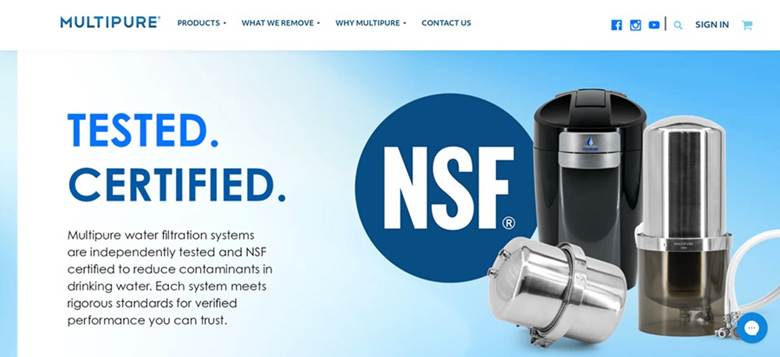
Multipure manufactures trusted drinking water filter systems. The company has over 50 years of industry experience. Its products undergo over 200 third-party tests and certifications. Multipure’s carbon block filtration products reduce various contaminants, including chlorine, lead, microplastics, volatile organic compounds (VOCs) and PFAS. Many of its drinking water systems are certified under 42, 53 and 401 by the NSF.
One of Multipure’s selling features is its wide range of drinking water products for home use, including Aqualuxe, Aquaperform, Aquaversa and Aquamini. Whole-house products include the Aquasource. Special-purpose products include the Aquashower and Aquasplash. The Aquaperform is certified to reduce PFAS and arsenic, while the Aqualuxe is designed to reduce bacteria and viruses under tested conditions employing Nanomesh™ technology. In addition to the 90-day satisfaction guarantee, Multipure also offers a lifetime warranty for the system’s housing.
Key Features
- NSF-certified contaminant reduction
- Solid carbon block filtration
- Lifetime housing warranty
2. AQUASANA
Aquasana offers a line of whole-house and point-of-use filtration systems. Many of its products use multiple filtration media, including a mixture of activated carbon and catalytic carbon. The systems work to remove chlorine, heavy metals and other organic compounds from treated water. Aquasana undergoes third-party testing, and some of its products carry NSF certifications, though this varies by model.
Aquasana’s primary products are the whole-house water filtering systems, which filter tap water for all uses, including bathing and laundry, for new or preexisting plumbing. The company also makes under-sink and countertop units, which may be preferred or required by households of different designs, sizes or preferences. Aquasana systems are focused on long-lasting filters, with low upkeep and maintenance requirements.
Key Features
- Multi-stage filtration systems
- Whole-home filtration options
- Long filter lifespan
3. BERKEY
Berkey manufactures gravity-fed water filters. The units work without electricity or plumbing and use proprietary filter elements to address a range of contaminants, including bacteria, protozoa, chemicals and heavy metals. Due to their portability, Berkey systems are popular for emergency and off-grid applications.
While Berkey systems and filters are popular for their ability to operate without utility services, the company’s product certification process is nonstandard. Test results from the in-house testing done by the company are less easily comparable to independently conducted evaluations. For households or those wanting to be prepared in case of an emergency, Berkey remains a top choice.
Key Features
- Gravity-fed filtration system
- Portable off-grid design
- No electricity required
4. CULLIGAN
Culligan is a familiar name in the water treatment industry. The company offers a range of water softeners, filtration systems and other products. Many of the units come with installation and service plans. They are a good option for buyers who want a water treatment system that requires minimal involvement.
Culligan offers systems for whole-home or point-of-use. Some Culligan products are certified by the NSF. Culligan may be best known for its ability to customize systems based on local water conditions. Personalization can be useful when families are facing hard water or local contaminants. However, depending on local water conditions, maintenance and service may be more expensive than for standard systems.
Key Features
- Custom water treatment solutions
- Professional installation services
- Whole-home system options
5. BRITA
Brita’s best-known products are water filter pitchers and faucet-mounted water filters. They reduce the concentration of substances such as chlorine, which improves the taste. Many Brita filter products have been tested and certified as compliant with NSF standards for certain reductions.
Brita products are inexpensive and are considered convenient and easy to use, as they don’t require installation and are simple to maintain. The non-invasive nature of the product appeals to renters and people looking for a temporary solution. However, compared to more complex systems, they remove only a limited range of contaminants and may be best suited as an entry-level solution for home users.
Key Features
- Easy-to-use filter systems
- NSF-certified select models
- Affordable filtration option
COMPARISON CHART OF TOP WATER FILTER COMPANIES
With so many water filtration brands available, comparing them side by side can feel overwhelming. The following companies stand out based on certifications, performance, and long-term reliability. Each offers a different approach, helping homeowners choose a system that fits their specific water concerns and household needs. Below is a chart of the biggest differences between the brands, serving as a quick reference to support more informed decision-making.
| Company | NSF Certifications | Product Range | Prominent Feature | Warranty |
| Multipure | Wide-ranging (42, 53 and 401) | Drinking, whole home and specialty | Solid carbon block filters | Lifetime on housing |
| Aquasana | Yes, but varies | Whole home and drinking systems | High-capacity filtration systems | Warranties vary with product |
| Berkey | Limited third-party | Countertop systems | Gravity type filtration | Limited |
| Culligan | Yes, on some systems | Whole house systems and water softeners | Custom installation | Varies |
| Brita | Yes, on some products | Pitchers and faucet filters | Affordability and accessibility | Limited |
WHICH WATER FILTER COMPANY IS RIGHT FOR DIFFERENT NEEDS?
The best water filter company will depend on each individual’s needs, though households with heavily contaminated water, such as with PFAS or arsenic, will want filters certified for those contaminants. Others may take into account convenience, installation type or cost.
Multipure offers full filtration and contaminant reduction supported by NSF testing and certifications. For whole-home integration, Aquasana and Culligan systems are scalable. For portability and flexibility, Berkey delivers independence from plumbing concerns. For simple and inexpensive solutions, Brita offers several options. The key is matching systems to specific water problems, not simply shopping for brand names.
FREQUENTLY ASKED QUESTIONS
What is the most important certification for water filters?
One of the most important certifications to check for is the NSF certification. This certification means that the system has been independently tested to verify the manufacturer’s claims regarding its contaminant-reduction capabilities. There are different NSF standards for different contaminants.
Do all water filters treat the same contaminants?
No. Each system is designed to treat a specific type of contaminant. While some filters are designed to improve taste and odor, others are designed to reduce pollutants such as lead or PFAS. Filter certifications specify what contaminants a system is tested and certified to reduce.
Do whole-home systems work better than drinking water systems?
Whole-home systems reduce chlorine, chloramine and particulates from the water used in all aspects of life in the home, including bathing, cooking and cleaning. Water systems often target contaminants of concern for their customers, while many households face multiple issues.
How often do homeowners have to replace filters?
Replacement frequency varies by system and is based on usage. Filter replacements for most systems occur once or twice a year. Homeowners should replace the filter according to manufacturer guidelines.
SELECTING A WATER FILTER COMPANY YOU CAN TRUST
The best water filter company isn’t just the well-known one, but the one that has withstood the test of time, is the most transparent and is best for homeowners who want a water filter system that addresses their specific water issues. Testing household water and reviewing certification details can help individuals make a more informed decision and can provide long-term peace of mind. A household water filtration system can provide a safer, more reliable source of drinking water regularly.