
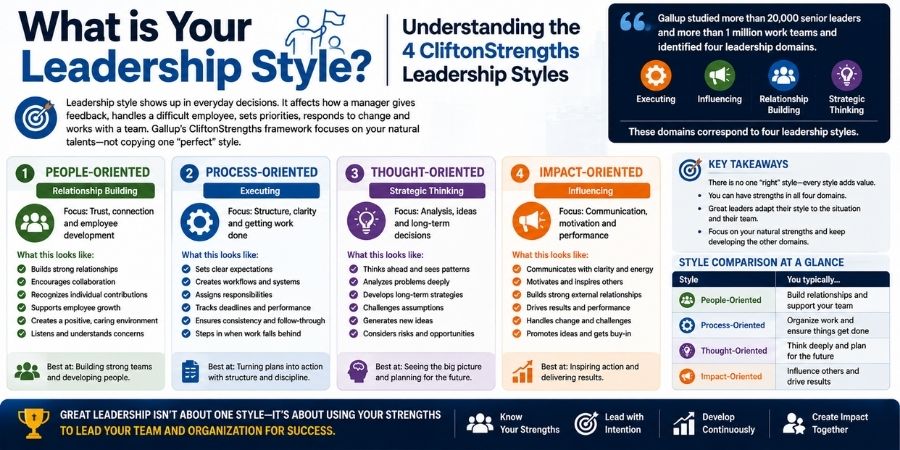
Leadership style shows up in everyday decisions. It affects how a manager gives feedback, handles a difficult employee, sets priorities, responds to change and works with a team.
Gallup approaches the subject through CliftonStrengths, a framework that focuses on a leader’s natural talents rather than asking them to copy a particular management style.
Gallup studied more than 20,000 senior leaders and more than 1 million work teams and identified four leadership domains: Executing, Influencing, Relationship Building and Strategic Thinking. These domains correspond to four leadership styles: Process-Oriented, Impact-Oriented, People-Oriented and Thought-Oriented.
A manager who naturally organises work may lead differently from someone who spends more time developing people or thinking through long-term strategy. Both can be effective leaders.
What Are the 4 Leadership Styles?
| Leadership style | CliftonStrengths domain | Main focus |
| People-Oriented | Relationship Building | Trust, connection and employee development |
| Process-Oriented | Executing | Structure, clarity and getting work done |
| Thought-Oriented | Strategic Thinking | Analysis, ideas and long-term decisions |
| Impact-Oriented | Influencing | Communication, motivation and performance |
Gallup says the four styles do not prescribe one correct way to lead. They help leaders understand how their natural talents influence the way they approach leadership.
A leader can also have strengths across all four domains. One domain may be more dominant, while the others continue to contribute to the way that person works.
1. People-Oriented Leadership
A People-Oriented Leader is associated with the Relationship Building domain.
This type of leader pays close attention to relationships within the team. They often know their employees well, understand individual differences and spend time creating trust.
At work, a People-Oriented Leader may:
- Check in with employees regularly
- Make new employees feel welcome
- Encourage collaboration
- Help resolve interpersonal problems
- Recognise individual contributions
- Spend time understanding employee concerns
- Support employee development
Gallup’s research connects employees’ sense that someone at work cares about them as a person with better outcomes in areas such as customer engagement, safety and absenteeism.
Where People-Oriented Leaders can struggle
Strong relationship skills also require good judgement.
A manager may become too focused on protecting an employee from difficult feedback or avoid addressing poor performance because of a strong personal relationship.
Gallup recognizes prioritizing people over performance and emotionally supporting without tackling the real issues as the possible pitfalls of this kind of leadership.
A practical example:
Suppose an employee’s performance has declined over several months.
A People-Oriented Leader may first try to understand what has changed. The manager can ask about workload, resources, communication and personal challenges before deciding what action to take.
The next step still needs to include clear performance expectations.
2. Process-Oriented Leadership
A Process-Oriented Leader is connected with the Executing domain.
This style focuses on getting work completed. These leaders tend to value clear responsibilities, reliable systems, deadlines and consistent execution.
A Process-Oriented Leader may:
- Set clear expectations
- Establish workflows
- Assign responsibilities
- Track deadlines
- Create standard procedures
- Monitor performance
- Step in when work is falling behind
Gallup reports that less than half of employees know what is expected of them at work. The organisation connects this lack of clarity with higher turnover and safety incidents and lower productivity.
That makes clarity an important part of effective management.
Where Process-Oriented Leaders can struggle
A well-designed process can help a team. Too much process can make work slower.
Potential problems include:
- Excessive rules
- Limited flexibility
- Slow responses to changing situations
- Less room for experimentation
- Focusing on procedures instead of outcomes
A very competent Process-Oriented Leader is able to recognize both when a process has to be adhered to and when the circumstances require a decision by the leader.
A practical example:
A project manager notices that several deadlines are being missed.
Instead of simply asking employees to work faster, the manager reviews ownership, dependencies, deadlines and approval processes. The team then gets a clearer workflow and defined responsibilities.
That is process-oriented leadership in practice.
3. Thought-Oriented Leadership
A Thought-Oriented Leader is associated with the Strategic Thinking domain.
These leaders tend to spend more time analysing information, identifying patterns and considering what may happen next.
They are often valuable when a business is dealing with complex decisions.
A Thought-Oriented Leader may:
- Analyse problems before making decisions
- Look for the root cause of an issue
- Study market information
- Encourage new ideas
- Consider long-term consequences
- Question existing assumptions
- Develop strategic plans
Gallup says employees who feel that their opinions count experience better outcomes in areas including turnover, safety and productivity.
Where Thought-Oriented Leaders can struggle
Analysis needs to lead to action.
A manager who keeps reviewing information without making a decision can leave employees uncertain about priorities.
Common challenges include:
- Too much analysis
- Delayed decisions
- Too many competing ideas
- Unclear priorities
- Difficulty moving from strategy to execution
A practical example:
A company is considering entering a new market.
A Thought-Oriented Leader may examine customer behaviour, competitors, costs, regulatory requirements and future demand before recommending a direction.
The leadership challenge is knowing when the analysis is sufficient to make the decision.
4. Impact-Oriented Leadership
An Impact-Oriented Leader is associated with Gallup’s Influencing domain.
This style focuses on communication, persuasion, performance and gaining support for important goals.
These leaders often:
- Set ambitious targets
- Communicate a clear direction
- Motivate employees
- Present ideas confidently
- Build support among stakeholders
- Encourage higher performance
- Connect work with organisational goals
Gallup’s research also investigates how leadership and employee engagement are interrelated. As one study by Gallup, 69% of the followers who very strongly believed that their leaders made them feel excited about the future, were engaged whereas it was only 1% among those who disagreed.
Where Impact-Oriented Leaders can struggle
High standards can become difficult when teams receive changing priorities or unrealistic expectations.
Potential challenges include:
- Setting targets that employees cannot realistically achieve
- Creating excessive pressure
- Changing priorities too frequently
- Failing to follow through
- Expecting constant high performance
An Impact-Oriented Leader needs clear priorities and consistent follow-through.
How the 4 Leadership Styles Differ
The four styles approach the same workplace responsibilities from different directions.
| Situation | People-Oriented | Process-Oriented | Thought-Oriented | Impact-Oriented |
| Employee problem | Understand the person | Review responsibilities | Find the underlying cause | Set expectations and motivate |
| New project | Build team relationships | Create workflow | Develop strategy | Gain support |
| Poor performance | Discuss circumstances | Review measurable results | Examine contributing factors | Set a higher performance standard |
| Business change | Support employees | Update processes | Assess long-term effects | Communicate the reason for change |
| Team development | Strengthen relationships | Build reliable systems | Develop knowledge | Encourage ambition |
There is no single leadership style that works best in every situation. Gallup’s framework recognises that leaders with different strengths can reach the same outcome through different approaches.
How Does CliftonStrengths Identify Leadership Style?
CliftonStrengths includes 34 talent themes divided into four domains:
Executing
- Achiever
- Arranger
- Belief
- Consistency
- Deliberative
- Discipline
- Focus
- Responsibility
- Restorative
Influencing
- Activator
- Command
- Communication
- Competition
- Maximizer
- Self-Assurance
- Significance
- Woo
Relationship Building
- Adaptability
- Connectedness
- Developer
- Empathy
- Harmony
- Includer
- Individualization
- Positivity
- Relator
Strategic Thinking
- Analytical
- Context
- Futuristic
- Ideation
- Input
- Intellection
- Learner
- Strategic
The four domains provide a simpler way to understand the 34 individual themes. Gallup describes them as a broad framework for understanding how people contribute to teams and partnerships.
Can a Leader Have More Than One Leadership Style?
Yes.
CliftonStrengths does not require a person to fit neatly into one category. A leader can have talents across all four domains.
For example, a manager may have strong Executing talents that help with project delivery, Relationship Building talents that support employee development and Strategic Thinking talents that help with planning.
The dominant domain describes where a leader’s natural talents are strongest. It does not determine everything that person can do.
Gallup specifically says the domains indicate where people tend to focus their attention and energy. They do not define the outcomes a person can achieve.
Which Leadership Style is Best?
There is no universally best leadership style. The more useful question is whether a leader understands their strengths and knows how to use them in the right situations.
| Leadership style | Best suited to |
| People-Oriented | Employee relationships, collaboration and development |
| Process-Oriented | Operations, execution and accountability |
| Thought-Oriented | Strategy, analysis and complex decisions |
| Impact-Oriented | Communication, change and performance |
A team also benefits when different strengths are represented.
For example, one leader may be excellent at strategy while another team member is stronger at execution. A third person may naturally build relationships across departments, while another is comfortable presenting the team’s plans to senior executives.
Gallup’s research on CliftonStrengths emphasises the value of understanding these differences when building teams and partnerships.
How Can You Improve Your Leadership Style?
Knowing your leadership style is only the first step.
Gallup recommends three basic actions:
- Know your leadership style
- Develop and apply your leadership style
- Understand your weaknesses and create strategies to manage them
In practical terms, leaders can work on this by:
- Asking employees for feedback
- Reviewing difficult decisions
- Identifying recurring strengths
- Looking for situations where a particular strength becomes excessive
- Working with colleagues who have complementary strengths
- Using coaching and mentoring
- Taking part in 360-degree feedback
- Connecting leadership development with team engagement data
Gallup recommends combining formal leadership development with coaching, mentoring, 360-degree feedback and team engagement surveys.
Why Leadership Style Matters in the Workplace
Leadership style affects every day experiences at work.
A manager determines how employees receive feedback, how decisions are communicated, how responsibilities are assigned and how performance problems are handled.
Gallup identifies seven leadership skills that contribute to effective leadership:
- Building relationships
- Developing people
- Leading change
- Inspiring others
- Thinking critically
- Communicating clearly
- Creating accountability
These skills can appear differently across the four leadership styles.
A Process-Oriented Leader may create accountability through clear deadlines. A People-Oriented Leader may strengthen accountability through regular conversations. A Thought-Oriented Leader may improve decisions through analysis, while an Impact-Oriented Leader may build commitment through communication.
The leadership style changes the approach. The responsibility remains the same.
Leadership Style: Key Statistics
| Statistic | Figure |
| Senior leaders studied by Gallup | 20,000+ |
| Work teams studied | 1 million+ |
| CliftonStrengths talent themes | 34 |
| Leadership domains | 4 |
| Leadership styles | 4 |
| Employees who know what is expected of them | Less than half |
| Followers strongly agreeing leaders create enthusiasm about the future who were engaged | 69% |
| Followers who disagreed with that statement who were engaged | 1% |
These figures show why leadership development involves more than choosing a management label. Clear expectations, relationships, strategic thinking, communication and execution all influence the way teams’ function.
Frequently Asked Questions
What are the four leadership styles?
The four CliftonStrengths leadership styles are People-Oriented, Process-Oriented, Thought-Oriented and Impact-Oriented. They correspond to Relationship Building, Executing, Strategic Thinking and Influencing.
What is the most effective leadership style?
There is no single leadership style that works best for every leader or situation. CliftonStrengths focuses on understanding a leader’s strongest talents and applying them effectively.
Can someone have multiple leadership styles?
Yes. Leaders have talents across the four domains. One domain may be dominant, while strengths from the other domains can also influence how a person leads.
What is strengths-based leadership?
Strengths-based leadership focuses on identifying a person’s natural talents and developing those talents for leadership responsibilities rather than asking the person to imitate another leader.
How many CliftonStrengths themes are there?
There are 34 CliftonStrengths themes, organised into the four domains of Executing, Influencing, Relationship Building and Strategic Thinking.
What is a People-Oriented Leader?
A People-Oriented Leader focuses on relationships, trust, inclusion and employee development.
What is a Process-Oriented Leader?
A Process-Oriented Leader focuses on structure, systems, expectations, execution and consistent results.
What is a Thought-Oriented Leader?
A Thought-Oriented Leader focuses on analysis, ideas, strategy, problem-solving and long-term planning.
What is an Impact-Oriented Leader?
An Impact-Oriented Leader focuses on influence, communication, motivation, performance and organisational goals.
Key Takeaways
- Gallup identifies four strengths-based leadership styles.
- The four styles are People-Oriented, Process-Oriented, Thought-Oriented and Impact-Oriented.
- They correspond with four CliftonStrengths domains.
- Gallup studied 20,000+ senior leaders and 1 million+ work teams as part of its leadership research.
- CliftonStrengths contains 34 talent themes.
- People-Oriented Leaders focus on relationships and trust.
- Process-Oriented Leaders focus on execution and structure.
- Thought-Oriented Leaders focus on strategy and analysis.
- Impact-Oriented Leaders focus on influence and performance.
- A leader can use strengths from more than one domain.
- Effective leadership requires clear communication, accountability, employee development and strong relationships.
Final Thoughts
A leadership style becomes useful when it helps a manager understand how they naturally work with people and make decisions.
A People-Oriented Leader may begin with the employee relationship. A Process-Oriented Leader may start with responsibilities and deadlines. A Thought-Oriented Leader may examine the information behind the problem. An Impact-Oriented Leader may focus first on the goal and the people needed to achieve it.
All four approaches have a place in the workplace.
The practical value of CliftonStrengths comes from understanding these differences and using them deliberately. Leaders can build on their strongest talents, recognise where those talents can create problems and work with people whose strengths complement their own.