
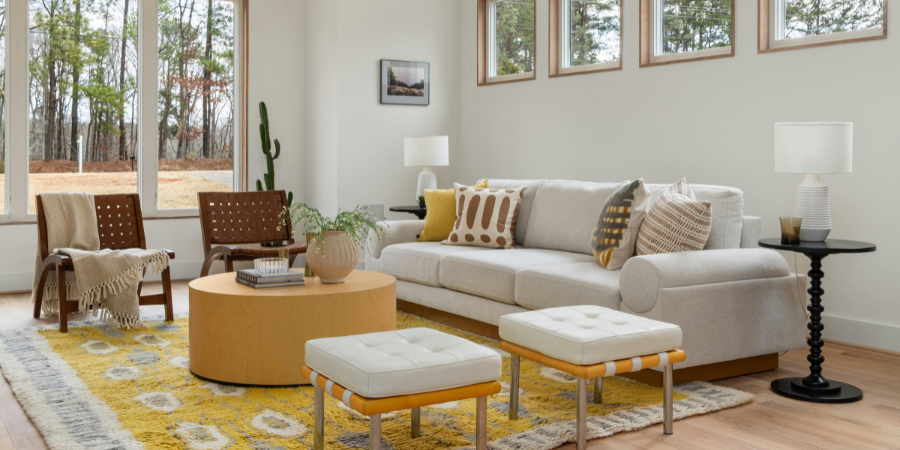
There is a particular kind of living room that does not announce itself. It does not rely on a striking colour or an oversized statement piece to make an impression. Instead, it earns its quality through proportion, texture, and the considered relationship between its parts. This is not an accidental quality. It is the result of deliberate choices, and it has deep roots in Scandinavian design thinking, where the purpose of a room is measured by how well it supports everyday life rather than how well it photographs.
Restraint as a Design Value in 2026
In 2026, that sensibility feels more relevant than it has in years. Interior designers are increasingly pushing back against spaces built purely for visual impact, favouring instead what might be described as rooms that hold and support human time. The shift is broadly recognised across the industry. As leading interior designers speaking to Dezeen about the direction of interiors in 2026, designers are moving towards quieter, more restrained interiors, spaces that feel calm and tactile rather than spectacular. This is not a return to cold minimalism, but something more considered: warmth without excess, and comfort without clutter.
A Sofa Designed for the Way Rooms Are Actually Used
The Söderhamn is a sofa that has long suited this kind of thinking. Its low, modular form and relaxed proportions make it well matched to rooms that prioritise ease over formality. For those looking to explore how the sofa fits into a broader design approach, Söderhamn interior inspiration for modern interiors offers a useful starting point. The range of cover options available reflects an understanding that a sofa’s material and tone are as important as its shape, and that both should respond to the room around them rather than compete with it.
Why Fabric Texture Is More Than a Surface Detail
Scandinavian interiors have always paid close attention to fabric. In a climate where homes are used intensively across long winters, the quality and feel of textiles matters in a way that goes beyond decoration. A well-chosen fabric contributes to the acoustic softness of a room, to the way it retains warmth at the end of the day, and to the tactile experience of simply being in it. These are not abstract qualities. They are felt immediately, even if they are rarely articulated. A cotton-linen sofa cover in a muted, natural tone introduces this kind of comfort in a way that few other single choices can match. It also signals something about the priorities of the household: that texture and durability matter, and that daily life should be met with something well-made.
The Height of a Sofa and the Height of a Room
The low-profile design of the Söderhamn also raises a point that is often overlooked in conversations about furniture. The height of a sofa determines much of the character of a room. A high-backed sofa asserts itself, drawing the eye and anchoring the space firmly. A lower silhouette does the opposite: it opens the room upward, makes the ceiling feel higher, and creates a sense of expansiveness that is particularly valuable in modern apartments where proportions are often compact. This is a detail that Scandinavian designers have understood for decades, and it is one of the reasons low-slung furniture remains a constant in Nordic interiors.
Setting the Emotional Register with Colour
Fabric colour on a sofa operates in much the same way as the dominant tone in a room’s palette. It sets the emotional register from which everything else is read. Warm neutrals, soft stone, pale linen, and dusty sage all function as backgrounds that allow the other elements of a room to breathe. They do not demand attention, and that is precisely their strength. A sofa that quietly holds the room together makes space for the details around it to register more fully: the grain of a wooden side table, the texture of a rug, the quality of the light in a particular corner during the afternoon.
The Practical Case for Removable Covers
There is also a practical argument for choosing fabric carefully in a room that is used daily. Sofa covers that can be removed and washed extend the life of the sofa and allow the room to be freshened without any structural change. This matters more now than it did when furniture was treated as a fixed investment. Today, the ability to update a cover in a new tone or a slightly different material is one of the most practical and cost-effective forms of home renewal available. It is also, in environmental terms, considerably less wasteful than replacing a structurally sound piece of furniture simply because its surface has aged.
Building a Room from the Sofa Outward
The idea of living with less but choosing better runs through Scandinavian design as a consistent thread. It is not about austerity. It is about the recognition that a room with fewer, more carefully chosen elements tends to feel more cohesive and more restful than one assembled from a series of individual impulses. The sofa sits at the centre of this logic. A room built around a sofa of good proportion and natural fabric, in a tone that supports rather than dominates the space, is easier to live in, easier to add to, and more likely to hold its quality over time. These are the qualities that distinguish furniture designed to be lived with from furniture designed to be noticed. And in a year when the dominant mood in interior design is one of considered restraint, that distinction matters more than ever.
Approaching a living room in this way does not require a complete overhaul. It begins with the largest surface in the room, which is almost always the sofa, and works outward from there. A thoughtful cover choice in a natural fabric establishes the tone and opens the rest of the room to development. Rugs, lighting, and secondary furniture can then be chosen in response to that base, rather than in competition with it. The result is a room that feels resolved: not finished in a rigid sense, but settled and liveable in the way that the best Scandinavian interiors always have been.