
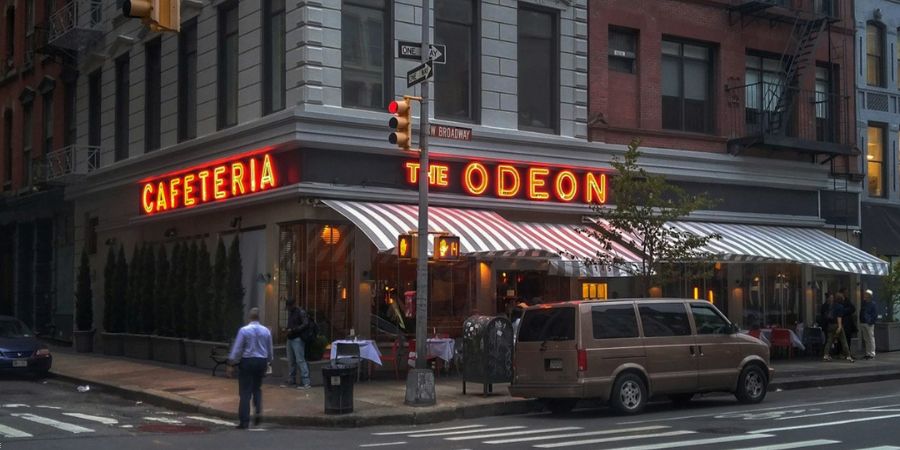
Plenty of small business owners will approve a monthly paid social budget without blinking, then spend three weeks agonizing over a one-off sign that will still be working eight years from now. The maths behind that hesitation rarely gets examined.
Signage lands in an awkward spot on the books. It is a single purchase, so it gets filed as a fit-out cost rather than a marketing asset, and once it is mounted nobody measures it again. The behavior it drives is well documented. A 2012 FedEx Office survey of 1,000 US adults, conducted with Ketchum Global Research & Analytics and ORC International, found that 76% had entered a shop they had never visited before because of its sign, and 68% had bought a product or service because a sign caught their eye.
The technology has changed since that survey. Psychology has not. LED neon flex replaced fragile glass tubing, stripping out the specialist fabrication and high-voltage gear that used to sit under every quote, and a custom piece became something a two-person business can sign off on a Tuesday afternoon. Seven benefits are worth understanding properly, along with the point where each one stops.
1. A One-Off Cost That Keeps Advertising Every Day
Paid search and paid social work on a meter. Stop paying, and the impressions stop the same afternoon. Signage inverts that model. You buy once, install once, and the asset keeps working through every trading hour it stays lit, which is one reason custom neon signs have moved out of bars and into ordinary small retail fit-outs.
The arithmetic is uncomplicated. A shopfront piece costing the equivalent of two months of a modest ad budget, spread across eight years of service, works out cheaper per month than the office coffee order. That comparison is deliberately crude, because a sign can’t be targeted, paused, or split-tested, and anyone claiming otherwise is selling something.
What it does instead is reach every person who walks past, an audience digital channels charge heavily to reach and often reach less well.
2. Customers Judge Your Quality Before They Speak To You
The same FedEx research found that 68% of consumers treat a shop’s signage as a proxy for the quality of what it sells. Just over half said they were less willing to walk into a business displaying a misspelled or badly made sign.
That’s an uncomfortable finding for anyone running a strong operation behind a tired shopfront. A vinyl banner cable-tied over a window says one thing about how long you plan to be there. A properly fabricated, lit piece says another. Neither judgment is fair. Both get made in about two seconds by somebody who has never met you.
3. Your Sign Keeps Selling After Closing Time
A sign switched off at closing time is an asset idling through two-thirds of its life. Evening commuters and weekend walkers pass premises that are shut, and an illuminated shopfront is often the only marketing from your business they meet that week.
Running a sign on a timer or a photocell overnight costs very little and converts dead hours into brand exposure. Check the lease and your local rules first. In England, an externally illuminated sign usually needs advertisement consent from the local planning authority, and the hours it can be lit are one of the conditions that can be attached to that consent.
Most other markets run some version of the same system, and landlords add their own restrictions on top.
4. Good Signage Gets Photographed And Shared Online For Free
Lit signage gets photographed in a way printed signage does not. A cafe wall, a salon reception, a gym stairwell: people take the picture themselves, and the business name travels with it.
There is a condition attached, and it gets ignored constantly. Almost nobody will photograph a sign reproducing your logo.

A sign saying something a customer actually wants to associate themselves with, rendered in your brand color and typeface, gets photographed weekly. Recognition comes from the color and the lettering, not from a logo being legible in the corner of somebody’s Saturday night.
5. LED Running Costs Are Small Enough To Ignore
Modern LED neon flex runs on a low-voltage driver, usually 12V or 24V DC. Traditional glass neon needs a high-voltage transformer to step current up to thousands of volts, which is where a large share of its consumption and heat originates. The LED version contains no neon gas and no mercury, which simplifies disposal and shortens the risk assessment.
Treat specific wattage claims with caution. Published figures vary widely between suppliers because draw depends on the length of tubing in the design, the color chosen, and the brightness setting. Ask for the wattage of your actual design rather than a category average. Manufacturers commonly rate quality LED neon at 50,000 hours or more, though that is a rating rather than an independent measurement.
The wider lighting evidence runs in the same direction: ENERGY STAR, the US federal labeling program for energy performance, states that certified LED products use at least 75% less energy and last up to 25 times longer than incandescent lighting. That benchmark covers bulbs rather than signage, so read it as a direction of travel and not as a spec sheet for your sign.
6. The Same Sign Travels To Your Next Location
Glass neon travels badly. LED flex mounted on acrylic weighs a fraction as much, survives a van journey, and hangs like a framed picture. Glass usually means a specialist install, and anything above head height brings access equipment into the budget.
For any business trading in more than one place, that matters. Market stalls, pop-up units, exhibition stands and seasonal sites can all carry the same piece, so the brand reads identically in a trade hall in March and a shopping center unit in November.
Relocation stops the need for a fresh signage budget. One caveat for outdoor use: only a properly weather-rated build belongs outside, so confirm the IP rating before anything goes on an exterior wall.
7. Staff Notice The Space As Much As Customers Do
The least measurable benefit is the one owners raise most often afterward. Staff carry themselves differently in a space that looks deliberate. Recruitment photographs improve. Candidates form a view of the business before the interview starts, and so do suppliers, landlords and anyone else who visits.
None of that appears in a report, which is why it never makes the business case. But it does show up in how people describe where they work.
Where This Leaves A Small Business
Signage will not rescue a weak product or a poor location. It amplifies whatever is already there, and it amplifies a tired shopfront just as faithfully as a good one.

What has shifted is the entry price. A category that once meant a specialist installer, a high-voltage transformer and a maintenance contract now means a piece you can specify, receive and mount without trade help, at a cost sitting comfortably inside a month of ad spend.
The businesses getting the most from it treat the sign as a brand decision rather than a shop-fitting line item. That comes down to what it says, far more than what it costs.




