
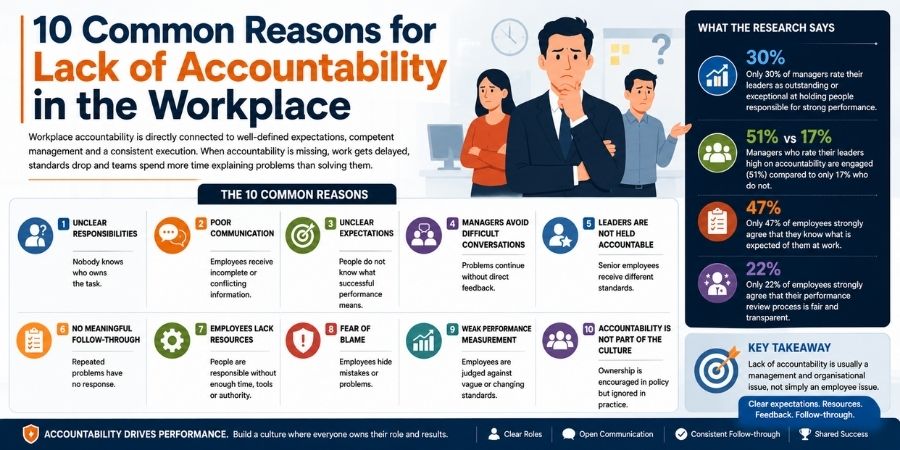
Workplace accountability is directly connected to well-defined expectations, competent management and a consistent execution. Without those, employees might not know what they are responsible for, managers may shy away from hard talks, and a lot of the teams’ effort might be directed to just explaining what went wrong rather than actually resolving the issues.
Gallup’s 2026 leadership research found that creating accountability was the lowest-rated of seven leadership competencies among both leaders and managers. Only 30% of managers rated their leaders as outstanding or exceptional at holding people responsible for strong performance. Managers who gave their leaders those high ratings were also much more likely to be engaged themselves: 51% compared with 17% among managers who did not rate their leaders highly on accountability.
Another Gallup study found that only 47% of employees strongly agreed that they knew what was expected of them at work, while only 22% strongly agreed that their performance review process was fair and transparent.
These figures point to an important fact: lack of accountability in the workplace is often a management and organisational issue, not simply an employee issue.
What is Lack of Accountability in the Workplace?
Lack of accountability in the workplace result in people not being answerable for their roles decisions behaviour, or results most of the time.
This could include employees’ managers departments or leaders at a higher level.
Common signs include:
- Missed deadlines without follow-up
- Unclear ownership of important tasks
- Employees blaming other teams for problems
- Managers avoiding performance conversations
- Leaders being treated differently from employees
- Repeated mistakes without corrective action
- Employees receiving vague performance expectations
- Problems being discussed without anyone taking responsibility
- Poor performance continuing without intervention
- Teams having responsibility without sufficient authority or resources
Accountability does not mean punishing employees whenever something goes wrong. A good accountability system combines clear expectations, appropriate resources, regular feedback and consistent follow-through.
Below are the 10 Common Reasons for Lack of Accountability
| No | Reason | What it looks like |
| 1 | Unclear responsibilities | Nobody knows who owns the task |
| 2 | Poor communication | Employees receive incomplete or conflicting information |
| 3 | Unclear expectations | People do not know what successful performance means |
| 4 | Managers avoid difficult conversations | Problems continue without direct feedback |
| 5 | Leaders are not held accountable | Senior employees receive different standards |
| 6 | No meaningful follow-through | Repeated problems have no response |
| 7 | Employees lack resources | People are responsible without enough time, tools or authority |
| 8 | Fear of blame | Employees hide mistakes or problems |
| 9 | Weak performance measurement | Employees are judged against vague or changing standards |
| 10 | Accountability is not part of the culture | Ownership is encouraged in policy but ignored in practice |
1. Roles and Responsibilities Are Unclear
Lack of accountability at work usually results from no one really knowing who a task is assigned to or who will be responsible. In multi-departmental projects this lack of task ownership occurs very often. Marketing team believes it is sales department’s responsibility to update customer data. Sales department, then again, might think that marketing is in charge.
As a result, none of them is prepared to step up and take on the responsibility. The work remains undone since no one has been explicitly designated a task owner.
The problem becomes even harder to solve when several people are described as being “responsible” for the same outcome.
A better system identifies:
- One person responsible for each major deliverable
- Who has decision-making authority
- Who needs to be consulted
- The deadline
- The expected result
Clear ownership gives managers something specific to review when a commitment is missed.
2. Communication is Inconsistent
Employees cannot take responsibility for information they never received or received too late.
Communication problems are especially common when teams work across departments, locations or time zones. A deadline may change in one meeting but never reach the people responsible for delivering the work.
The result can look like an accountability problem even when the underlying issue is poor information flow.
Recent iHire research found that 72.1% of U.S. workers who had experienced a toxic workplace cited poor communication by leaders and managers. The same 2026 report found that 79.1% attributed workplace toxicity to unethical, unaccountable or unsupportive management.
Lack of accountability example:
A product team sets a new launch date but customer support is not informed. Support staff inform the customers about the earlier date.
The employees may appear careless, but the organisation has a communication failure that needs to be addressed first.
3. Expectations are Too Vague
Employees need to know what their manager considers successful performance.
“Improve your productivity” is difficult to measure.
“Complete the weekly client report by 3 p.m. Friday and maintain an error rate below 2%” gives an employee a much clearer standard.
Gallup found that only 47% of employees strongly agreed that they knew what was expected of them at work. That figure had fallen from 56% immediately before the pandemic and 61% in 2015.
This matters because accountability starts with an agreed expectation.
A useful performance expectation should answer:
- What needs to be completed?
- Who owns it?
- When is it due?
- What quality standard applies?
- How will the result be measured?
Without those details, performance conversations can become subjective.
4. Managers Avoid Difficult Conversations
A manager may notice that an employee is repeatedly missing deadlines but hesitate to address the issue.
The first missed deadline may seem minor. The second becomes frustrating. By the third or fourth, the manager may be dealing with a larger performance problem.
This pattern is common in organisations where managers receive little training in performance management.
Gallup reports that only 44% of managers globally say they have received management training. Its research also finds that trained managers are less likely to be actively disengaged.
Effective accountability requires managers to discuss problems early.
A useful conversation should cover:
- What happened
- What was expected
- What caused the gap
- What support is required
- What will happen next
- When progress will be reviewed
That is more useful than waiting until an annual review and presenting several months of accumulated criticism.
5. Leaders are Not Held Accountable
Lack of accountability in leadership has a particularly strong effect on workplace culture.
Employees notice when senior leaders expect standards from others that they do not follow themselves.
Examples include:
- A manager criticising employees for lateness while regularly arriving late
- Executives ignoring company policies
- Senior employees avoiding responsibility for failed projects
- Leaders receiving exceptions that are unavailable to other employees
- Poor behaviour being overlooked because someone produces strong financial results
Gallup 2026 study reported that accountability, from a leader viewpoint, is least rated among seven competencies they studied. Just 30% of managers believe that the leaders have held people accountable for delivering a great job.
Accountability therefore has to move upward as well as downward.
If employees are expected to own their results, managers and executives should be expected to do the same.
6. There is Little Follow-Through
Accountability requires action after a commitment is made.
If an employee repeatedly misses deadlines and nothing changes, the organisation has effectively communicated that deadlines are flexible.
The response does not always need to be disciplinary.
Depending on the situation, the manager may need to:
- Provide additional training
- Reassign work
- Clarify priorities
- Remove an obstacle
- Adjust an unrealistic deadline
- Establish a performance improvement plan
- Apply an appropriate consequence
The important part is that something happens.
A workplace where problems are repeatedly discussed without follow-through develops a gap between what leaders say and what the organisation actually does.
7. Employees Do Not Have the Resources to Meet Expectations
Accountability only works when employees have a reasonable opportunity to succeed.
A person may be responsible for delivering a project but lack sufficient staff, budget, technology, information or decision-making authority.
That creates a common management mistake: holding someone responsible for an outcome they were not equipped to control.
Before assigning accountability, managers should ask:
- Does this person have enough time?
- Do they have the required skills?
- Do they have the right tools?
- Can they access the necessary information?
- Can they make the decisions required?
- Are competing priorities preventing completion?
Harvard Business Review has identified limited resources and unclear roles among the factors that can sit behind apparent accountability problems.
The solution may therefore be better resource allocation rather than stricter supervision.
8. Employees are Afraid of Being Blamed
A workplace that treats every mistake as a personal failure can encourage employees to protect themselves rather than report problems.
That may lead to:
- Delayed reporting
- Blame shifting
- Hidden mistakes
- Avoidance of difficult decisions
- Reluctance to raise concerns
- Incomplete information reaching managers
Accountability works better when employees can distinguish between an honest mistake, poor performance and deliberate misconduct.
A team member who says, “I made an error in the report and here is how I will correct it,” is demonstrating ownership.
A team member who hides the error for weeks because they expect punishment is operating within a different workplace culture.
The goal should be to make responsibility visible without creating a culture of fear.
9. Performance is Not Measured Properly
People need a fair way to understand whether they are meeting expectations.
Yet performance measurement is often vague.
Gallup found that only 22% of employees strongly agreed that their performance review process was fair and transparent.
Poor measurement can create accountability problems in several ways.
| Poor practice | Result |
| Vague goals | Employees are unsure what to prioritise |
| Changing targets | Employees struggle to plan |
| Subjective ratings | Performance discussions become personal |
| Metrics outside an employee’s control | Employees are judged unfairly |
| Annual-only feedback | Problems are addressed too late |
A stronger system connects organisational objectives to team goals and individual responsibilities.
10. Accountability is Not Part of the Workplace Culture
Policies can say that employees should take ownership. The actual workplace culture may tell a different story.
If managers regularly tolerate missed deadlines, senior employees avoid responsibility and poor performance is ignored, employees learn from those behaviours.
This is why lack of accountability in organizations can become a cultural problem.
Gallup’s research shows how strongly leadership behaviour is connected to employee engagement. Managers who rated their leaders highly for accountability had an engagement rate of 51%, compared with 17% among managers who did not give their leaders high ratings.
Culture develops through repeated behaviour.
If leaders consistently:
- Keep their commitments
- Admit mistakes
- Give direct feedback
- Apply standards fairly
- Explain decisions
- Follow up on commitments
Employees receive a clear understanding of what accountability means in practice.
Common Lack of Accountability Examples:
Here are some situations managers may recognise:
| Workplace situation | Possible cause |
| A project repeatedly misses deadlines | Poor planning or unclear ownership |
| Employees blame another department | Siloed working or unclear responsibilities |
| Problems are reported only after they become serious | Fear of blame |
| A senior manager ignores company policies | Weak leadership accountability |
| Employees receive conflicting instructions | Poor communication |
| A team is overloaded with work | Resource or prioritisation problem |
| Performance reviews contain vague criticism | Weak performance measurement |
| The same mistakes happen repeatedly | Lack of follow-through |
| Nobody wants to make a decision | Unclear authority |
| High performers receive different standards | Inconsistent leadership |
These lack of accountability examples should be investigated rather than automatically treated as employee misconduct.
The same behaviour can have different causes in different organisations.
How Can Companies Improve Accountability?
Improving accountability requires practical management systems rather than another policy document.
1. Define ownership: Assign one clear owner to each important task, project or decision.
2. Set measurable expectations: Use specific deadlines, outcomes and performance standards.
3. Review progress regularly: Short, regular check-ins help managers identify problems before they become major failures.
4. Give managers better training: Managers need skills in goal setting, coaching, feedback and performance conversations.
5. Hold leaders to the same standards: Accountability should apply to executives, managers and employees.
6. Check resources before assigning responsibility: Make sure people have sufficient time, information, authority and tools.
7. Make performance discussions specific: Discuss observable behaviour and measurable results instead of using vague labels such as “unmotivated” or “not committed.”
8. Follow through consistently: When commitments are missed, discuss the reason and agree on a specific next step.
9. Encourage early reporting: Employees should have a clear way to raise problems before they become larger issues.
10. Separate mistakes from misconduct: An honest mistake may require coaching. Repeated negligence may require stronger intervention. Deliberate misconduct is a separate issue.
Accountability and Transparency: What is the Difference?
Accountability and transparency are closely related, but they are not the same thing.
| Accountability | Transparency |
| Taking responsibility for actions and results | Providing relevant information openly |
| Focuses on ownership | Focuses on visibility |
| Requires follow-through | Requires clear communication |
| Answers “Who is responsible?” | Helps answer “What happened and why?” |
An organisation needs both.
For example, if a company changes a major process, transparency means explaining the change and providing relevant information. Accountability means assigning responsibility for implementing the change and reviewing whether it happened as agreed.
Frequently Asked Questions
What are the common reasons for lack of accountability?
The most common reasons include unclear responsibilities, vague expectations, poor communication, weak management, insufficient resources, fear of blame, inconsistent performance measurement and a workplace culture that does not reinforce ownership.
What are examples of lack of accountability at work?
Common examples include repeatedly missing deadlines without follow-up, blaming colleagues for mistakes, hiding problems, ignoring agreed responsibilities and allowing poor performance to continue without intervention.
How does lack of accountability in leadership affect employees?
When leaders avoid responsibility or apply different standards to themselves, employees may lose trust in management and become less willing to take ownership of their own work.
How can managers create more accountability at work?
Managers can establish clear expectations, assign ownership, provide regular feedback, remove obstacles, measure performance fairly and follow up consistently when commitments are missed.
Does accountability mean punishment?
No. Accountability means taking responsibility for actions and results. Coaching, additional resources, clearer expectations and corrective action can all be part of an effective accountability system.
Final Takeaway
The common reasons for lack of accountability usually involve more than an employee’s attitude.
Unclear responsibilities, weak communication, unrealistic workloads, poor performance measurement and inconsistent leadership can all make accountability difficult. In many cases, employees are working within a system that has never clearly established who owns what, what good performance looks like or what happens when commitments are missed.
The data reinforces that point. Gallup’s 2026 research identifies accountability as a major leadership weakness, while its performance-management research shows that fewer than half of employees strongly agree that they know what is expected of them.
A stronger workplace starts with straightforward management practices: clear ownership, measurable expectations, adequate resources, regular feedback and consistent follow-through.
Most importantly, accountability has to apply to everyone. Employees, managers and senior leaders all contribute to the standards that define how an organisation operates.