Financial crime rarely announces itself in ways that are easy to recognise. It moves through networks, exploits institutional weaknesses and adapts to the systems designed to prevent it. As financial institutions expand across borders and digital transactions become increasingly sophisticated, the task of identifying illicit activity demands more than regulatory knowledge. It requires an understanding of human behaviour, the ability to anticipate emerging threats and the discipline to build safeguards that work under real-world conditions. In this environment, compliance is no longer simply a matter of meeting obligations. It has become an essential part of how organisations protect their credibility and pursue sustainable growth.
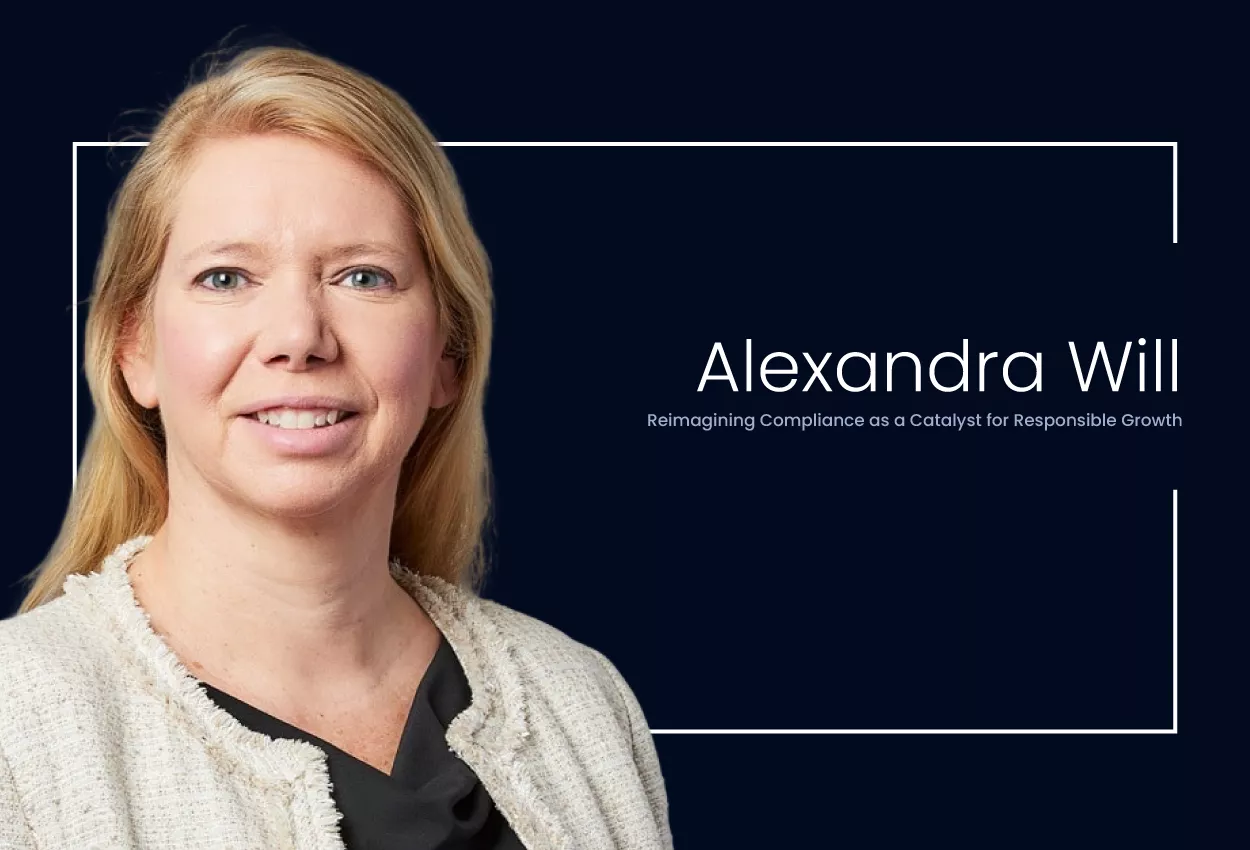
Alexandra Will has built her career around this evolving responsibility. With nearly two decades of experience across consulting and financial services in four continents, she has developed a distinctive understanding of financial crime risks, regulatory expectations and organisational governance. As a Partner at Grant Thornton and Head of its Financial Crime Compliance Advisory practice, she works with institutions to strengthen their compliance frameworks while ensuring that these systems remain practical, adaptable and aligned with business objectives. Her approach challenges the perception of compliance as an obstacle, presenting it instead as a strategic capability that enables organisations to grow responsibly.
A Perspective Shaped by Every Line of Defence
Alexandra’s experience across all three lines of defence has given her an unusually comprehensive understanding of financial crime compliance. Having worked with different functions responsible for managing, overseeing and independently assessing risk, she has witnessed how weaknesses emerge and why apparently robust frameworks can sometimes fail in practice.
Her experience in the first line reinforced the importance of practical controls that function effectively within everyday operations. Work in the second line provided insights into designing scalable, risk-based frameworks, while exposure to the third line strengthened her ability to question assumptions, identify overlooked vulnerabilities and assess whether controls are genuinely effective.
This breadth of experience influences how she approaches advisory engagements. Rather than treating compliance as a collection of policies and procedures, Alexandra believes it must become part of an organisation’s operating culture. Systems must be technically sound, but they must also reflect the realities of the business, its people and the risks it faces.
For her, the objective is clear: compliance should enable business activity without compromising the controls necessary to manage risk.
Balancing Global Standards with Local Realities
Working across multiple jurisdictions has given Alexandra a close understanding of the challenges multinational institutions encounter when aligning regulatory expectations. Although international financial crime standards are guided by common principles, including the recommendations of the Financial Action Task Force, their implementation can vary according to local regulatory maturity, economic conditions, political considerations and cultural differences.
This creates a demanding environment for organisations operating across borders. A framework that works effectively in one jurisdiction may require substantial adjustments in another. At the same time, institutions must maintain consistent governance and operational efficiency across their international operations.
Alexandra advocates principle-based compliance frameworks that focus on meaningful risk outcomes rather than mechanical adherence to checklists. Technology and data can automate routine processes, allowing professionals to concentrate on complex decisions that require human judgement. However, local regulatory requirements must still be respected wherever strict compliance is necessary.
Her experience in the UAE has added another dimension to this perspective. She has been particularly encouraged by the country’s progress in anti-money laundering transformation, its regulatory development and its growing commitment to technology and artificial intelligence. She sees significant potential in the UAE’s ambition to strengthen its position within the international financial system.
Recognising the Threats That Do Not Operate in Isolation
Financial crime has become increasingly interconnected with other forms of criminal activity. Money laundering, cybercrime, fraud and even environmental, social and governance-related risks can overlap, creating vulnerabilities that traditional compliance structures may fail to recognise.
Alexandra believes institutions must move beyond fragmented risk management approaches. Criminal networks do not operate within departmental boundaries, and financial institutions cannot afford to assess threats as though they exist independently. Understanding the relationship between different forms of illicit activity is essential to identifying risks closer to their source.
Another concern is the continued dependence on outdated technology and static risk models. Criminals adapt their methods, exploit emerging channels and identify weaknesses in existing controls. Institutions that rely too heavily on historical patterns may struggle to recognise new threats.
Yet Alexandra considers organisational culture just as important as technological capability. Even sophisticated monitoring systems can be undermined when employees hesitate to raise concerns or challenge established assumptions. People remain an essential part of the financial crime defence framework, and their ability to speak up can make a significant difference.
Turning Compliance into a Business Advantage
One of Alexandra’s notable advisory engagements involved a rapidly expanding fintech company seeking to enter multiple markets. Its existing compliance framework had been designed for a smaller organisation and was no longer adequate for the demands of cross-border operations. Regulatory concerns were creating obstacles to further expansion, while the business faced pressure to maintain its growth trajectory.
Rather than responding with additional layers of bureaucracy, Alexandra and her team worked with senior management, compliance professionals and business functions to redesign the framework. The solution involved automating customer onboarding, strengthening anti-money laundering transaction monitoring through existing fraud controls and establishing a clearly defined risk-based approach.
The resulting transformation was not simply a technical improvement. It changed how the organisation understood the role of compliance. Instead of viewing it as a function that restricted commercial activity, the business began recognising its potential to support responsible expansion and strengthen institutional credibility.
For Alexandra, this is what effective advisory work should achieve: a framework that satisfies regulatory expectations while remaining practical enough to support the organisation’s ambitions.
Leadership That Develops People, Not Just Processes
Alexandra’s leadership philosophy has evolved considerably throughout her career. Earlier, she associated effective leadership with having answers, maintaining control and personally ensuring that every detail met the highest standards. Experience has gradually shifted her perspective towards trust, delegation and the development of others.
She believes strong teams are built through complementary strengths and diverse perspectives. Having led professionals across different countries, cultures and career stages, she recognises that varied experiences can improve the quality of decision-making and help teams examine problems from different angles.
Mentorship is particularly important to her, especially for women pursuing careers in risk and regulatory consulting. She is committed to creating opportunities for professionals to grow, express their views and develop the confidence to take on greater responsibilities.
Her approach also places considerable emphasis on psychological safety. In high-stakes compliance environments, employees must feel comfortable questioning decisions, admitting uncertainty and reporting potential problems. Alexandra encourages open communication and prefers resolving mistakes through learning and corrective action rather than creating a culture of blame.
She believes leadership is ultimately measured by the opportunities created for others to realise their potential.
Bringing Human Judgement into the Age of AI
Artificial intelligence is creating significant possibilities for financial crime compliance. Advanced analytics can improve the detection of suspicious activity, streamline investigations and reduce false positives, allowing compliance professionals to focus on more complex cases.
Alexandra is actively exploring how these capabilities can be incorporated responsibly into financial crime prevention. She recognises that AI can improve the speed and effectiveness of monitoring systems, but also highlights the ethical, regulatory and operational questions that accompany its adoption.
Financial crime is driven by human behaviour, and understanding the intentions and patterns behind suspicious activity requires contextual judgement. Technology can process information at scale, but it cannot independently replace the experience and critical thinking needed to interpret complex situations.
Her vision is therefore based on collaboration between intelligent systems and human expertise. AI should strengthen the capabilities of compliance professionals, reduce repetitive workloads and support better-informed decisions while remaining subject to meaningful human oversight.
Building a Career That Makes a Difference
Alexandra’s professional outlook extends beyond regulatory frameworks and advisory assignments. She sees financial crime compliance as a discipline with a broader social responsibility. Effective controls can help disrupt criminal networks involved in drug trafficking, human smuggling, fraud and other activities that cause harm beyond the financial system.
This belief influences the way she approaches team engagement. When employees understand the wider significance of their work, routine responsibilities can acquire a stronger sense of purpose. Alexandra has witnessed how this change in perspective can transform the motivation of operational teams responsible for reviewing alerts and identifying suspicious transactions.
For young professionals entering the field, she emphasises curiosity, integrity, confidence and mentorship. The regulatory environment will continue to evolve, making continuous learning indispensable. Equally important is the willingness to speak up, challenge assumptions and maintain ethical standards even when doing so is difficult.
She also encourages experienced professionals to support those following their paths, sharing knowledge and creating opportunities for others to advance.
The Future of Compliance Is Built on Confidence
As financial institutions confront increasingly sophisticated threats, the role of compliance will continue to expand. Real-time monitoring, predictive analytics and cross-border information sharing are likely to become more important, but their effectiveness will depend on the strength of the governance structures surrounding them.
Alexandra envisions a future in which compliance functions operate as strategic partners, helping organisations identify vulnerabilities, respond to emerging threats and pursue growth without compromising integrity. Her work at Grant Thornton reflects this ambition, combining technical expertise with a collaborative approach that places people and practical outcomes at the forefront.
Her professional journey demonstrates that financial integrity cannot be sustained through policies alone. It requires informed leadership, empowered employees, responsible technology and a culture in which doing the right thing is understood as an organisational responsibility. By bringing these elements together, Alexandra continues to challenge conventional perceptions of compliance and strengthen its role as a foundation for responsible business.