
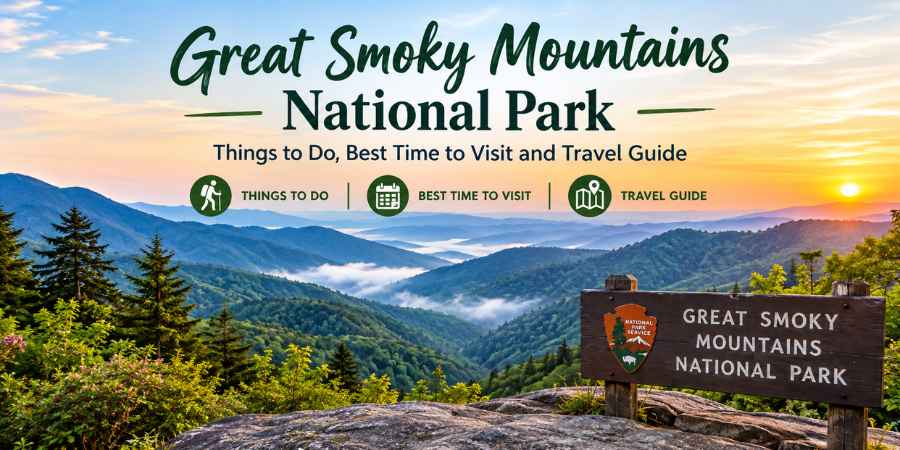
Great Smoky Mountains National Park is one of the most visited national parks in the United States, stretching across eastern Tennessee and western North Carolina. It is known for mist-covered mountains, dense forests, waterfalls, wildlife, scenic drives and more than 800 miles of hiking trails.
For travelers, the appeal of Great Smoky Mountains National Park is its variety. You can spend a few hours driving through mountain roads and stopping at overlooks, or spend several days hiking, camping and exploring remote areas.
There is also an important difference between visiting the Smokies and many other U.S. national parks: there is no entrance fee. However, visitors who park inside the park for more than 15 minutes need a parking tag. In 2026, the tags cost $5 for one day, $15 for a week or $40 for a year.
Where is Great Smoky Mountains National Park?
Great Smoky Mountains National Park sits along the Tennessee-North Carolina border, with popular gateway communities including Gatlinburg and Townsend in Tennessee and Cherokee in North Carolina.
| Travel fact | Details |
| Location | Tennessee and North Carolina |
| Best known for | Mountains, forests, waterfalls, wildlife and hiking |
| Hiking trails | More than 800 miles |
| Entrance fee | None |
| Parking tag | $5 daily, $15 weekly, $40 annual |
| Camping | Frontcountry and backcountry options |
| Popular activities | Hiking, wildlife viewing, scenic drives, camping, fishing and horseback riding |
The park has several major access points and visitor centers, so where you stay can make a significant difference to how much time you spend driving.
Why is Great Smoky Mountains National Park So Popular?
The biggest attraction is variety.
Great Smoky Mountains National Park combines mountain scenery with an unusually rich collection of forests, streams, waterfalls, historic buildings and wildlife. The National Park Service describes it as a place for hiking, camping, fishing, wildlife viewing, auto touring, horseback riding, picnicking and ranger programs.
You do not have to be an experienced hiker to enjoy the park.
A scenic drive can give you a very different experience from a full-day trail, while short walks can take you to waterfalls and viewpoints.
The landscape also changes considerably with elevation, which is one reason the park looks different throughout the year.
What are the Best Things to Do in Great Smoky Mountains National Park?
There is no single best activity in Great Smoky Mountains National Park. Your choice depends on how much time you have and how active you want the trip to be.
1. Go Hiking
Hiking is one of the main reasons people visit the Smokies.
The park has more than 800 miles of trails, ranging from relatively short walks to demanding backcountry routes.
Popular hikes and destinations include:
- Laurel Falls
- Alum Cave Trail
- Chimney Tops
- Abrams Falls
- Rainbow Falls
- Andrews Bald
- Mount LeConte
- Charlies Bunion
Trail conditions can change quickly, particularly in the mountains. The National Park Service recommends checking current conditions, carrying the essentials and turning around if a hike becomes more difficult than expected.
2. Drive Through Cades Cove
Cades Cove is one of the most popular areas of Great Smoky Mountains National Park.
The historic valley is surrounded by mountains and includes old homes, churches, barns and other structures that reflect the communities that lived in the area before the park was established.
It is also a good place for wildlife viewing.
The National Park Service identifies Cades Cove Loop Road as one of the park’s popular auto-touring routes, although heavy traffic can create long waits.
3. See the Waterfalls
Waterfalls are another major attraction.
The park contains numerous waterfalls and cascades, and you do not necessarily have to undertake a difficult hike to find moving water. The National Park Service notes that smaller cascades can be found throughout the park’s rivers and streams.
Do not climb waterfalls or rocks around them. The park warns that falls in these areas have resulted in serious injuries.
4. Look for Wildlife
Great Smoky Mountains National Park is home to a wide range of wildlife.
Black bears are among the animals’ visitors most want to see, but wildlife viewing should always be done from a safe distance.
Other animals you may encounter include:
- White-tailed deer
- Wild turkeys
- Elk
- Black bears
- Salamanders
- Birds and other forest species
Seeing wildlife is never guaranteed, and approaching animals can put both visitors and wildlife at risk.
5. Explore Historic Buildings
The Smokies are not only about scenery.
Throughout Great Smoky Mountains National Park, visitors can find historic cabins, churches, barns, mills and other structures that provide a glimpse into the lives of earlier Appalachian communities.
This makes the park particularly interesting for travelers who want history alongside outdoor activities.
What is the Best Time to Visit Great Smoky Mountains National Park?
The best time to visit Great Smoky Mountains National Park depends on what you want to see.
| Season | What to expect |
| Spring | Wildflowers, flowering trees and fresh greenery |
| Summer | Warm weather, lush forests and busy trails |
| Fall | Autumn foliage and cooler temperatures |
| Winter | Fewer leaves, quieter areas and different mountain views |
The National Park Service notes that every season offers a different experience. Spring brings wildflowers and flowering trees, while winter can open views that are hidden by leaves during warmer months.
Fall is particularly popular because of the changing leaves, so expect heavier crowds around scenic roads and popular viewpoints.
If avoiding crowds is more important than seeing peak autumn colors, visiting during less busy periods can make the trip more relaxed.
How Much Does It Cost to Visit Great Smoky Mountains National Park?
One of the biggest advantages of Great Smoky Mountains National Park is that there is no entrance fee.
However, parking tags are required for vehicles parked inside the park for more than 15 minutes.
2026 parking tag prices
- Daily: $5
- Weekly: $15
- Annual: $40
The parking tag applies to the vehicle and must display the matching license plate information. Buying a parking tag does not guarantee a parking space.
An America the Beautiful pass does not replace the Smokies parking tag.
Can You Camp in Great Smoky Mountains National Park?
Yes. Camping is one of the best ways to experience Great Smoky Mountains National Park.
The park has 10 developed campgrounds for tent and RV campers. Reservations are required. Backpackers can also stay at designated backcountry campsites and shelters with the appropriate permit.
Current standard campground rates are generally $30 per night, although group and electric sites can cost more.
For backcountry camping, the 2026 fee is $8 per person per night, along with a $6 non-refundable permit fee under the current reservation system.
Backcountry camping requires advance planning. Mountain weather and trail conditions can change quickly, and remote areas have limited services.
How Many Days Do You Need in Great Smoky Mountains National Park?
For a first visit, three days is a good starting point.
One day: Focus on a scenic drive, a visitor center, one short hike and a few viewpoints.
Two days: Add a longer hike, Cades Cove or another major area and more time for wildlife and historic sites.
Three to four days: You can explore several sections of the park without trying to rush from one attraction to another.
A week or longer: This works well for hikers, campers and travelers who want to explore deeper into the backcountry. Because the park is large, trying to see everything in one day is unrealistic.
Is Great Smoky Mountains National Park Good for Families?
Yes.
Families can choose from scenic drives, picnic areas, short walks, waterfalls, historic sites and easier hiking trails.
The key is choosing activities that match everyone’s ability.
The National Park Service specifically recommends selecting trails according to the length and difficulty that suit everyone in your group.
Families should also plan around weather, water, food, footwear and wildlife safety rather than assuming a short mountain trail will be easy.
What Should You Know Before Visiting Great Smoky Mountains National Park?
A little preparation can make a major difference.
- Check road and trail conditions: Mountain weather can affect roads and trails quickly.
- Download a map: Cell service is not reliable everywhere in the park. Having a map before heading out is important.
- Start popular activities early: Cades Cove and other well-known areas can become crowded, particularly during peak travel periods.
- Carry water: Even shorter hikes can become tiring, especially in warm weather.
- Respect wildlife: Never approach, feed or attempt to photograph wildlife from an unsafe distance.
- Stay on designated trails: The terrain can be uneven and conditions can change.
The National Park Service warns that backcountry conditions can include swollen streams, washouts, fallen trees and erosion.
Does Great Smoky Mountains National Park Have Hotels?
There are no regular hotels or vacation rental cabins inside Great Smoky Mountains National Park, with LeConte Lodge being the notable exception. The park itself primarily provides camping facilities.
Most visitors stay in nearby communities such as:
- Gatlinburg
- Pigeon Forge
- Townsend
- Cherokee
Your choice of town should depend on which part of the park you plan to visit.
Is Great Smoky Mountains National Park Worth Visiting?
Yes. Great Smoky Mountains National Park is worth visiting if you enjoy mountains, hiking, wildlife, waterfalls, scenic drives or Appalachian history.
Its biggest strength is that you do not have to experience it in one particular way.
You can spend the morning hiking, stop at a historic cabin in the afternoon and finish the day watching the mountains from a scenic overlook.
For experienced hikers, there are hundreds of miles of trails to explore. For families and casual travelers, there are scenic roads, short walks and easily accessible viewpoints.
That flexibility is what makes Great Smoky Mountains National Park appealing to such a wide range of travelers.
Frequently Asked Questions
What is Great Smoky Mountains National Park known for?
It is best known for its mist-covered mountains, forests, waterfalls, wildlife, scenic drives, historic Appalachian structures and more than 800 miles of hiking trails.
Is Great Smoky Mountains National Park free?
There is no entrance fee, but vehicles parked inside the park for more than 15 minutes need a parking tag. In 2026, tags cost $5 daily, $15 weekly or $40 annually.
What is the best time to visit Great Smoky Mountains National Park?
Spring is ideal for wildflowers, fall is popular for autumn foliage, summer offers lush scenery and longer daylight, while winter can provide quieter conditions and more open mountain views.
How many days should you spend in Great Smoky Mountains National Park?
Two to three days is a practical length for a first visit. Hikers and campers may want several additional days.
Can you see bears in Great Smoky Mountains National Park?
Black bears live throughout the park, but sightings are not guaranteed. Visitors should maintain a safe distance and never approach or feed wildlife.
Do you need a reservation for Great Smoky Mountains National Park?
There is no timed-entry reservation system for general park access. However, camping requires reservations, and backcountry overnight stays require permits and advance reservations.
Great Smoky Mountains National Park: Key Takeaways
- Great Smoky Mountains National Park spans Tennessee and North Carolina.
- It has more than 800 miles of hiking trails.
- There is no entrance fee.
- A parking tag is required when parking for more than 15 minutes.
- The 2026 parking tag costs $5 daily, $15 weekly or $40 annually.
- Cades Cove, waterfalls, scenic overlooks, wildlife and historic sites are among the park’s major attractions.
- Spring, summer, fall and winter each offer a different experience.
- The park has 10 developed campgrounds and extensive backcountry camping options.
- Popular areas can become congested, so early starts and advance planning are useful.
- Trail conditions can change quickly, making preparation important.
The best way to experience Great Smoky Mountains National Park is not to rush through a checklist. Pick a part of the park, give yourself time to explore it and let the mountains set the pace.




