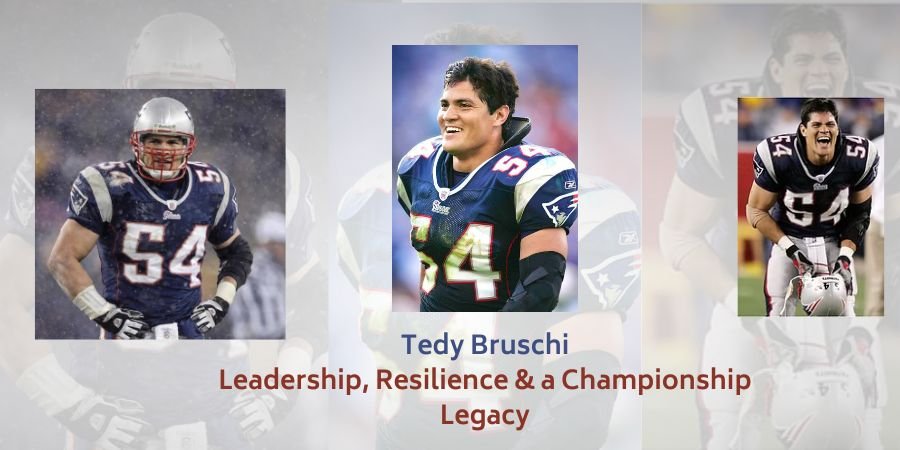
Some leaders get respect with the job title. Others build it through their standards and the way they handle hard moments. Tedy Bruschi built his.
He played 13 years for the New England Patriots and became one of the faces of their championship defence. He was a seven-time team captain, a three-time Super Bowl champion and the 2005 NFL Comeback Player of the Year.
At 31, Bruschi had a stroke. He spent months in rehabilitation, returned to the field and later started Tedy’s Team, an organisation that works on stroke awareness, research and survivor support.
His story separates two things people often blur together. Success brings attention. What a person does with that attention, and how they act when life goes wrong, decides whether the success means anything.
Who is Tedy Bruschi?
Tedy Bruschi is a former American football linebacker who played his whole professional career for the New England Patriots, from 1996 to 2008. He was born on June 9, 1973, in San Francisco, California.
His record includes:
- Three Super Bowl championships with the Patriots.
- Seven seasons as a defensive team captain.
- One Pro Bowl selection, after the 2004 season.
- Induction into the Patriots Hall of Fame in 2013.
- The 2005 NFL Comeback Player of the Year award.
- 189 regular-season games and 22 playoff appearances.
After he retired in 2009, ESPN hired him as an NFL analyst. According to ESPN, he started about a week after announcing his retirement.
His career was steady. No single monster season made his name. He showed up year after year and took responsibility when things went wrong. Bill Belichick called him the “perfect player” at the 2009 retirement press conference, according to the Patriots Hall of Fame.
Tedy Bruschi’s Early Football Journey
Bruschi grew up in California and attended Roseville High School, where he played football, wrestled and threw the shot put.
He played at the University of Arizona from 1991 to 1995 as part of the Wildcats’ “Desert Swarm” defence. In 1995, he recorded 60 tackles, 18.5 sacks and 22.5 tackles for loss.
His college honours included:
- Consensus first-team All-American in 1994 and 1995.
- The 1995 Morris Trophy, given to the Pacific-10’s best defensive lineman.
- A share of the NCAA Division I-A career sack record, with 52.
- Induction into the College Football Hall of Fame in 2013.
A big college résumé guarantees nothing in the NFL. Pro teams want players who learn new systems quickly and still perform against tougher opposition.
The Patriots took Bruschi in the third round of the 1996 NFL Draft, with the 86th overall pick. They also moved him from defensive lineman to linebacker, so he had to learn a new job at the highest level.
Early success builds confidence, but credibility has to be earned later. His college numbers got him drafted. His work afterwards, and his willingness to learn a new position, kept him on the roster for 13 years.
Tedy Bruschi’s Rise with the New England Patriots
When Bruschi joined the Patriots, the team had not yet become a dynasty. Over his 13 seasons, he became central to how the defence played.
He cared about communication between defenders and about keeping standards up when games got tense. He read plays before they developed, and big games often showed it. Coaches and teammates trusted him, and they voted him captain for seven seasons. According to ESPN, the Patriots reached the playoffs nine times during his career, with eight division titles and five conference championships.
He never played anywhere else. One organisation, many different rosters, and he adjusted to all of them.
Business teams work the same way. People relax when they know how their manager will behave. A boss who holds the line during a bad quarter gives everyone else something stable to lean on. Credibility comes from doing the right thing many times in a row, and a few brilliant moments do not replace that.
The Leadership Qualities Behind Tedy Bruschi’s Success
The Tedy Bruschi leadership lessons that stand out most are accountability, preparation and putting the group first.
1. Consistency creates credibility
Bruschi played all 13 of his NFL seasons for one franchise, and his teammates picked him as captain seven times. Employees tend to trust managers who explain things clearly, keep their word and own the result when a project falls short.
2. Team success comes before individual recognition
Defence is a team job. One player makes the tackle, but the play usually works because several others were in the right spot. Bruschi understood where he fitted into the bigger picture.
3. Preparation builds confidence under pressure
Great performances rarely come out of nowhere. In a company, that means preparing people for tough decisions early and making sure everyone knows their responsibilities before a crisis starts.
4. Accountability strengthens team leadership
Leaders set expectations by how they act. Asking others to meet a standard the leader ignores does not work.
5. Resilience requires patience
His return after the stroke took months of rehabilitation, medical checks and a slow path back to competition. Recovery has its own timetable.
Tedy Bruschi and His Championship Career
Bruschi played on the New England Patriots teams that won Super Bowl XXXVI, XXXVIII and XXXIX. He also earned second-team All-Pro recognition in 2003 and 2004.
The three wins in brief:
- Super Bowl XXXVI (2002): The Patriots beat the St. Louis Rams for the first championship of the Bill Belichick and Tom Brady era.
- Super Bowl XXXVIII (2004): New England beat the Carolina Panthers in a close game.
- Super Bowl XXXIX (2005): The Patriots beat the Philadelphia Eagles for their third title in four seasons.
Bruschi was also part of the undefeated 16-0 regular season in 2007, although the Patriots lost Super Bowl XLII.
Championship teams rely on players who know their jobs, speak up under pressure and do not mind when someone else gets the credit. High-performing companies show the same pattern: different strengths fit together, expectations are shared and someone owns the final outcome.
Tedy Bruschi’s 2005 Comeback Story
In February 2005, at 31, Bruschi suffered an ischemic stroke, just days after playing in the Pro Bowl in Hawaii.
He felt numbness and weakness down his left side, had trouble with balance and vision, and developed a severe headache. Doctors found a patent foramen ovale, a hole between the upper chambers of the heart, and linked it to the stroke.
Tedy’s Team says Bruschi and his wife, Heidi, did not know the warning signs of a stroke and did not realise what his symptoms meant. Even a professional athlete with team doctors on call missed it, which shows how easy the signs are to overlook.
Treatment, recovery and rehabilitation replaced his preparation for the next season. About eight months later, in October 2005, he returned to the Patriots lineup. In his first game back, against the Buffalo Bills, he recorded 10 tackles and was named AFC Defensive Player of the Week.
He kept playing well, and that helped him win the 2005 NFL Comeback Player of the Year award. The comeback was about more than getting back on the field. He had to rebuild his confidence and physical readiness after a health scare that could have ended his career.
Organisations love to praise resilience, yet few look at how people actually get there. Bruschi’s recovery took help, expert advice, time and acceptance of slow progress. Managers who want resilient teams should let people rebuild at their own speed and avoid demanding instant results.
How Tedy Bruschi Turned Adversity into Strength
The stroke gave Bruschi a new view of stroke awareness and of the people who live with its effects.
In 2019, he had a second stroke-related event, a transient ischemic attack (TIA). He recovered and carried on with his broadcasting work and advocacy.
His case also showed that strokes hit young, fit and seemingly healthy people. Anyone can learn the warning signs, and anyone who spots them should get medical help immediately. Bruschi chose to talk about it openly and used his public profile to spread awareness.
His path through adversity had a few clear parts:
- Accepting the situation: Recovery starts when a person admits what has happened and faces what is ahead.
- Seeking the right support: Doctors, family and rehabilitation specialists each play a role.
- Respecting the recovery process: Progress often needs patience, and a rushed return to old routines can backfire.
- Finding a wider purpose: Personal experience can become a way to help people in the same position.
Workplaces can learn from this. Resilient teams do not appear because employees are told to cope alone. They appear when the organisation provides resources, understanding and support.
Tedy Bruschi’s Contribution Beyond the Football Field
Tedy’s Team is one of the most meaningful parts of Bruschi’s legacy. He founded it with Heidi after his 2005 stroke.
The American Stroke Association supported the early work. The aims were to raise awareness of stroke symptoms, fund research and encourage survivors to join community activities. The organisation also wanted to challenge the idea that stroke only affects certain people.
Running became central to the mission. Participants trained for events such as the Boston Marathon and the Falmouth Road Race, and used the training to raise money and attention.
According to the organisation’s current information, Tedy’s Team has:
- Raised more than $13 million for stroke and heart disease initiatives.
- Engaged more than 1,700 alumni.
- Supported awareness, research and community outreach.
- Set up programmes that help stroke and heart survivors recover.
In 2019, it launched the Comeback Assistance Program for survivors and caregivers. In 2023, it teamed up with the MGH Institute of Health Professions to create the Tedy’s Team Center of Excellence in Stroke Recovery, which covers clinical practice, education, research and community awareness.
Tedy’s Team also points to a shift in the United States. Since the organisation started, stroke has dropped from the third-leading cause of death to the fifth. The group is quick to add that plenty of work remains.
Bruschi’s community work came straight out of what happened to him. He had lived through a gap in public knowledge, and he helped build something to close it. Business leaders can borrow the idea. Social responsibility works better when it starts with a real need, has committed people behind it and becomes a lasting programme in place of a one-off donation.
Leadership Lessons from Tedy Bruschi
The Tedy Bruschi leadership lessons give practical ideas to executives, founders, managers and people early in their careers.
1. Build trust through everyday actions
Credibility grows out of small promises kept again and again. Teams notice whether a leader follows through, owns mistakes and holds the standard.
2. Make collective progress a priority
Lasting success depends on helping other people do their jobs well. Good leaders see how their own work feeds the larger goal.
3. Prepare before challenges arrive
In business, thinking ahead about risks, training staff and keeping backup plans ready all help an organisation handle surprises.
4. Give people room to recover
Someone going through a hard time may need time, guidance and support before their confidence returns.
5. Turn experience into meaningful action
Leaders can look for problems they know well and use their influence, contacts and resources to fix them.
6. Measure success beyond personal recognition
Awards and milestones mark progress. The effect a person has on colleagues, communities and the next generation is another way to judge leadership.
Tedy Bruschi’s Legacy with the New England Patriots
Fans voted Bruschi into the Patriots Hall of Fame in 2013, in his first year of eligibility, and he became the 19th player to enter it. The honour recognised his 13 seasons with the team. Seven years as captain, three championships and steady defensive play put him among the franchise’s notable players. Bruschi has said he is proud to have played for just one organisation.
People respected his work ethic and competitive streak, and those qualities fit the culture of the title teams he played on.
After he retired in 2009, he moved into broadcasting with ESPN, where he talks about the game through NFL coverage.
Football alone does not explain his legacy. Tedy’s Team has taken his influence into health awareness, fundraising and survivor support. A career legacy gets stronger when the values someone showed on the job keep helping people after they leave it.
Tedy Bruschi Career Highlights
| Career milestone | Achievement |
| College football | University of Arizona, 1991–1995 |
| College recognition | Two-time consensus All-American |
| NFL Draft | Selected by the Patriots in the third round in 1996 |
| Professional career | 13 seasons with New England, 1996–2008 |
| Super Bowl championships | XXXVI, XXXVIII and XXXIX |
| Team leadership | Seven seasons as defensive captain |
| Pro Bowl | Selected following the 2004 season |
| Stroke recovery | Returned to the Patriots lineup in October 2005 |
| NFL recognition | 2005 Comeback Player of the Year |
| Retirement | Announced in August 2009 |
| Broadcasting | Joined ESPN in August 2009 |
| Patriots Hall of Fame | Inducted in 2013 |
| Community contribution | Co-founded Tedy’s Team in 2005 |
Frequently Asked Questions
1. Who is Tedy Bruschi?
Tedy Bruschi is a former NFL linebacker who spent 13 seasons with the New England Patriots. He won three Super Bowls, captained the defence, joined the Patriots Hall of Fame and speaks out about stroke awareness.
2. How many Super Bowls did Tedy Bruschi win?
Bruschi won three Super Bowls with the New England Patriots: XXXVI, XXXVIII and XXXIX.
3. What happened to Tedy Bruschi in 2005?
Bruschi had an ischemic stroke in February 2005, soon after winning his third Super Bowl. He went through treatment and rehabilitation, then returned to professional football in October of that year.
4. When did Tedy Bruschi retire from the NFL?
He announced his retirement on August 31, 2009, after 13 seasons with the Patriots.
5. What is Tedy’s Team?
Tedy’s Team is an organisation that Tedy and Heidi Bruschi founded in 2005. It raises awareness and money for stroke and heart disease work and supports survivors and caregivers.
6. How many seasons was Tedy Bruschi a Patriots captain?
Bruschi was a defensive team captain for seven seasons with New England.
7. What leadership lessons can professionals learn from Tedy Bruschi?
His career points to consistency, accountability, preparation, teamwork and resilience. His charity work shows how a person can put professional influence behind a bigger cause.
8. What is Tedy Bruschi doing after retirement?
Since retiring, Bruschi has worked as an NFL analyst at ESPN and stayed involved in stroke awareness through Tedy’s Team.