
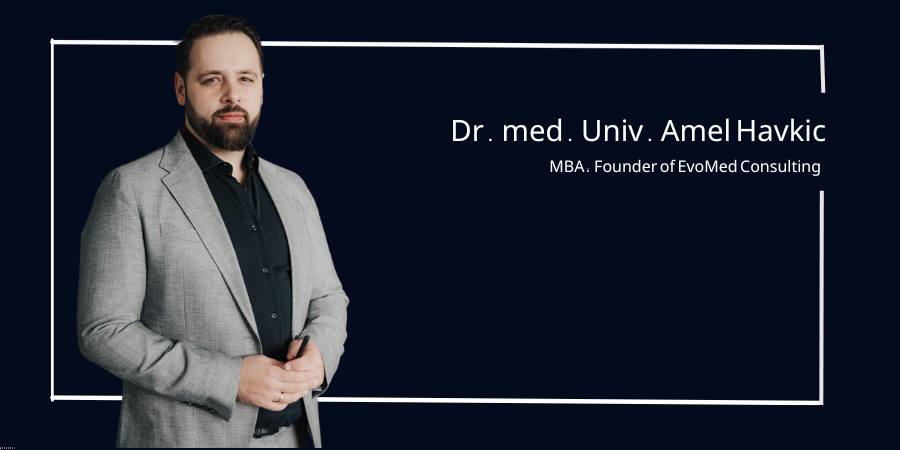
By Dr. med. univ. Amel Havkic, MBA, Founder of EvoMed Consulting
Healthcare technology has never suffered from a shortage of ideas. Walk through any medical conference, and you will see screens displaying breathtaking technical brilliance. You will see alerts that promise to save lives and algorithms that claim to see what the human eye misses.
Yet, as a practicing physician who has lived in the high-pressure corridors of the ICU, I have seen a parallel tragedy. I have seen brilliant MedTech solutions reach the bedside and fail quietly. They don’t fail with a loud crash, they fail through non-adoption, through clinician workarounds, and through the weight of tools that were built for a reality that doesn’t exist.
The data is unforgiving: 75% of MedTech startups fail and never deliver a return on investment to their backers. [Source: MDDI Journal, Nelson, S. 2025].
Most founders assume this failure is a “sales problem” or a “funding problem.” They assume that if they just get that one regulatory checkbox or that next VC check, the path will clear. But after diagnosing hundreds of companies through the EvoMed lens, I’ve realized the truth is much more personal.
Failure in MedTech is rarely about the technology. It is a “systems alignment” problem. And more often than not, the shape of that misalignment is determined by the person leading the company.
The Myth of the “General” Founder
In the world of SaaS or consumer apps, a founder can often “move fast and break things.” In healthcare, breaking things kills people. This creates a gravity that pulls every founder toward their own area of comfort.
Our latest industry research, based on over 150 MedTech executives, reveals that 48% of innovators could not identify the specific clinical problem they were trying to solve before entering the market. [Source: EvoMed Consulting Industry Report, 2026].
To navigate the “Valley of Death,” you must first look in the mirror. You must recognize which of the four MedTech Archetypes you inhabit, because your greatest strength is almost certainly your company’s greatest strategic risk.
Archetype 1: The Adoption-Stuck Builder (The Technical Founder)
The DNA: Usually an engineer or IT specialist. They have built a product that is technically flawless and elegant.
The Belief: “If the data is better and the UI is faster, clinicians will naturally use it.”
The Fatal Flaw: Workflow Friction.
The Technical Founder builds for performance, but they often ignore the “biological reality” of a hospital. A clinician does not start their day wishing for more innovation. They start their day wishing to survive a workload that is already overwhelming.
If your tool requires a nurse to open a separate tab, adds three extra clicks to a documentation process, or requires two days of intensive training, you have already lost. You aren’t just selling a device, you are selling behavior change.
The Alignment Gap: Our research shows that 41% of MedTech Innovators identify Clinical Adoption as their primary challenge. For the Builder, adoption fails because the product was validated in isolation, away from the chaos of the ICU or the time-constraints of a private practice.
Strategic Pivot: You must backward-engineer your solution from a workflow that feels natural to a tired human being. If a product doesn’t fit the clinician’s hands like a “warm embrace,” it will end up collecting dust.
Archetype 2: The Fundability Seeker (The Business Founder)
The DNA: Often an ex-consultant or MBA. They are masters of the pitch deck, the narrative, and the financial model.
The Belief: “Funding is the fuel that solves all problems. If I can prove the TAM and get the VC check, the clinical side will follow.”
The Fatal Flaw: Structural Incoherence.
The Business Founder is often so focused on “investor readiness” that they prioritize a strong narrative over proving the project’s economic logic. They chase the “Gold Rush” of trends, like AI, without understanding if the hospital CFO can actually justify the purchase.
Hospitals operate on razor-thin margins. A tool that provides “clinical benefit” but doesn’t have a clear reimbursement pathway or a documented ROI is a luxury most systems can’t afford. Insufficient reimbursement is consistently cited as a top-three barrier to digital health adoption. [Source: Managed Healthcare Exec].
The Alignment Gap: 31% of founders struggle with funding readiness because they cannot translate clinical value into financial predictability. Investors are becoming more restrictive, they are no longer funding “cool tech.” They are funding “repeatable scale.”
Strategic Pivot: Stop selling “innovation” and start selling “economic viability.” If you cannot produce a 1-page ROI case study that a hospital CFO would accept, you are not building a business, you are building an expensive hobby.
Archetype 3: The Overloaded Innovator (The Clinical Founder)
The DNA: A doctor, nurse or someone with a health issue themselves, who saw a problem in the healthcare sytem and decided to fix it.
The Belief: “I understand this problem better than anyone. Solving the clinical need guarantees success.”
The Fatal Flaw: Sequencing Errors.
This type of founder is sitting at the heart of the industry, but they are often crushed by the sheer weight of healthcare’s “necessary evils.” They struggle with the multi-front war of regulatory compliance, data security (GDPR/ISO), and market access strategies.
Because they are so focused on the patient, they often treat “business logic” as a distraction. The result? They build a solution that patients love and doctors want, but it never reaches the market because it hits a regulatory wall or a commercial trap.
The Alignment Gap: 42% of MedTech innovators struggle with several strategic areas at once. This leads to “Multi-Pressure Exposure,” where decisions made to solve one problem (like clinical efficacy) create new downstream constraints (like a product that is too expensive to compete, manufacture or regulate).
Strategic Pivot: You need a “Sherpa.” You cannot be the expert in clinical care, regulatory law, and venture capital simultaneously. Success is not about doing more. It is about doing the right things in the right order.
Archetype 4: The Strategy Explorer (The Early-Stage Team)
The DNA: A small, agile team that is still “pivoting” and exploring use cases.
The Belief: “We are in exploration mode. We will figure out the specifics once we have more data.”
The Fatal Flaw: Latent Structural Risk.
“Exploration” is often a proxy for uncertainty. Many teams in this phase believe they are avoiding risk by keeping their options broad. In reality, they are accumulating it.
When you try to build a “one-size-fits-all” gadget for healthcare, you end up being no one’s first choice. Specialization doesn’t limit your market; it deepens your value. Deep specialization is how you build clinical trust.
The Alignment Gap: A staggering 48% of innovators are in “Exploration Mode,” accumulating misalignments that will only surface later during a high-stakes funding round or a failed pilot.
Strategic Pivot: You must choose your “Constellation.” Define your specific patient subgroup and your specific clinical niche today. Clarity is not created by more information; it is created by structured evaluation.
Moving Beyond the Archetype: The StarMap Framework
The healthcare ecosystem is perhaps the most complex system humans have ever put together. To succeed, you cannot simply be a “Doctor,” a “Techie,” or a “Businessman.” You must be an Aligner.
Successful market access happens when you treat adoption, regulation, and commercialization as a single system. At EvoMed, we built the EMC StarMap to help you do exactly that. It measures your performance across 7 critical Constellation Points:
- Specialization: Is your clinical depth focused or broad?
- Predictability: Does your service slot into existing workflows?
- Ambulantization: Is your product ready for care “anywhere, anytime”?
- Ecosystem Fit: Can your tool speak HL7/FHIR and play well with others?
- Economic Viability: Do you have a data-backed ROI model?
- Quality of Care: Are you tracking real-world patient outcomes?
- Implementation Friction: Can you onboard a user in under 15 minutes?
Conclusion: Don’t Scale the Wrong Thing
The most damaging mistake a founder can make is trying to scale before “workflow fit” is proven. This burns funding, destroys trust, and accelerates the timeline toward failure.
In healthcare, the right decision at the wrong time can harm a patient. In MedTech, the same principle applies to your business. Regulatory approval is a milestone, but clinical adoption is the real finish line.
Are you building a “product” or are you building a “solution”? Are you accumulating structural misalignments that will block your growth later?
Don’t let your background become your blind spot. Discover where your strategy is actually breaking down before the cost becomes irreversible. Apply for your free Diagnostic Screening Call at www.evomed-consulting.




