
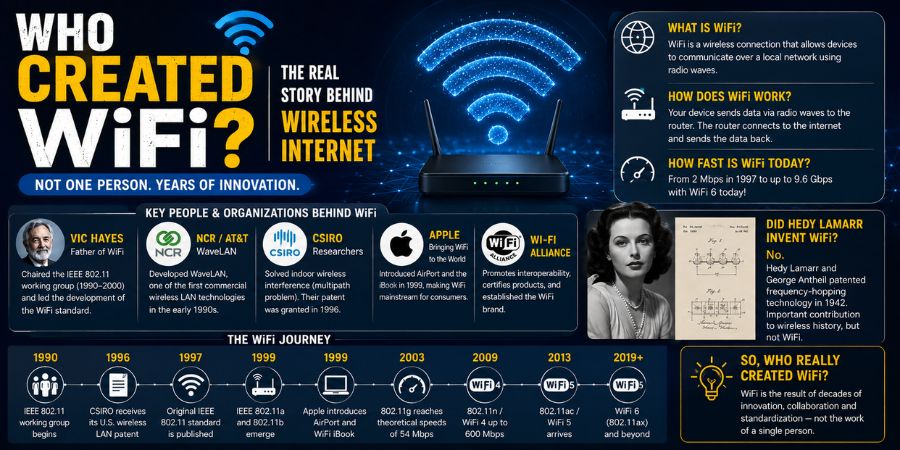
Modern WiFi was a result of blending numerous technologies with many years of development. The IEEE 802.11 wireless network standard was issued in the year 1997 at the same time that NCR engineers were working on a wireless LAN system called WaveLAN and Australian researchers (CSIRO) had developed a piece of technology that assisted in tackling the problem of wireless radio signals reflecting indoors. The person responsible for guiding the development of this wireless networking standard is “Vic Hayes” who, in charge of the IEEE 802.11 working group from 1990 to 2000, is usually thought of as the “Father of WiFi.”
Hedy Lamarr belongs in the story, but she did not invent WiFi. She and composer George Antheil patented a frequency-hopping communication system in 1942, decades before the first WiFi standard.
Who invented WiFi?
No single person invented WiFi. Modern WiFi grew from the IEEE 802.11 standard, early wireless LAN technology such as WaveLAN, and research that made high-speed wireless communication practical indoors.
If you need one name, Vic Hayes is the closest answer. Hayes chaired the IEEE 802.11 working group during its formative years and played a central role in bringing different wireless networking proposals into a common standard.
But Hayes did not invent every technology used by WiFi.
The development involved several groups:
- Vic Hayes and the IEEE 802.11 working group: developed the wireless LAN standard.
- NCR/AT&T engineers: developed WaveLAN, an early commercial wireless LAN technology.
- CSIRO researchers: developed technology to deal with radio interference caused by indoor reflections.
- Apple: helped bring WiFi to mainstream consumers with AirPort and the iBook.
- Wi-Fi Alliance: helped establish interoperability and promote the WiFi name.
That is why calling one person the inventor of WiFi misses how the technology actually developed.
What did Vic Hayes contribute to WiFi?
Vic Hayes played a fundamental role in developing the IEEE 802.11 standard which became the basis of modern wifi.
Hayes, together with other members of the IEEE 802.11 working group who began operations in 1990, were instrumental in publishing the first IEEE 802.11 standard in 1997. Their work enabled devices to communicate wirelessly at a speed of up to 2 Mbps through free 2.4 GHz radio spectrum.
This was a great breakthrough as wireless devices desperately needed standardisation.
If manufacturers had been allowed to produce wireless products operating on different principles without a common ground, the wireless products of different makers would have been incompatible in operation.
The 802.11 project brought out, from the industry, a setup for wireless local area network, or WLAN.
It is that reason why Hayes is regularly regarded as the Father of WiFi.
Vic Hayes’s achievement was in standard setting and making things work together, not actually inventing the technology on its own.
Did Hedy Lamarr invent WiFi?
No. Hedy Lamarr did not invent WiFi. She and George Antheil patented frequency-hopping spread-spectrum technology in 1942.
Their invention was called the Secret Communication System. The idea was to make radio-controlled torpedoes harder for an enemy to jam by rapidly changing the frequency used for communication.
The invention became part of the broader history of wireless communication.
But there is an important date problem with the popular version of the story.
Lamarr’s patent dates from 1942.
The IEEE 802.11 standard that defines WiFi appeared in 1997.
That is a gap of 55 years.
So, the accurate statement is: Hedy Lamarr contributed to the history of wireless communications, but she did not invent modern WiFi.
Her work is worth remembering without giving it credit for a technology it did not directly create.
What was WaveLAN and why was it important?
WaveLAN was an early wireless LAN technology developed by NCR and later associated with AT&T. It was one of the important predecessors to WiFi.
WaveLAN demonstrated that computers could communicate over a wireless local network rather than relying entirely on physical cables.
IEEE’s history of the technology identifies WaveLAN as a precursor to WiFi.
This was an important period in networking because businesses were beginning to look for ways to connect computers without installing cables everywhere.
Wireless networking had to become fast enough, reliable enough and affordable enough to make that practical.
WaveLAN was part of that transition.
The next challenge was even more technical: getting wireless signals to work reliably inside buildings.
That is where CSIRO’s work became important.
What did CSIRO contribute to WiFi?
CSIRO researchers developed technology that helped wireless networks handle the interference created when radio signals bounce off walls, furniture and other objects indoors.
This problem is known as multipath or indoor reverberation.
A radio signal does not simply travel directly from a router to a laptop. Inside a building, signals reflect from surfaces and can reach the receiver along different paths.
Those copies of the signal can interfere with one another.
CSIRO’s wireless LAN team developed techniques to deal with this problem. Its U.S. patent was granted in 1996, and the technology was incorporated into the IEEE 802.11a standard in 1999.
The CSIRO team included researchers such as John O’Sullivan, Graham Daniels, Terence Percival, Diethelm Ostry and John Deane.
This research was significant because high-speed wireless networking had to work in the real world, not just in controlled laboratory conditions.
CSIRO says its technology eventually generated more than $430 million in licensing revenue by 2012, with agreements covering 23 companies representing around 90% of the industry at that time.
When was WiFi invented?
The first IEEE 802.11 standard was published in 1997. WiFi’s major consumer breakthrough came in 1999.
Below is the timeline:
| Year | What happened |
| 1990 | IEEE 802.11 working group begins |
| 1996 | CSIRO receives its U.S. wireless LAN patent |
| 1997 | Original IEEE 802.11 standard is published |
| 1999 | IEEE 802.11a and 802.11b emerge |
| 1999 | Apple introduces AirPort and the WiFi-enabled iBook |
| 2003 | 802.11g reaches theoretical speeds of 54 Mbps |
| 2009 | 802.11n, later known as WiFi 4, reaches up to 600 Mbps |
| 2013 | 802.11ac, later known as WiFi 5, arrives |
| 2019 onward | WiFi 6 based on 802.11ax becomes the next major generation |
IEEE records the original 1997 standard at up to 2 Mbps and identifies Apple’s 1999 AirPort and iBook as a major commercial breakthrough.
When did WiFi become popular?
WiFi became a mainstream consumer technology in 1999, when Apple introduced AirPort and the iBook with wireless networking.
This was one of the moments when WiFi moved beyond specialist networking equipment.
Apple’s AirPort system used the then-new IEEE 802.11b standard, which offered theoretical data rates of up to 11 Mbps.
The significance was simple: consumers could now buy a computer and connect it to a network without running an Ethernet cable to the machine.
That helped establish the basic experience we now take for granted.
Open a laptop.
Choose a network.
Connect.
How does WiFi work?
WiFi uses radio waves to connect devices to a local wireless network.
A router or wireless access point communicates with devices such as:
- Smartphones
- Laptops
- Tablets
- Smart TVs
- Printers
- Game consoles
- Smart-home devices
The device sends the information to the router via radio waves.
In case the network is connected to the web, the traffic will go to the internet after the router receives it.
The key point is that WiFi and the internet are two separate things.
WiFi is simply a form of wireless communication between devices on one hand and a network or the other hand.
Internet means a global computer network that local networks can connect to. That is the reason even when your internet service provider is giving trouble, you may still have a WiFi connection in your home or workplace.WiFi is a wireless connection that a device can use to access the network whereas the internet refers to a global network of devices and systems.
How fast is WiFi today?
WiFi has progressed from the original 2 Mbps IEEE 802.11 standard to theoretical speeds measured in gigabits per second.
Some major generations include:
- 802.11: up to 2 Mbps
- 802.11b: up to 11 Mbps
- 802.11g: up to 54 Mbps
- 802.11n / WiFi 4: up to 600 Mbps
- 802.11ax / WiFi 6: up to 9.6 Gbps
These figures are theoretical maximums defined by the standards. Actual WiFi speed depends on the router, device, distance, interference, network traffic and other conditions.
The jump from 2 Mbps in 1997 to 9.6 Gbps for WiFi 6 illustrates how dramatically wireless networking has developed.
So, who really created WiFi?
WiFi was created through the combined work of standards engineers, wireless researchers and technology companies rather than one inventor.
Vic Hayes helped lead the IEEE 802.11 standardisation effort and is widely known as the Father of WiFi. NCR’s WaveLAN was an important early wireless LAN technology. CSIRO researchers developed technology that solved major indoor wireless interference problems. IEEE 802.11 provided the technical standards, and companies such as Apple helped bring WiFi into the consumer market.
Hedy Lamarr deserves credit for her 1942 frequency-hopping invention, but she did not invent WiFi.
The real history of WiFi is therefore less about finding one inventor and more about understanding how several pieces of engineering came together to make wireless networking practical.




