
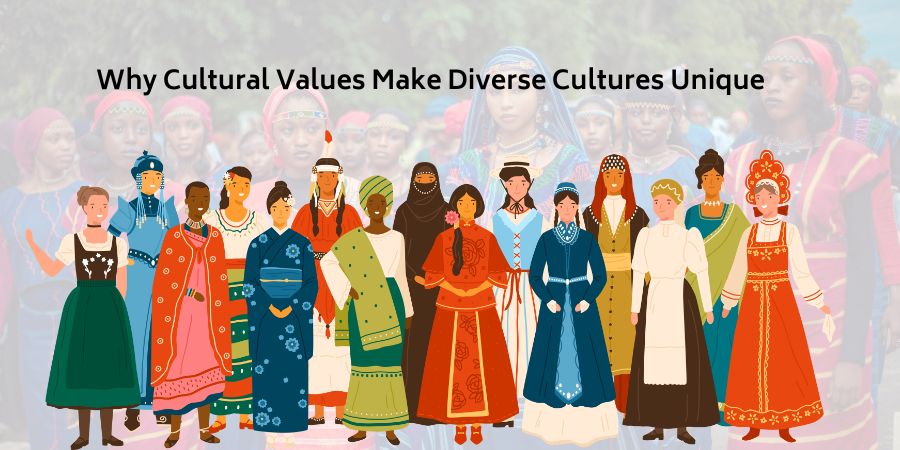
Culture is often introduced through what we can see: food, clothing, music, festivals, architecture and language. But these are only the visible expressions of something deeper. Cultural values influence how communities understand family, responsibility, hospitality, work, nature, celebration and belonging, and those values are what give cultural practices their meaning.
That is why two societies can share a similar tradition yet practise it in remarkably different ways. The uniqueness of a culture does not come simply from having a custom that another community does not have. It comes from the history, values and collective meaning attached to that custom.
UNESCO defines culture broadly, including the distinctive intellectual, spiritual, material and emotional features of societies, along with lifestyles, ways of living together, value systems, traditions and beliefs.
What Makes a Culture Unique?
A culture develops through the interaction of history, geography, language, belief systems, social structures, migration and everyday experience. Over time, these influences shape what a community considers important and how those priorities are expressed.
Consider hospitality.
Welcoming a guest is common across many societies, but hospitality does not look the same everywhere. In one community, offering food may be a central expression of respect. In another, sharing tea or coffee may carry particular social meaning. Elsewhere, hospitality may be expressed through extended family gatherings or formal rituals of welcome.
The underlying value, welcoming another person, can be shared. The cultural expression gives that value its local character.
This is one reason it is misleading to describe cultures only through lists of customs. A custom becomes culturally meaningful because people attach values and memories to it.
Why Are Cultural Values Important?
Cultural values provide communities with informal frameworks for understanding behaviour and relationships.
They can influence how people think about:
- family responsibilities
- respect for older generations
- community participation
- hospitality
- education
- work and cooperation
- relationships with nature
- celebrations and rituals
- mourning and remembrance
- individual and collective responsibility
Rarely are these values taught in a single lesson; rather, they are learned by imitation and participation: a child observes how relatives welcoming guests, how food is distributed, how festivals are celebrated or how elders are treated.
Over generations, repeated behaviour can become tradition.
UNESCO’s definition of intangible cultural heritage captures this process particularly well. It includes oral traditions, performing arts, social practices, rituals, festive events, knowledge concerning nature and traditional craftsmanship. Crucially, UNESCO describes this heritage as living because communities continue to adapt and recreate it.
How Does Culture Determine Identity?
Culture can give people a sense of continuity between the past and the present.
Language is one of the clearest examples. A language conveys expressions, stories, memories and knowledge that may not translate perfectly into another language. UNESCO describes multilingualism as important to inclusion, cultural heritage and the empowerment of Indigenous and marginalised communities.
The same principle applies to traditional knowledge.
For example, Indigenous communities may maintain detailed knowledge of local plants, weather patterns, landscapes or natural resources through practices transmitted between generations. UNESCO notes that Indigenous living heritage can contain locally rooted knowledge connected to environmental resilience, education and biodiversity.
In this sense, culture is not simply a record of the past. It can function as a knowledge system.
What are Real Examples of Cultural Diversity?
The strongest examples show how values become visible through everyday practices.
- Arabic coffee and hospitality: UNESCO’s Intangible Cultural Heritage list includes Arabic coffee, a symbol of generosity, shared across the United Arab Emirates, Oman, Qatar, Saudi Arabia and Jordan. The example demonstrates how a beverage can represent something much larger than consumption: hospitality, social interaction and cultural identity.
- Kumbh Mela in India: India’s Kumbh Mela is also included on UNESCO’s Representative List of the Intangible Cultural Heritage of Humanity. It demonstrates how religious belief, pilgrimage, collective participation and ritual can combine to create a cultural practice experienced by communities at a massive scale.
- Traditional weaving: Traditional crafts provide another example. UNESCO’s list includes Al Sadu, traditional weaving skills in the United Arab Emirates. Such practices preserve technical knowledge while also carrying cultural memory and community identity.
- Food as cultural heritage: Food traditions can carry similar meaning. UNESCO’s list includes practices ranging from Al-Man’ouché, a culinary tradition in Lebanon, to the breakfast culture of Malaysia, recognised in the context of its multi-ethnic society. These examples show why food cannot always be treated simply as cuisine; it can also express social relationships, history and belonging.
Why is Cultural Diversity Important?
Cultural diversity expands the range of ways in which human communities understand and respond to life.
UNESCO describes cultural diversity as a source of exchange, innovation and creativity. Its Universal Declaration on Cultural Diversity also connects cultural pluralism with cultural exchange and the flourishing of creative capacities.
There is a practical dimension to this.
A classroom containing students from different cultural backgrounds can expose learners to different family traditions and perspectives. A workplace with people from different backgrounds may bring different approaches to communication and collaboration. A city shaped by migration can develop new combinations of food, music, language and creative expression.
None of these outcomes is automatic. Diversity becomes valuable when people have opportunities to interact, participate and understand one another.
UNESCO’s work on intercultural dialogue similarly focuses on the ability of societies to engage constructively across differences rather than treating diversity as something that should simply exist side by side.
Does Cultural Diversity Mean Cultures Never Change?
No. This is one of the most important points often missing from discussions about cultural identity.
Cultures change constantly.
Migration introduces practices into new communities. Technology changes how traditions are transmitted. Younger generations reinterpret customs. Cities bring different groups into regular contact. Languages borrow words from one another, and food traditions adapt to ingredients available in new places.
UNESCO explicitly describes intangible cultural heritage as traditional, contemporary and living. It can evolve as communities respond to their environments and circumstances.
That means preserving culture does not necessarily mean preserving every practice exactly as it existed centuries ago.
It can mean ensuring that communities retain the ability to transmit, reinterpret and continue practices that they themselves recognise as meaningful.
Why Should Cultural Heritage Be Preserved?
When a language disappears or a traditional skill is no longer transmitted, a community can lose more than a form of expression.
It may also lose stories, specialised knowledge, techniques and ways of understanding the surrounding world.
UNESCO therefore emphasises that the importance of intangible heritage lies not only in the cultural expression itself but also in the knowledge and skills transmitted through it.
Preservation can take many forms: teaching languages to younger generations, supporting traditional craftspeople, recording oral histories, maintaining community celebrations and creating opportunities for people to practise their heritage.
But preservation should also involve the communities themselves. UNESCO states that intangible heritage is community-based and that the communities, groups or individuals who create and transmit a practice are central to recognising it as their heritage.
Can Different Cultures Share Values?
Yes, and this is where cultural diversity becomes more interesting than a simple catalogue of differences.
Different societies may value family, generosity, respect, courage, community or care for nature while expressing those values through very different traditions.
A shared value does not produce identical cultures.
Instead, history and circumstance shape how that value is lived.
Two families may both consider hospitality important, yet one may express it through elaborate meals while another may express it through daily acts of community support. The value is familiar; the cultural language around it is different.
This is why cultural diversity is not simply about how different people are from one another. It is also about how human beings have developed different answers to many of the same fundamental questions.
What Can Cultural Diversity Teach Us?
The most useful way to understand another culture is to look beyond the practice itself and ask what it means to the people who maintain it.
A festival may reveal ideas about community. A meal may reveal ideas about hospitality. A language may preserve history. A craft may contain generations of technical knowledge. A ceremony may connect present generations with ancestors.
Seen this way, cultural values make diverse cultures unique because they turn ordinary activities into expressions of identity and collective memory.
Culture is therefore neither a museum piece nor a fixed formula. It is something communities inherit, practise, reinterpret and pass forward.
That continuing process is what makes cultural diversity living, and why protecting it matters.
Author’s Note
In my view, the real beauty of cultural diversity lies in what we cannot immediately see. We notice a different language, a festival, a traditional dish or a particular style of clothing, but behind each of these are generations of values, memories and choices that have shaped how a community understands life.
What makes one culture different from another is therefore not simply the custom itself. It is the meaning people give to that custom. A meal can represent hospitality, a language can carry family history, and a festival can connect generations that might otherwise have little opportunity to share the same memories.
I also believe cultural preservation should not mean keeping traditions frozen in time. Cultures have always changed through migration, interaction and changing generations. UNESCO similarly describes cultural heritage as living and evolving, with communities continuing to transmit and adapt their practices.
For me, respecting cultural diversity begins with curiosity rather than comparison. We do not have to understand every tradition in order to respect the people for whom it carries meaning. Sometimes, understanding why a practice matters tells us far more about a culture than simply knowing what the practice is.




