
Artificial Intelligence has moved far beyond experimentation. Across boardrooms globally, the conversation is no longer centred on whether organisations should adopt AI, but how they can scale it responsibly, securely, and strategically. From multinational corporations to government departments, AI is now influencing decision-making, customer engagement, operational efficiency, workforce productivity, and long-term transformation strategies. Generative AI, predictive analytics, intelligent automation, and Agentic AI are rapidly reshaping how organisations operate and compete.
Yet, despite significant investment in AI technologies, many organisations are discovering the same reality: technology itself is rarely the greatest challenge.
The real challenge is governance.
Across years of advising organisations on AI and digital transformation initiatives, one pattern consistently emerges. Organisations with the strongest AI ambitions do not necessarily struggle with access to tools, platforms, or talent. More often, success is determined by how effectively leadership governs AI across the organisation.
This is where AI governance becomes critically important. AI governance is increasingly becoming the foundation that allows organisations to scale innovation with confidence while maintaining accountability, transparency, and trust. It is what ensures AI initiatives are aligned to business priorities rather than becoming isolated experiments that fail to deliver meaningful value.
Many organisations initially approached AI through pilots and innovation labs. Teams explored use cases enthusiastically, departments launched proof-of-concepts, and executives encouraged experimentation. While this phase created valuable momentum, organisations are now entering a far more mature stage of AI adoption, one focused on operationalisation, scalability, and enterprise-wide integration.
This shift changes the role of leadership significantly. Boards and executive teams are now being asked more strategic questions around AI accountability, data governance, ethics, risk management, compliance, investment priorities, and long-term organisational impact. Increasingly, AI is no longer viewed as simply a technology initiative managed within IT or innovation departments. It is becoming a core business capability that influences the entire organisation.
As AI systems become more embedded into customer journeys, financial operations, strategic planning, and service delivery, leadership oversight becomes essential.
The organisations making the greatest progress are typically those that establish clarity early. They define who owns AI accountability. They create governance structures that connect technology decisions to strategic outcomes. They implement policies that guide responsible usage while still allowing innovation to move quickly.
Importantly, the most effective organisations do not treat governance as a constraint.
There remains a common misconception that governance slows down innovation. In practice, the opposite is often true. Organisations with clear governance frameworks are frequently able to scale AI faster because teams understand the boundaries within which they can innovate confidently. Clear standards around data usage, model validation, security, ethical considerations, and decision-making create stability. They reduce uncertainty and accelerate adoption.
Strong governance also creates consistency across the organisation. Without it, AI initiatives often become fragmented between departments, resulting in duplicated efforts, unclear accountability, inconsistent data practices, and growing operational risk. This becomes even more important as organisations increasingly adopt Generative AI and Agentic AI systems capable of autonomous reasoning, workflow orchestration, and dynamic decision-making. These technologies offer enormous potential, but they also introduce new governance challenges around explainability, monitoring, security, human oversight, and accountability.
Another important lesson emerging across AI transformation programmes is that governance is not purely structural. It is deeply cultural.
The organisations progressing most successfully with AI are those where leadership actively engages with the technology, not necessarily as technical experts, but as responsible stewards of organisational transformation. These organisations invest in AI literacy, encourage responsible experimentation, and foster cross-functional collaboration between business, technology, operations, legal, and governance teams.
Culture ultimately determines whether AI remains confined to isolated innovation initiatives or evolves into a sustainable enterprise capability.
For boards, this means the role is evolving rapidly. Directors and executive leadership teams are increasingly expected to understand not only the opportunities AI creates, but also the operational, ethical, reputational, and governance implications that accompany large-scale adoption. This does not require deep technical expertise. However, it does require leadership maturity around accountability, oversight, strategic alignment, and risk governance.
As global regulatory expectations around AI continue evolving, organisations that establish strong governance foundations early are likely to gain significant advantages. They will be better positioned to scale AI responsibly, build stakeholder trust, improve operational resilience, and generate measurable long-term value from their investments.
Ultimately, AI governance is not about limiting innovation. It is about creating the conditions for innovation to scale responsibly and sustainably. When organisations approach governance effectively, AI evolves from a collection of promising experiments into a trusted enterprise capability, one capable of delivering meaningful transformation across customers, employees, operations, and society at large.
About the Author
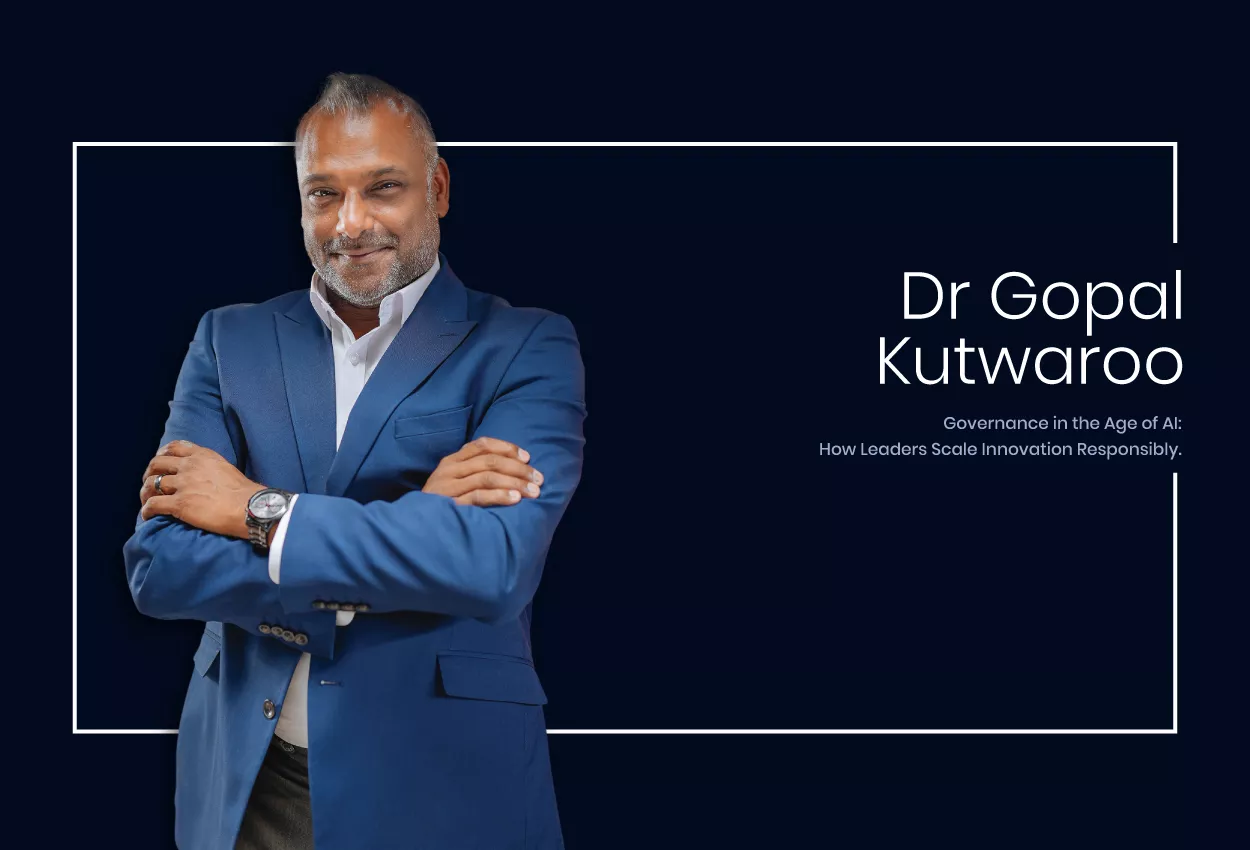
Dr Gopal Kutwaroo is a globally recognised AI strategist, digital transformation advisor, executive educator, and founder of thevaluespace. With leadership experience spanning multinational corporations, governments, and enterprise transformation programmes, he specialises in AI strategy, AI governance, digital transformation, growth strategy, and helping organisations bridge the gap between strategic ambition and operational execution.
www.thevalue.space




